
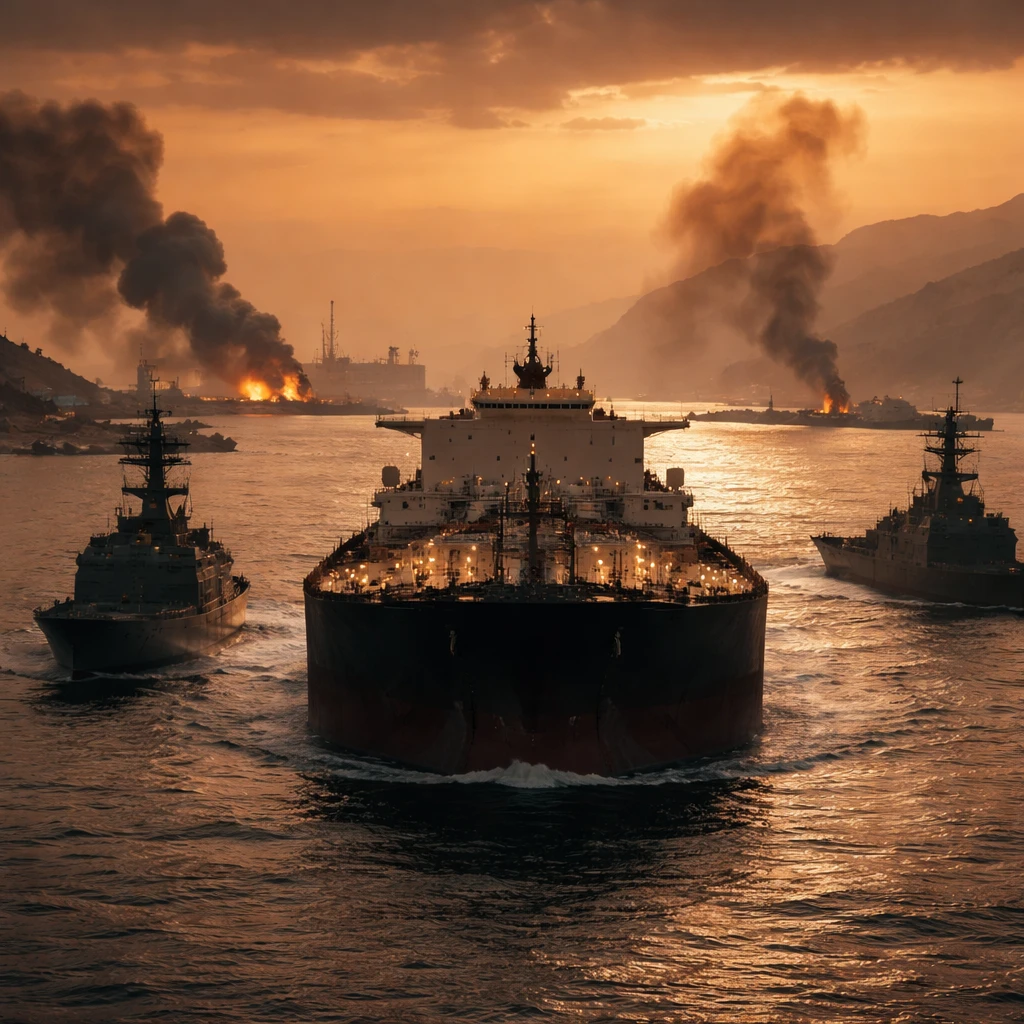
President Donald Trump has publicly requested that several countries join Washington in efforts to reopen the Strait of Hormuz, the narrow but globally critical waterway south of Iran that carries roughly one-fifth of the world's oil supply. Speaking to reporters aboard Air Force One, the president said multiple nations should help restore shipping through the passage, but he did not indicate whether any had agreed to his appeal.
In separate remarks to the Financial Times, Mr. Trump urged members of the North Atlantic Treaty Organization to assist in reopening the strait, warning that a failure to respond or to support the effort "will be a very bad for the future of NATO." The president also highlighted China by suggesting that he could cancel a planned summit with Chinese leader Xi Jinping in April if Beijing does not use its leverage to help unblock the waterway.
Reporting cited by U.S. and international outlets indicates mixed movement through the passage. The New York Times reported that some tankers bound for China have been permitted to transit the strait, while other vessels have been struck by projectiles. Meanwhile, the Wall Street Journal, citing the European Union's top diplomat, said the EU is exploring options to restart shipping through the Hormuz corridor.
The disruption of tanker traffic through the Strait of Hormuz has had immediate economic consequences. By impeding most tanker transits, Tehran has limited access to key energy supplies for major economies, particularly in Europe and Asia. That constriction has driven oil and gas prices higher, a development that market commentators warn could reintroduce inflationary pressures into the global economy and weigh on overall economic activity.
Market analysts at Vital Knowledge summed up the situation by noting that, from a market perspective, the fundamental dynamic remains unchanged: the United States and Israel are prevailing in conventional military terms, while the Iranian regime remains in power and is using control over the Hormuz passage to exert outsized influence over the global economy.
The recent spike in oil prices presents a political and economic dilemma for the administration. U.S. strikes on Iran have so far shown limited signs of abating, and questions are circulating in policy and market circles about Washington's objectives and how — and when — it might withdraw from a campaign that has already affected much of the Middle East, including several large oil-producing states across the Persian Gulf.
On the ground and at sea, hostilities and security incidents continue to unfold. Officials in the United Arab Emirates reported that the oil-industry zone at Fujairah was struck by a second drone attack in as many days; authorities, as reported by the Wall Street Journal, said there were no injuries. Separately, Israeli officials conveyed that they are conducting "limited and targeted ground operations" in southern Lebanon, according to the Journal.
Domestically, the economic effects are visible at the pump. Gasoline prices at U.S. stations have risen in response to higher crude prices, a trend analysts have warned could create political headwinds for President Trump and his Republican Party ahead of the midterm elections in November.
In trading, oil futures have shown volatility. Prices eased from earlier intraday gains in early-afternoon European dealings, yet Brent crude, the global benchmark, remained north of the psychologically significant $100-per-barrel threshold.
The situation remains fluid and closely watched by investors, energy consumers and governments. The president's appeal to NATO members and to China, combined with reported regional strikes and disrupted tanker movements, underscores the interconnected risks to energy supply, inflation and geopolitical stability.
This is a developing story and further updates are expected as government responses, market reactions and on-the-ground events evolve.