
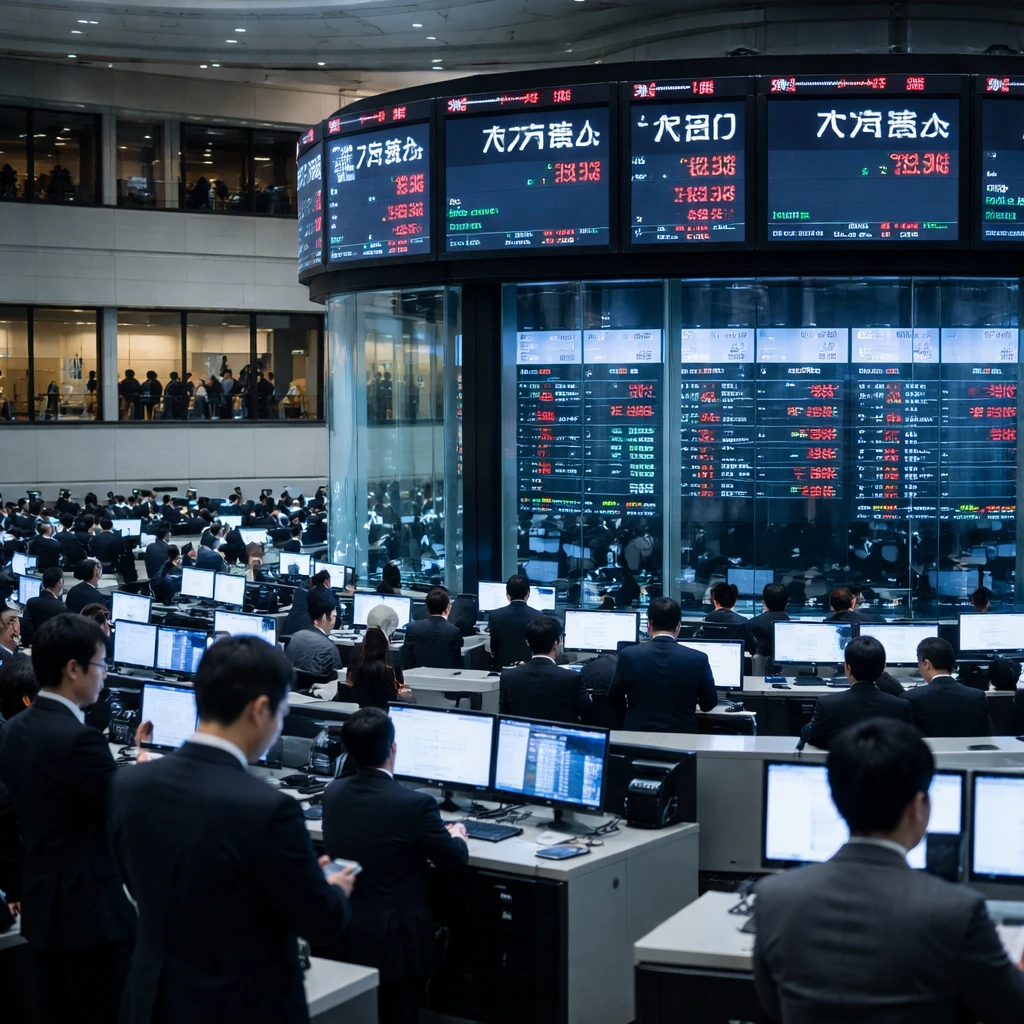
Tokyo's stock market closed lower on Tuesday as the Nikkei 225 eased 0.22% at the end of trade. Losses were driven by sectors including Paper & Pulp, Transport and Communication, which collectively pressured the index.
The session's strongest performers on the Nikkei 225 included Kawasaki Kisen Kaisha, Ltd. (TYO:9107), which advanced 6.33% - rising 167.50 points to close at 2,813.00. Daiichi Sankyo Co., Ltd. (TYO:4568) climbed 5.93%, up 164.50 points to finish at 2,938.00, and Nippon Yusen K.K (TYO:9101) gained 5.67%, or 319.00 points, to end the day at 5,943.00.
On the downside, Furukawa Electric Co., Ltd. (TYO:5801) recorded the largest decline among the Nikkei components listed, falling 6.68% - a drop of 1,965.00 points to 27,440.00 at the close. Sumitomo Electric Industries Ltd. (TYO:5802) decreased 6.16%, losing 625.00 points to close at 9,525.00, while Lasertec Corp (TYO:6920) was down 5.16%, or 1,950.00 points, to 35,850.00.
Market breadth on the Tokyo Stock Exchange showed more advancing issues than decliners, with 1,974 stocks higher compared with 1,554 that fell. A further 271 stocks finished unchanged.
Notable price milestones were recorded during the session. Shares of Kawasaki Kisen Kaisha, Ltd. rose to three-year highs, while Nippon Yusen K.K reached an all-time high in late trade.
Volatility in Nikkei options eased, with the Nikkei Volatility index falling 7.21% to 42.50 by the close.
Commodities moved higher in parallel trading. Crude oil for May delivery rose 4.55%, gaining $4.21 to $96.67 a barrel. Brent crude for May delivery climbed 3.52% or $3.53 to $103.74 a barrel. April Gold Futures increased 0.29%, up $14.75 to trade at $5,016.95 a troy ounce.
In foreign exchange markets, the yen weakened against the US dollar, with USD/JPY rising 0.18% to 159.36. EUR/JPY fell slightly, down 0.03% to 183.00. The US Dollar Index Futures moved up 0.29% to 99.75.
Despite the index decline, the session exhibited pockets of strength among shipping and pharmaceutical names that outpaced heavier losses elsewhere, while materials- and technology-linked stocks contributed materially to the downside. Volatility readings and commodity moves reflected an active cross-market environment into the close.