
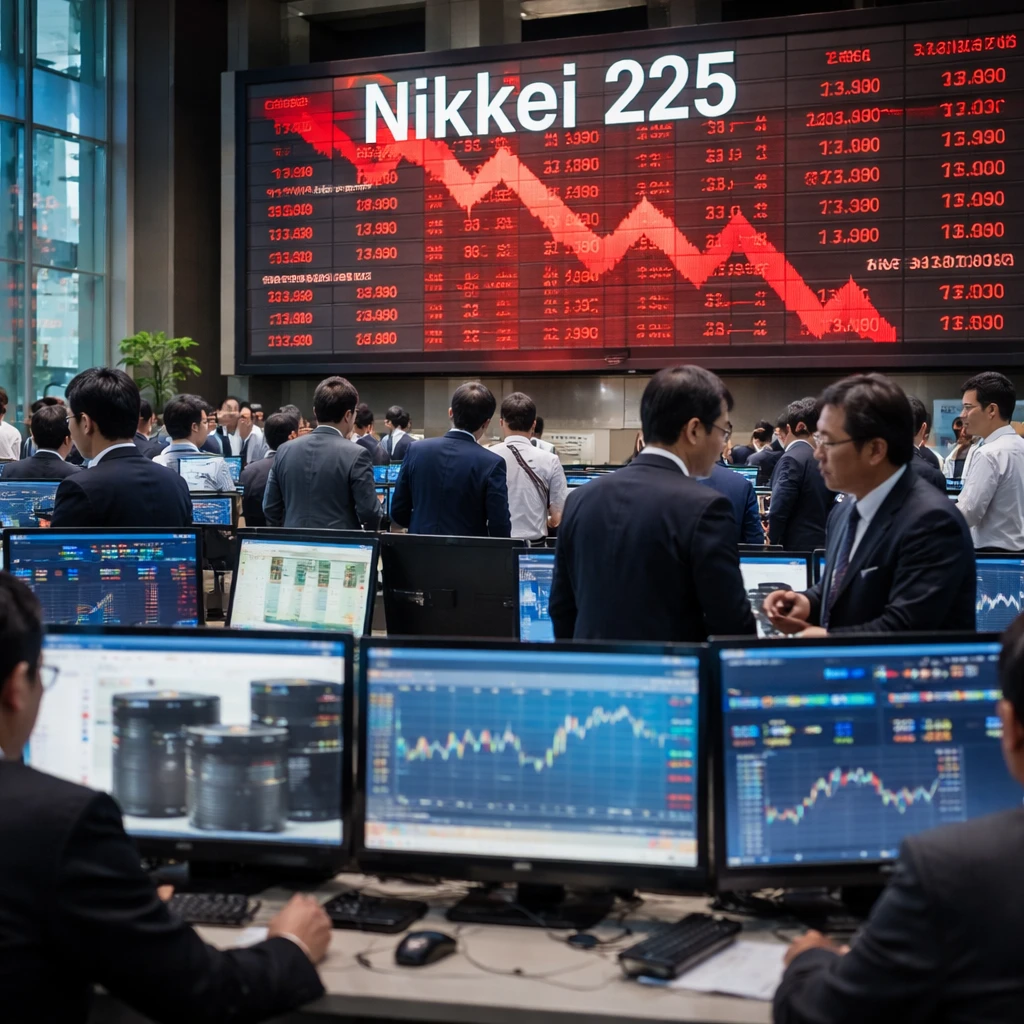
Japan's equity benchmark finished the trading day in negative territory on Friday as sector-specific weakness pressured the market. The Nikkei 225 ended the session down 1.40% following declines led by the Paper & Pulp, Transport and Communication sectors.
Market breadth on the Tokyo Stock Exchange favored sellers, with 2,427 stocks retreating versus 1,147 that rose. A further 221 issues finished unchanged.
Among the Nikkei 225 constituents, Furukawa Electric Co., Ltd. (TYO:5801) recorded the largest advance, jumping 6.08% or 1,760.00 points to finish at 30,690.00. That move took the stock to a five-year high at the close. Marubeni Corp. (TYO:8002) climbed 4.02% or 216.00 points to end at 5,591.00, while GS Yuasa Corp. (TYO:6674) added 3.92% or 196.00 points to settle at 5,193.00.
On the downside, BayCurrent Consulting Inc (TYO:6532) registered the steepest loss among Nikkei names, falling 6.67% or 308.00 points to close at 4,307.00. Honda Motor Co Ltd (TYO:7267) declined 5.56% or 80.50 points to finish at 1,368.00, and Renesas Electronics Corp (TYO:6723) was down 5.24% or 136.00 points to 2,461.50.
The Nikkei Volatility index, which tracks implied volatility in Nikkei 225 options, rose 3.33% to 44.37, indicating a pickup in option-implied market uncertainty compared with the prior session.
Commodity markets showed modest directional movement during the same session. Crude oil for April delivery gained 0.50% or 0.48 to trade at $96.21 a barrel. Brent oil for May delivery rose 0.79% or 0.79, closing at $101.25 a barrel. By contrast, April Gold Futures fell 0.62% or 31.86 to trade at $5,093.94 a troy ounce.
In foreign exchange markets, the USD/JPY pair inched higher by 0.03% to 159.39, while EUR/JPY moved lower by 0.26% to 182.97. The US Dollar Index Futures was up 0.23% at 99.99.
Market context note - The session featured a broad selloff across a range of sectors, with Paper & Pulp, Transport and Communication leading declines, while a subset of industrial and trading names outperformed. Volatility increased modestly as measured by the Nikkei Volatility index.