
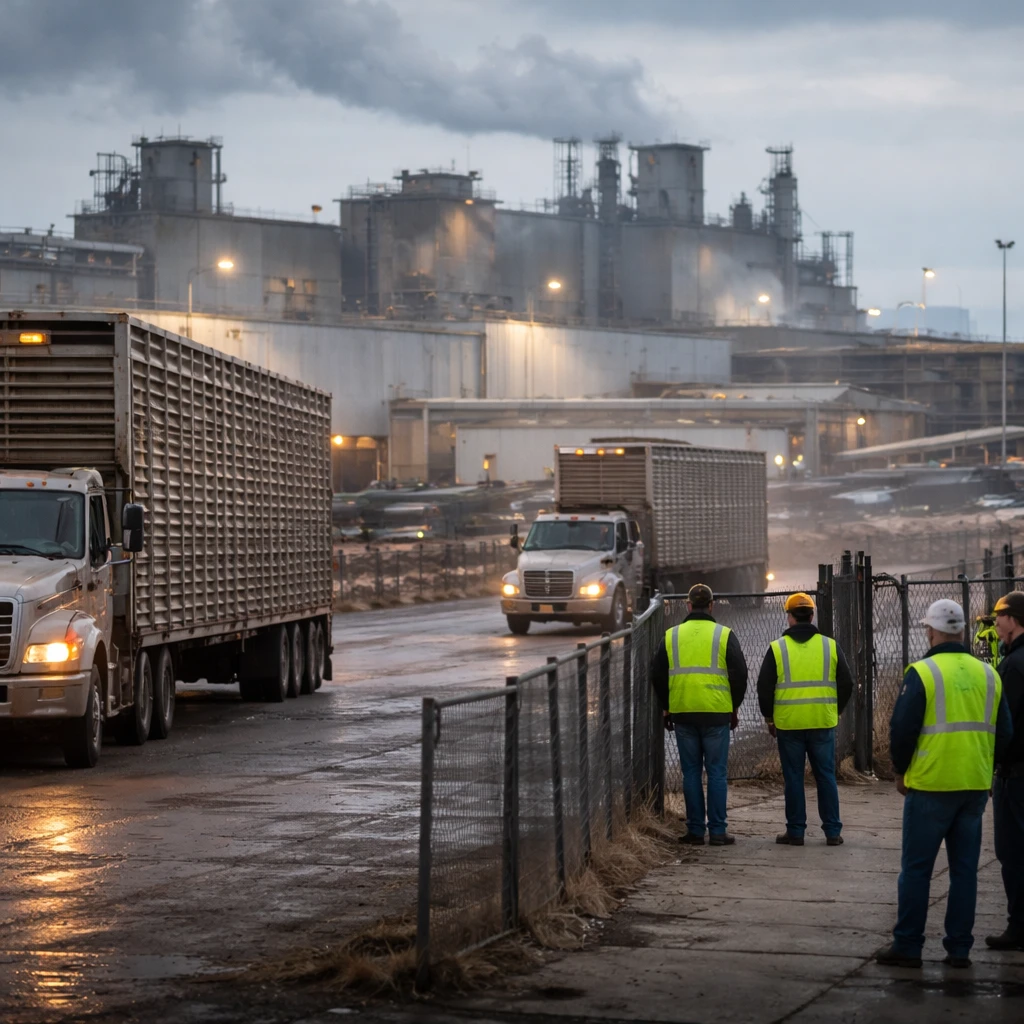
About 3,800 meatpacking employees at JBS' Greeley, Colorado plant intend to begin a strike on March 16, the United Food and Commercial Workers Local 7 said on Monday. The union said the work stoppage would deeply impair output at one of the largest beef plants in the United States at a time when consumers are already contending with record-high beef prices.
The workforce at the plant is composed largely of immigrant employees, and the announced labor disruption has already prompted some cattle producers to divert deliveries to other processing sites. Beef prices have reached record levels this year after the nation's cattle herd declined to its smallest size in 75 years; meatpackers such as JBS have benefited from rising retail prices even as they face record-high costs to purchase cattle for slaughter.
JBS disclosed in November that its third-quarter profit was $581 million, down from $693 million a year earlier. The company said it is adjusting cattle deliveries and processing schedules at Greeley and moving production to other facilities to meet customer needs. JBS did not slaughter cattle at the Greeley plant on Monday, and cattle feeders reported that JBS had canceled slaughtering in Greeley for the entire week.
"While customers are paying more than they ever have, none of that is trickling down to the frontline worker that's actually doing all the heavy work," said Kim Cordova, president of UFCW Local 7, which represents the Greeley workers. Cordova said the union had been negotiating with JBS for eight months and accused the company of engaging in unfair labor practices and failing to bargain fairly on a new contract.
Workers, according to the union, have sought wage increases that would keep pace with inflation and demanded that the company stop charging employees for replacing protective equipment that they use to perform their jobs safely.
JBS said it complies with labor laws and has sought to reach a fair agreement. The company stated that it charges employees for protective equipment when it is lost or maliciously damaged. "We stand by the offer we presented," JBS said, adding that the proposal is "strong, fair, and consistent with the historic national contract reached in 2025."
Last year, unionized meatpacking workers at multiple plants ratified the first-ever national contract with JBS. Cordova noted that workers in Greeley already received some of the benefits contained in that national agreement, including sick leave.
Cattle feeders told reporters that some ranchers have redirected livestock to other company facilities; one feeder said he was taking cattle to a JBS facility in Cactus, Texas. Corbitt Wall, a livestock market analyst at DVAuction, said there is more slaughter capacity than finished cattle ready to be processed and that ranchers will move animals to alternative locations.
Rival meatpacker Tyson Foods closed a very large beef plant in Nebraska earlier this year.
Is JBSS32 a bargain right now? The fastest way to find out is with a Fair Value calculator. It uses a mix of 17 proven industry valuation models to assess value. The tool offers a bottom line for JBSS32 along with thousands of other stocks to help investors evaluate potential opportunities.