
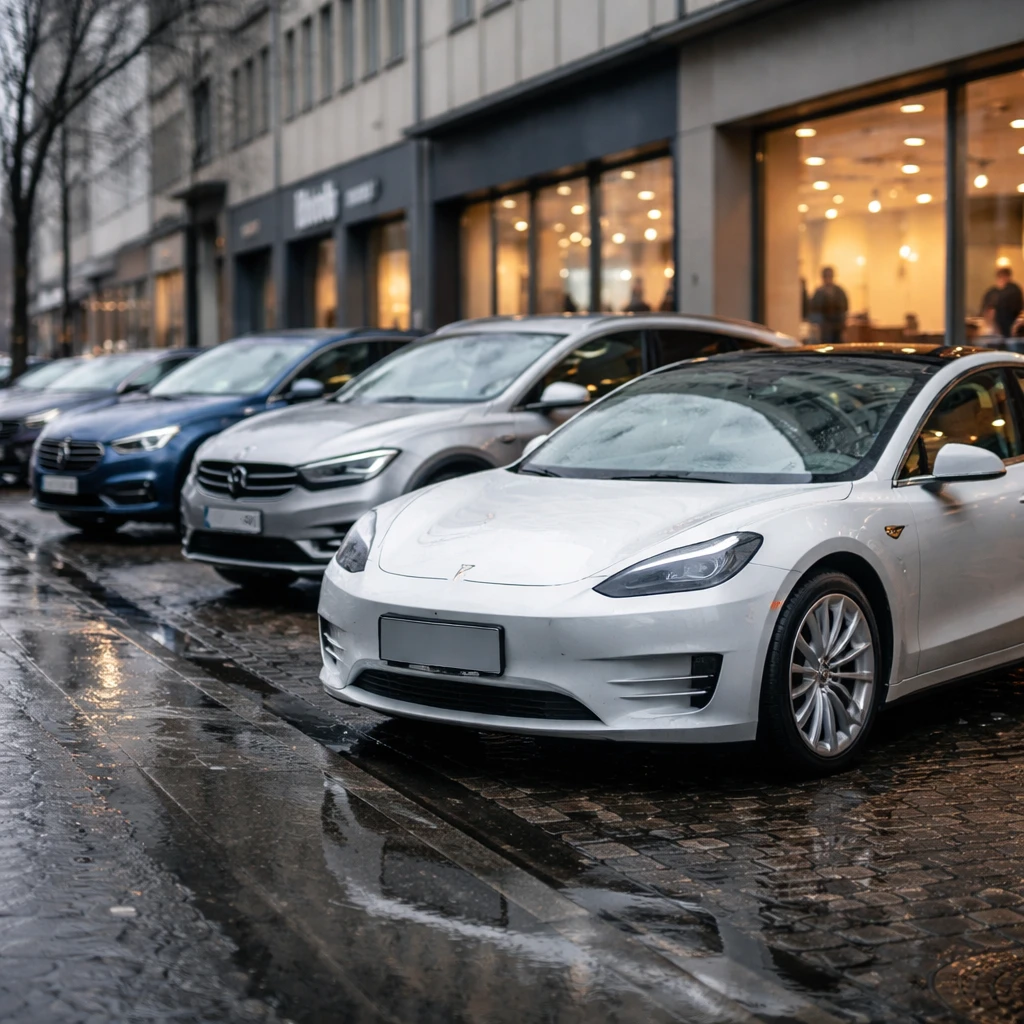
Summary: Industry figures show Tesla's new-car registrations in the European Union fell sharply in January, while the broader EV segment expanded its presence across the bloc. The U.S. electric-vehicle maker registered 8,075 cars in the month, down from 9,733 a year earlier, and now holds 0.8% of the EU market, according to the European Automobile Manufacturers' Association.
Tesla's January performance represents a 17% year-on-year decline in new-car registrations in the European Union. The company recorded 8,075 new vehicles registered in the bloc during the month, compared with 9,733 in the same month a year earlier. That change reduced Tesla's share of the EU new-car market to 0.8% from 1.0% the prior year, per the European Automobile Manufacturers' Association.
At the same time, total new-car registrations across the European Union fell by 3.9% in January. Despite the overall drop in demand, battery-electric vehicles (BEVs) increased their penetration of the market, lifting their share to 19.3% from 14.9% a year earlier. Hybrid-electric vehicles remained the most widely registered powertrain in January, accounting for 38.6% of registrations. Conventional petrol and diesel models continued to lose market share.
The divergence between Tesla's weaker registrations and the faster growth of BEVs in several key markets - notably France and Germany - points to intensifying competition from established European automakers. The data highlight that while the BEV segment is growing within the EU, that expansion is not translating into higher registration volumes for Tesla in the opening month of the year.
These figures underline a shifting dynamic in the European car market in January: an overall modest decline in new-car registrations paired with a meaningful move toward electrified powertrains. For Tesla, the combination of a lower absolute number of registrations and a falling market share in the EU suggests the company faces mounting pressure from rivals that are expanding their BEV offerings in major European markets.
Market context:
- Tesla recorded 8,075 new-car registrations in the EU in January, down from 9,733 a year earlier.
- Tesla's EU market share slipped to 0.8% from 1.0% year-on-year.
- Total EU new-car registrations fell 3.9% in January while BEV share rose to 19.3% from 14.9%.
- Hybrid-electric vehicles held 38.6% of registrations; petrol and diesel continued to lose ground.
Implications: The data indicate that even as electrified vehicles gain a larger share of the EU market, that growth is increasingly captured by a broader set of manufacturers rather than being concentrated with a single producer. Strong BEV uptake in France and Germany, in particular, appears to be intensifying competitive pressures on Tesla in Europe.