
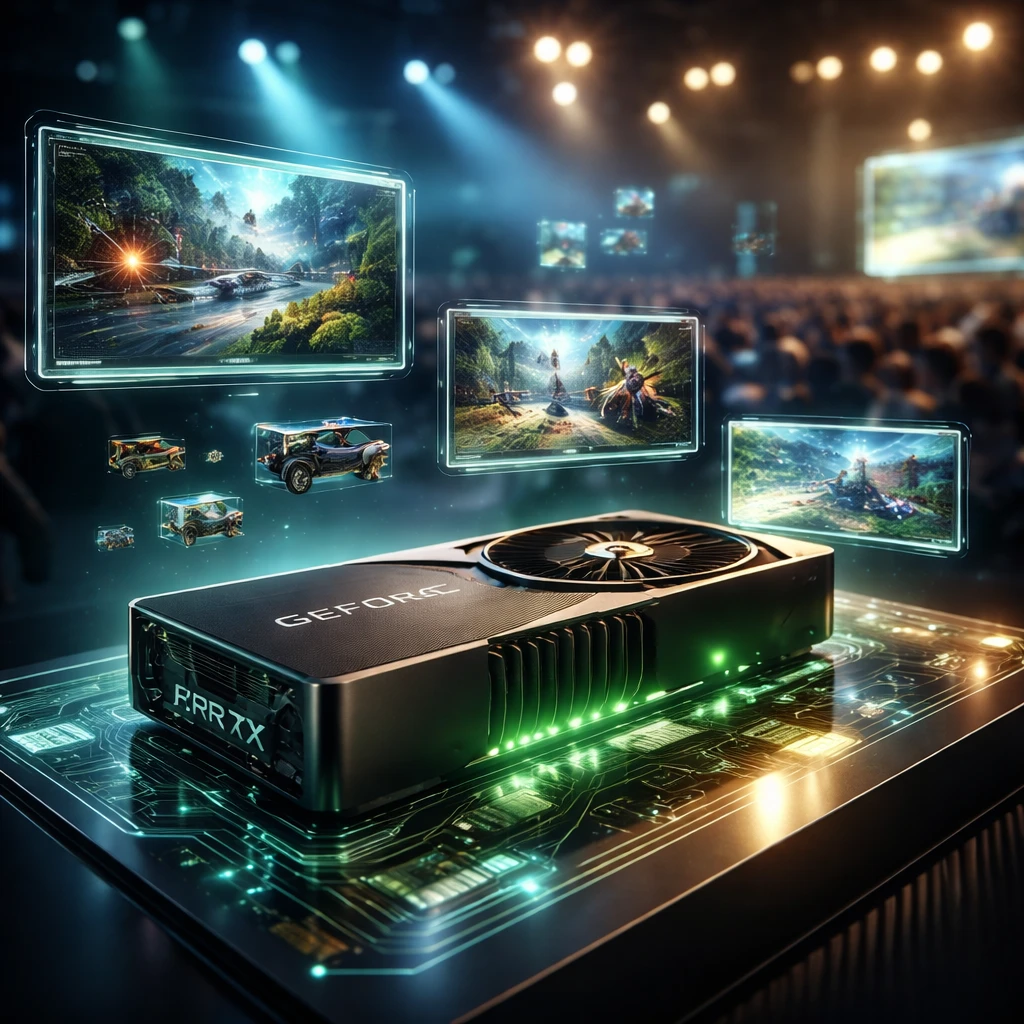
Shares of Take-Two Interactive (NASDAQ:TTWO) declined 2.4% on Tuesday, a move that coincided with NVIDIA’s presentation of new artificial intelligence video-generation and game-development tools at the Game Developers Conference in San Francisco.
At the event, NVIDIA (NASDAQ:NVDA) unveiled an assortment of updates to its developer-facing toolset. Among the changes, the company introduced ComfyUI’s App View - a simplified interface intended to make generative AI workflows more accessible by allowing users to input prompts and tune parameters without working through complex node graphs.
NVIDIA also announced RTX Video Super Resolution for ComfyUI, a capability it says enables real-time upscaling to 4K. According to NVIDIA, this upscaling runs roughly 30 times faster than alternative local upscalers while using less video memory.
The chipmaker presented new NVFP4 and FP8 model variants for FLUX.2 Klein. NVIDIA stated that these variants produce up to 2.5x performance gains and 60% lower memory usage on GeForce RTX 50 Series GPUs when using NVFP4, and that FP8 offers 1.7x faster performance with 40% reduced memory usage. NVIDIA further noted that overall RTX GPU performance in ComfyUI has improved by about 40% since September.
Those new models are available through Hugging Face, and NVIDIA highlighted that default workflows can be accessed via ComfyUI’s Template Browser. Additional announcements at the conference included updates to RTX Remix, the LTX Desktop video editor, and collaborations with Topaz Labs and Microsoft focused on GPU-optimized applications.
NVIDIA described RTX Video Super Resolution as powered by the NVIDIA Video Effects software development kit and running on RTX GPU Tensor Cores.
Market reaction to the announcements included the slide in Take-Two’s stock, though the precise cause of the decline was not definitively established. The timing of the share drop aligned with NVIDIA’s GDC disclosures about AI-enabled tools for game development, but no direct linkage was confirmed.
Context and implications
The announcements emphasize NVIDIA’s push to integrate AI-driven video processing and developer tooling into workflows for real-time upscaling and content creation. The company’s performance and memory-reduction claims for new model variants and the ComfyUI improvements are presented as manufacturer-supplied metrics. How those capabilities influence game development pipelines, software tools adoption, and the competitive landscape in gaming and graphics will depend on developer uptake and real-world performance.