
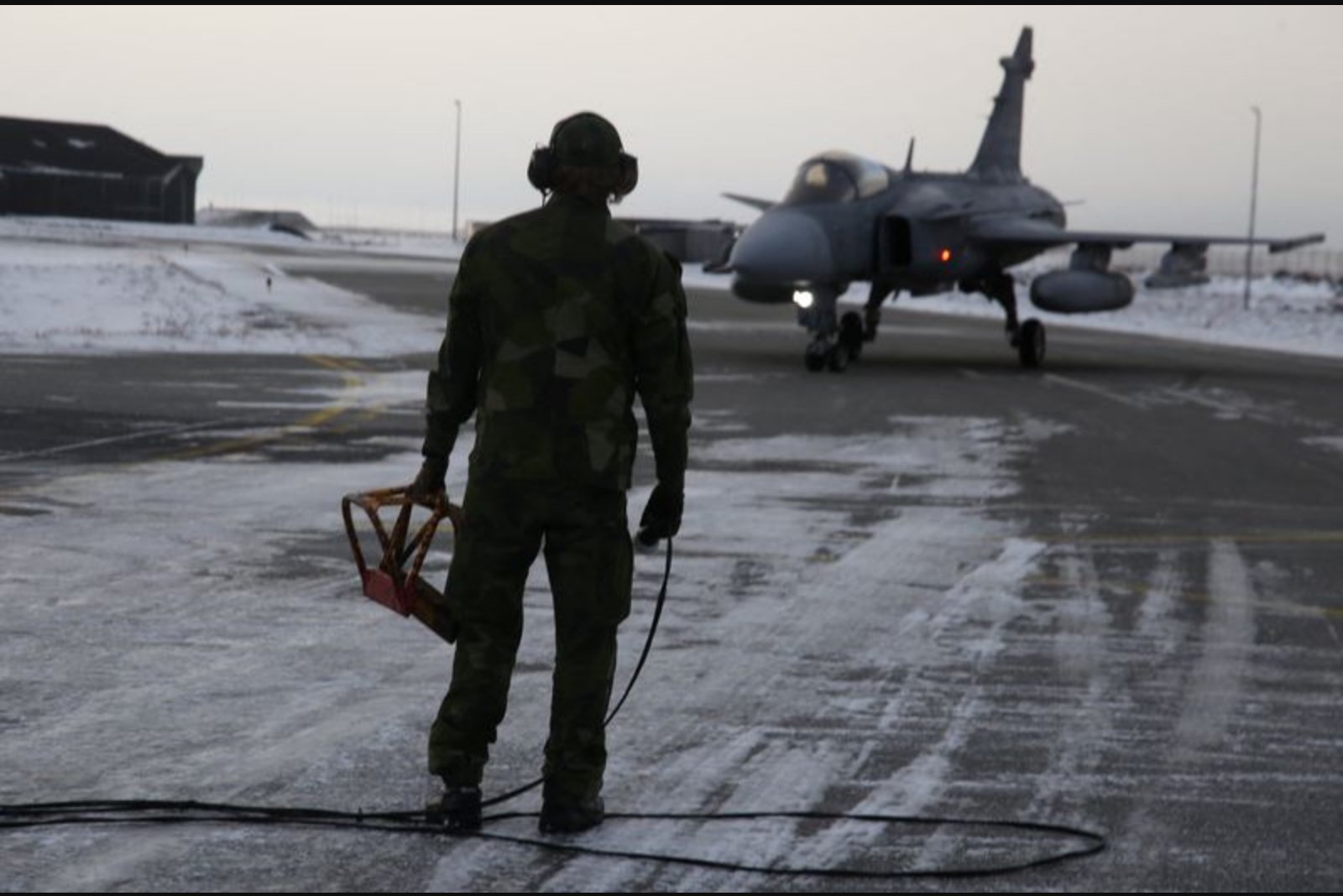
Sweden has deployed six of its JAS 39 Gripen fighter jets to Iceland, marking the first time Swedish fighters have patrolled the skies around the island nation as part of NATO’s Arctic Sentry mission. The deployment is intended to bolster NATO presence in the strategically sensitive Arctic region and to monitor potential long-range threats.
The aircraft were sent to Keflavik Air Base, a facility established during World War Two and used by the United States until 2006, which now hosts periodic NATO air policing missions that have been conducted since 2008. The Swedish jets are tasked primarily with watching for long-range Russian bombers that can operate from airfields on the Kola Peninsula, a region that houses Russia’s Northern Fleet and nuclear missile silos.
Major General Frode Arnfinn Kristoffersen, deputy chief of staff, operations, at NATO Joint Force Command Norfolk, described Iceland and the wider Arctic as strategically crucial in the event of a conflict. "Iceland as well as all of the Arctic would be important (in case of a conflict) because that’s the warning chain for attacks against the U.S. or Canada across the Arctic," he said.
The Arctic Sentry mission forms part of NATO efforts to strengthen its posture in the north after tensions within the alliance escalated following U.S. President Donald Trump’s public interest in acquiring Greenland. That episode contributed to pressure within the alliance for higher defence spending, including in the Arctic. Trump has criticized Denmark’s defence presence on Greenland, deriding it as "two dog sleds."
Russian officials have repeatedly rejected assertions that Moscow seeks control of Greenland or poses an expanding Arctic threat, dismissing such suggestions as false "horror stories" propagated by Western leaders, according to statements reported alongside the deployment.
Swedish Air Force leadership highlighted the Gripen’s suitability for operations in Iceland’s climate. Major General Jonas Wikman, Sweden’s Air Force chief, noted the service’s experience operating in harsh conditions and described operating in Iceland as "quite natural." Lieutenant Colonel Robin Arvidsson, a Swedish fighter pilot and squadron commander, emphasized the aircraft’s design pedigree: "It’s perfectly suitable for this weather. It’s built in Sweden for the Swedish climate, and this is basically what we have back in Sweden."
The JAS 39 Gripen is described as a fourth-generation, light, single-engine supersonic multi-role aircraft capable of air-to-ground, air-to-surface, and air-to-air missions. Its logistical footprint is small; the jets can reportedly be refuelled and rearmed by one officer and four conscripts in as little as 10 minutes, according to Swedish air force officials cited with the deployment.
Not all observers see the NATO build-up in the Arctic as necessary. Some analysts and politicians have questioned the rationale for increasing military deployments in the region, arguing that the perceived threat — particularly to Greenland — may not currently justify the scale of the response.
Pavel Devyatkin, a senior associate at The Arctic Institute, warned of the risks associated with expanding military activity in the High North. "This is very dangerous because it leads to an action-reaction cycle," he said, adding that there is a significant chance of an accidental incident and escalation. He also characterized recent deployments by Sweden and NATO as moves that are "basically appeasing President Trump."
While the immediate objective of the Swedish deployment is to enhance air surveillance around Iceland and deter potential long-range bomber activity from the Kola Peninsula, the mission also underscores broader alliance concerns about posture, readiness, and deterrence in the Arctic. The operation highlights tensions within NATO over burden-sharing and defence spending in the region, as well as differing views on the level of threat posed by Russia in the High North.