
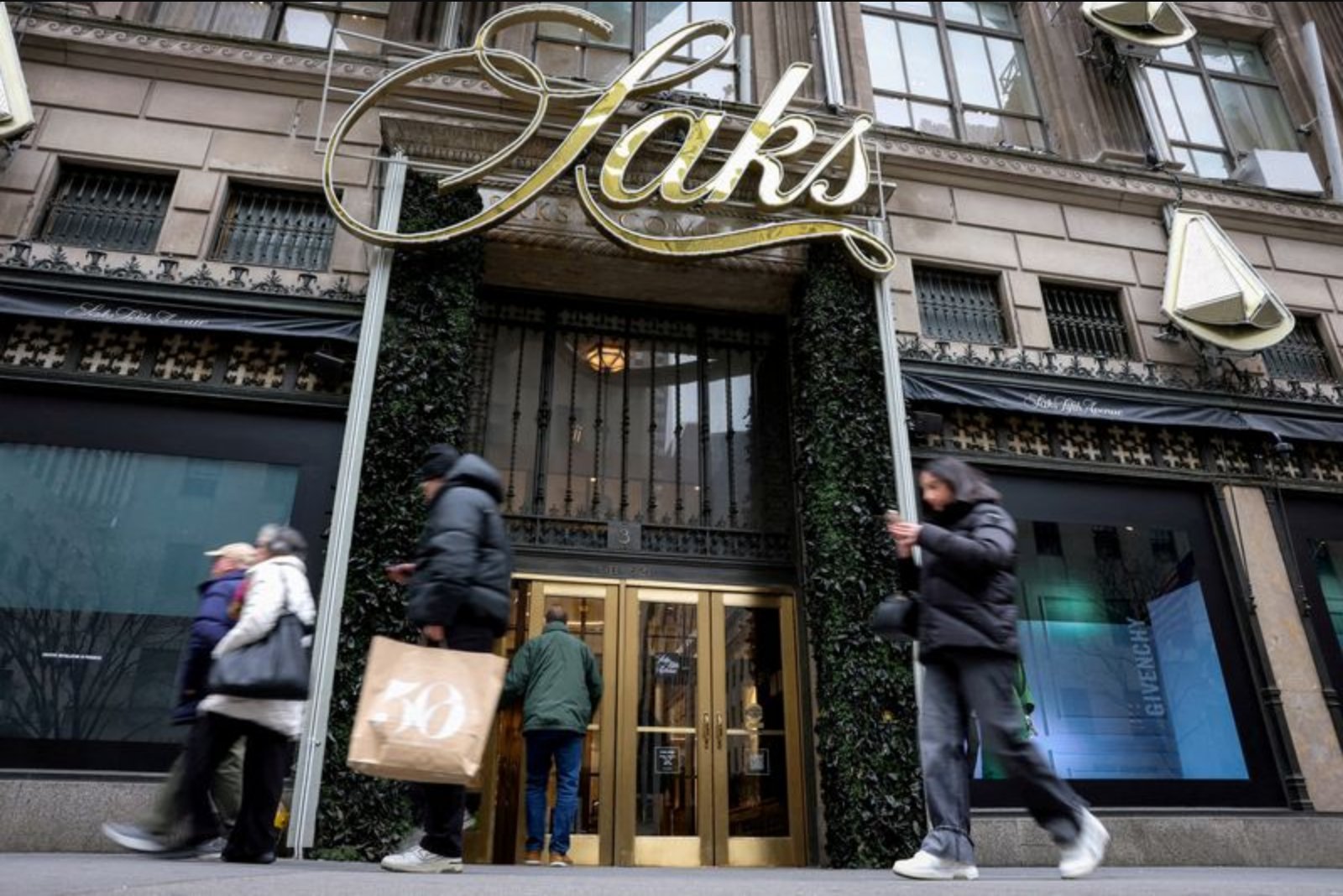
Saks Global moved into Chapter 11 late on Tuesday, initiating a restructuring process that places a new spotlight on the value of its physical retail portfolio. The luxury retailer obtained a $1.75 billion financing package intended to sustain operations while it navigates bankruptcy proceedings, but court approval of that financing remains pending.
The company’s U.S. footprint and leasehold positions appear likely to play a central role in efforts to stabilize the business and negotiate with lenders. Saks Global operates about 125 stores totaling around 13 million square feet (1.2 million square meters), and the company either owns or controls ground leases at 39 of those locations, according to its court disclosure.
Real estate as a liquidity lever
Analysts and real estate advisers describe several pathways through which Saks could extract value from its stores without immediately shuttering operating locations. One commonly discussed option is a sale-leaseback transaction, where Saks would sell property assets to an investor and then lease them back. That approach can provide liquidity while allowing stores to remain open under long-term leases.
"One of the ways to monetize its portfolio would be through the sale-leaseback option, where Saks could sell its assets to an investor and lease them back to continue making money on the asset, providing it with liquidity and allowing it to keep things running at its stores," said Matt Weko, division president of consumer goods and services at JLL.
Brandon Isner, head of U.S. retail research at Newmark, noted that closing underperforming retail space could be a necessary step to secure the business’s viability. Owners of high-quality retail centers may view the availability of anchor space as an opportunity to reconfigure tenant mixes, repurpose two-story anchors, or introduce new large-format tenants and mixed-use concepts.
Immediate actions signaled in court filings
In filings with the bankruptcy court, Saks Global requested permission to close roughly four locations that are no longer operating, commonly referred to as "dark stores." A real estate adviser familiar with evaluations of the portfolio said such properties would likely sell at a discount of 40% to 50% relative to their "lit value," which assumes an operating store.
The financing package could provide the company with the runway to preserve the value of its assets and monetize them in an orderly manner, potentially avoiding rapid, deeply discounted fire-sale closures, industry observers said. But the financing is not yet approved by the court, and its ultimate scope and terms remain subject to judicial approval.
Store co-location and competitive pressures
The structure of the luxury retail landscape complicates decisions about which locations to retain. Saks, Neiman Marcus and Bergdorf Goodman often co-anchor the same luxury centers, which can create internal competition for the same customer base. One example cited in filings and commentary is the Galleria Mall in Houston, owned by Simon Property Group, where Neiman Marcus and Saks sit within a broader high-end tenant mix that includes brands such as Balenciaga, Louis Vuitton, Gucci and Bottega Veneta.
Those co-located stores will likely be part of the portfolio review and could be among the first assets considered for sale. Luxury corridors such as Fifth Avenue in Manhattan, Beverly Hills, and top-tier malls like Bal Harbour Shops in Florida are included in the chain’s footprint, underscoring the concentration of value in a subset of locations.
Notably, Saks’ flagship Fifth Avenue store is not part of the bankruptcy estate. The site is leased from a separate entity that carries a $1.25 billion mortgage and is not among the debtors in the Chapter 11 case.
Supply chain and vendor relations
Bankruptcy experts expect Saks to prioritize vendor payments to encourage brands to resume deliveries after a year in which more than 100 labels paused shipments. Restoring vendor confidence and keeping inventory flowing is a practical priority for retailers emerging from financial distress; keeping shelves stocked will be central to stabilizing sales and preserving the value of profitable locations.
"Why would a shopper choose Saks over a brand’s flagship boutique, where they receive VIP perks and immersive brand experiences? Multi-brand retail only works when the environment adds value, and Saks hasn’t delivered that," said George Gottl, chief creative officer, spatial design, at FutureBrand. Gottl’s observation highlights the strategic challenge for multi-brand department stores in competing with brand-owned boutiques that increasingly emphasize immersive, VIP experiences.
Neighboring moves in department store sector
Other department store operators are also reshaping their footprints. Macy’s, the parent company of Bloomingdale’s, is closing about 150 underperforming locations as part of a strategy to cut costs and redeploy capital toward stores with stronger returns. Those closures include key addresses such as the Fulton Street store in Brooklyn, New York.
Retail analysts say owners of A-quality centers would welcome reclaimed anchor space. Repurposing large anchor footprints into split big-box formats or mixed-use developments can refresh tenant mixes and support mall-level performance.
Outlook and next steps
For Saks Global, the path through Chapter 11 will involve balancing the monetization of valuable real estate with operational needs such as inventory replenishment and vendor relations. The exact sequence of store closures, asset sales, and lease restructurings will be determined as the company secures court approval for its financing and advances a restructuring plan.
Until the court rules on the financing and Saks completes a detailed portfolio review, the scope and timing of asset-level transactions remain uncertain. The coming weeks should clarify whether the company can use its real estate holdings to buy time and preserve value, or whether more aggressive disposals will be necessary.