
Stock Markets March 4, 2026

Russia Alleges Ukrainian Drone Strike Set Fire to LNG Carrier in Mediterranean

Moscow says Arctic Metagaz was hit near Maltese international waters; crew reported safe, Kyiv has not commented

By Marcus Reed
Russia Alleges Ukrainian Drone Strike Set Fire to LNG Carrier in Mediterranean

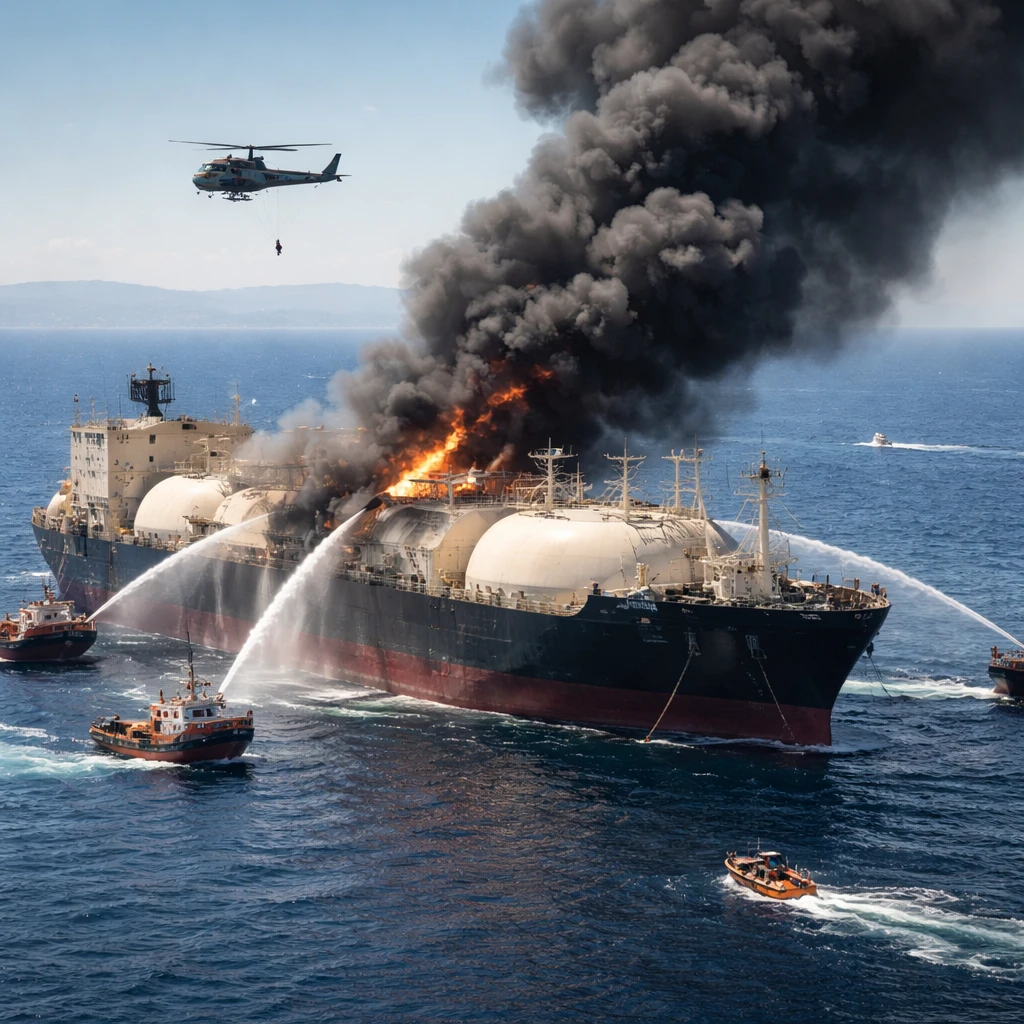
Russia's transport ministry has accused Ukrainian naval drones of attacking the liquefied natural gas carrier Arctic Metagaz, which caught fire in the Mediterranean. Moscow says the vessel - laden with cargo from Murmansk - was struck near waters belonging to Malta and that all 30 Russian crew members are safe. Ukraine's security service did not answer requests for comment, and Russian energy and ship-management firms have not issued statements.

Key Points

  • Russia's transport ministry says the Arctic Metagaz LNG carrier caught fire in the Mediterranean after an attack by Ukrainian naval drones; all 30 crew members were reported safe - impacts energy and maritime shipping sectors.
  • Moscow alleges the vessel was carrying cargo from Murmansk and was struck near international waters belonging to Malta; Maltese rescue services were thanked.
  • Ukraine's Security Service did not respond to requests for comment, and the vessel's manager LLC SMP Techmanagement and Novatek had not commented - leaving attribution and broader consequences unclear.

Moscow on Wednesday publicly attributed a fire aboard the Russian liquefied natural gas carrier Arctic Metagaz to an attack by Ukrainian naval drones, saying the incident occurred a day earlier in the Mediterranean. According to the transport ministry, the vessel had been carrying cargo from the Russian Arctic port of Murmansk when it was struck near international waters that the ministry said belong to Malta.

The ministry said all 30 crew members on board - identified as Russian nationals - were safe. In a statement, officials characterized the event as "an act of international terrorism and maritime piracy, a gross violation of the fundamental norms of international maritime law." The ministry also thanked Maltese rescue services for their assistance.

Russia's account stated that Ukrainian naval drones launched the operation from the Libyan coast. The Security Service of Ukraine did not respond to a request for comment, according to the reporting.

If Moscow's attribution is borne out, this would represent the first instance of Ukraine attacking a Russian LNG carrier, according to the Russian claim. The transport ministry also framed the incident in the broader context of Ukrainian attacks on Russian energy assets, noting Kyiv has repeatedly targeted oil refineries and other elements of energy infrastructure with the stated aim of reducing funding for Russia's war effort.

As of Wednesday, the vessel's Russia-based manager, LLC SMP Techmanagement, and Russia's largest LNG producer, Novatek, had not provided comments on the incident.


Context and logistical considerations

Details supplied by the transport ministry identify the ship's last documented cargo origin as Murmansk, and place the incident in international waters near Malta. Beyond those assertions and the statement that the crew were unharmed, official confirmation from other parties named in the ministry's account was not available at the time of the report.

The limited public information leaves several factual points unverified, including independent confirmation of the attack method, the route and status of the cargo following the fire, and formal responses from the Ukrainian authorities and the vessel's management.

Risks

  • Attribution remains unconfirmed - the Security Service of Ukraine did not respond and the vessel's managers have not commented, creating uncertainty for incident verification. This uncertainty affects maritime risk assessment and insurance considerations in the shipping sector.
  • Potential escalation or additional strikes on energy-related maritime assets cannot be confirmed from current information, which introduces risk perceptions for energy supply chains and LNG logistics.
  • Operational and commercial consequences for the Arctic-to-Mediterranean LNG shipping route are unclear given limited public details about the cargo's condition and subsequent movements, posing uncertainty for carriers and energy market participants.

More from Stock Markets

UBS Cuts Syensqo Rating and Target, Citing Weakness in Specialty Polymers Mar 4, 2026 UBS Elevates Viscofan to Buy, Boosts Price Target to €72 on Stronger Growth and Cash Returns Mar 4, 2026 Citi Points to Libya 2011 as a Useful Reference for S&P 500 Reaction to Iran Conflict Mar 4, 2026 Implenia Posts Record Order Book and Improved Cash Flow, Boosts Dividend Despite Revenue Miss Mar 4, 2026 Barclays Sees Selloff in Nexans as Overdone, Lifts Rating and Targets After GSI Fallout Mar 4, 2026