
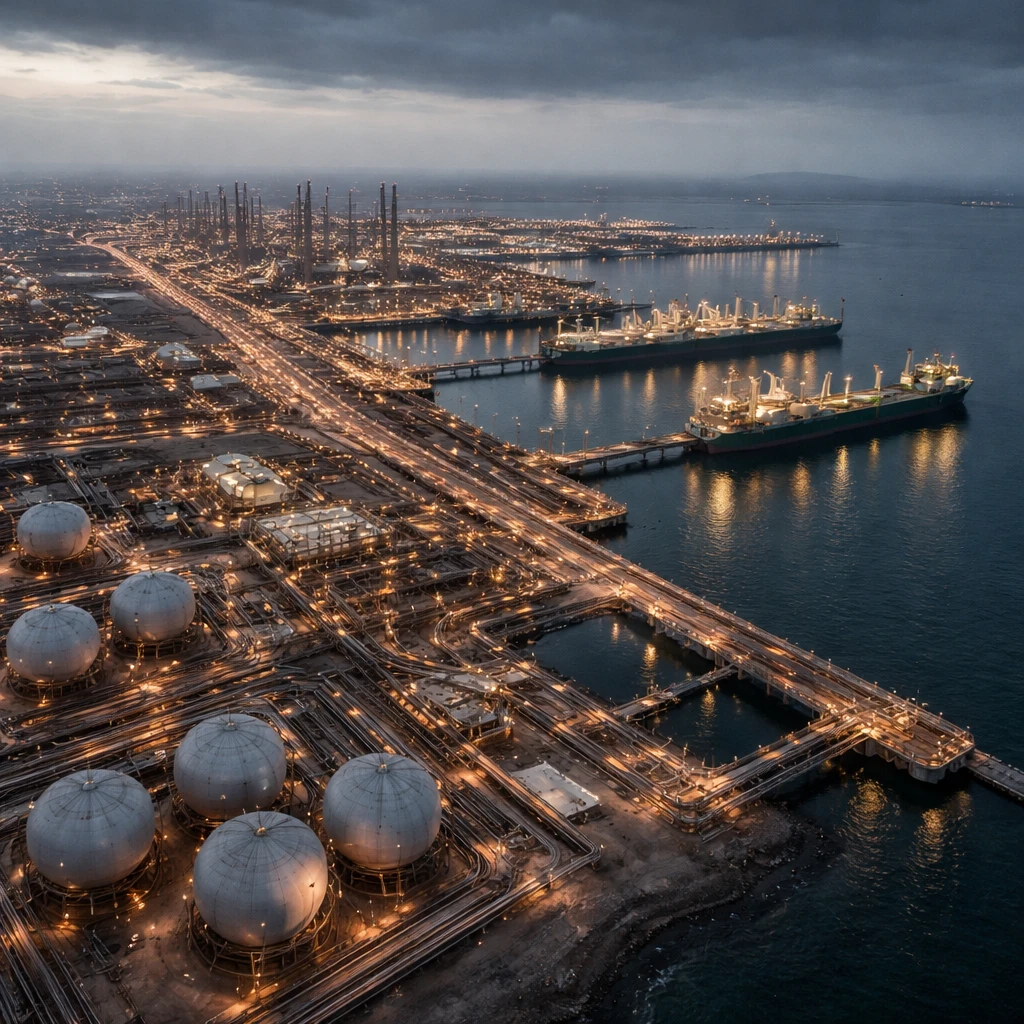
Bank of America is flagging a potential shift in the global gas balance after Iran-backed strikes damaged part of Qatar's flagship liquefied natural gas infrastructure. The bank said QatarEnergy has indicated it is weighing a force majeure lasting three to five years on about 17% of the Ras Laffan Industrial City Complex's capacity.
The Ras Laffan complex, which accounts for a substantial share of on-water global supply, holds more than 10 billion cubic feet per day of LNG production capacity. Affected capacity equivalent to 17% of the facility translates to more than 1.7 billion cubic feet per day of natural gas that Bank of America says may not return to the market even after the conflict concludes.
Bank of America framed the disruption as an event that could materially tighten the market once fighting subsides and the Strait of Hormuz is no longer blocked. While the bank noted that the immediate market reaction may be muted while the strait remains closed, it views the post-conflict supply picture as meaningfully thinner than previously expected.
That altered supply outlook has direct implications for U.S. natural gas benchmarks and certain U.S. producers. In January, Bank of America had reduced its bullishness on U.S. gas, in part because it expected Qatari Northfield expansions to add a significant volume of low-cost supply that could depress Henry Hub prices. Those Northfield expansion plans were outlined to come online in phased steps, with the first expansion train expected in the second half of 2026 and subsequent trains starting every six months until reaching an added 8.5 billion cubic feet per day of capacity by 2030. The expansion program would have raised Qatar's total capacity to 18.5 billion cubic feet per day, equal to roughly 25% of global on-water supply in 2030.
Bank of America said the potential multi-year outage removes a key downside risk to Henry Hub because Qatar is the global low-cost gas supplier by a wide margin. The bank quantified production economics in U.S. basins, noting that activity in the Haynesville region tends to pause when Henry Hub trades in the $3.25 to $3.50 range, while curtailed Appalachia output occurs at around $1.50 in-basin, which corresponds to approximately $2.50 at Henry Hub.
Against that backdrop, Bank of America identified U.S. names with LNG-linked exposure that it expects could benefit from a tighter market. The bank highlighted APA Corp (NASDAQ:APA) and EOG Resources (NYSE:EOG) as producers likely to see gains. Separately, Bank of America's top large U.S. gas picks include EQT and Expand (EXE), both rated Buy.
Despite the more constructive external supply backdrop, the bank emphasized that domestic U.S. supply growth remains a material internal risk. The principal uncertainty is whether U.S. producers can coordinate production increases with the commissioning of new U.S. export facilities. In addition, Bank of America warned that if oil prices rise and prompt producers to boost oil-directed drilling in 2027, associated gas volumes could become a headwind for prices once an additional 4.5 billion cubic feet per day of Permian egress capacity comes online later this year.
Bottom line: Damage to a portion of Qatar's Ras Laffan complex and the possibility of a prolonged force majeure on that output could remove a major source of low-cost incremental LNG supply that had weighed on U.S. gas price prospects. The shift improves the relative outlook for LNG-linked U.S. producers, though domestic supply dynamics and future associated gas from oil-directed activity remain key uncertainties.