
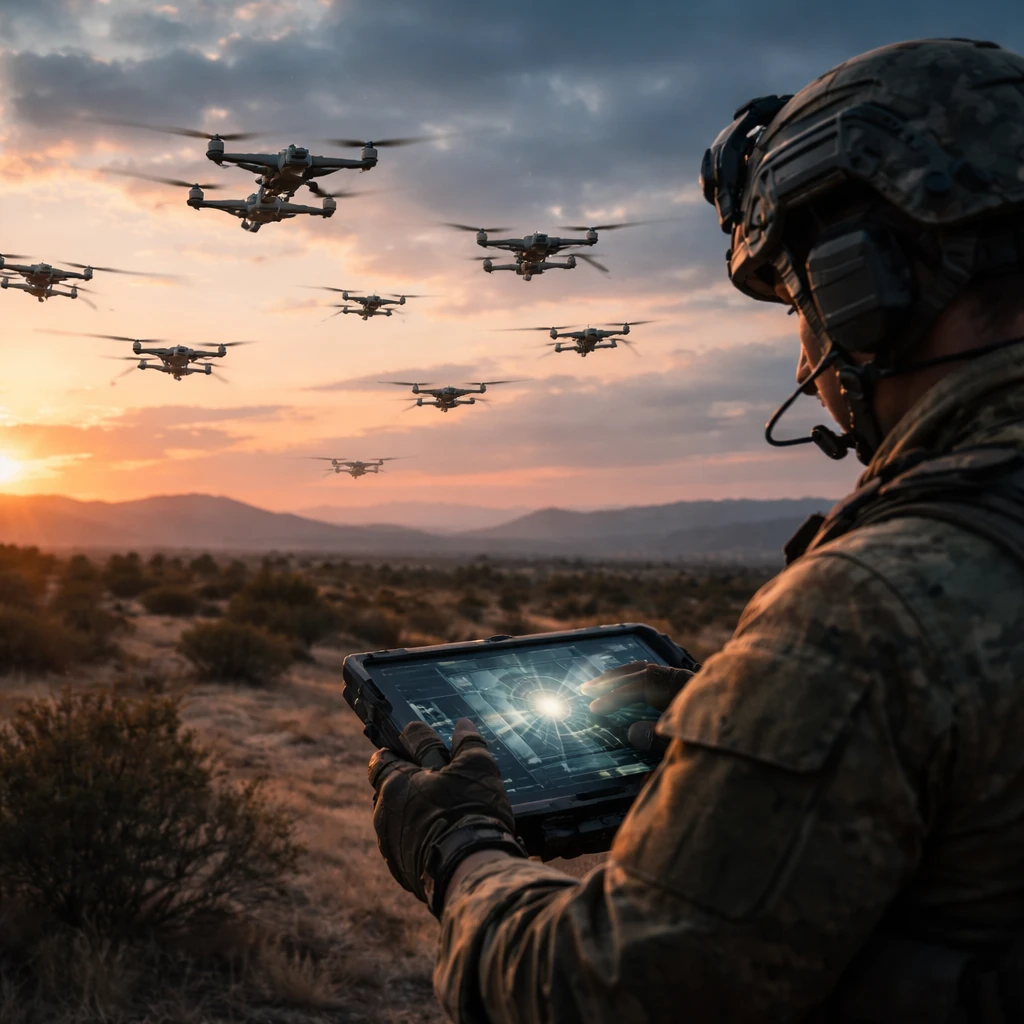
OpenAI has joined forces with two defense technology companies selected by the Department of War to supply voice-controlled software intended to convert spoken orders into machine-readable commands for autonomous drone swarms, according to individuals familiar with the matter.
The work is part of a $100 million prize challenge launched by the Department of War to modernize how humans interact with machines on the battlefield. The competition runs for six months and seeks prototype systems that can coordinate very large numbers of autonomous platforms using plain-language instructions.
Officials framing the challenge say the goal is to move away from laborious manual programming toward more intuitive interfaces that suit high-pressure combat settings. "We want orchestrator technologies that allow humans to work the way they already command - through plain language," said LtGen Frank Donovan, Director of the Defense Autonomous Warfare Group, in the challenge announcement in January.
OpenAI's role in the program is narrowly defined. Company-provided tools will be used to translate commanders' verbal directives into digital instructions, but they will not be employed for weapons integration, targeting authority, or the direct operation of the drone swarms.
The Department of War has emphasized speed and practical outcomes in its selection process, adopting an iterative, sprint-oriented approach intended to deliver usable capabilities quickly. "This solicitation’s approach is the new standard - we’re moving fast to deliver tangible capabilities to the warfighter," said Hon. Emil Michael, Acting Director of DIU.
While a number of artificial intelligence firms submitted direct bids for the prize, OpenAI chose not to file its own proposal and is participating in a supportive, peripheral capacity. An OpenAI spokesperson told reporters that the company did not submit an independent bid and described its expected involvement as cursory.
Summary of the program and OpenAI's involvement:
- The competition is funded at $100 million and designed to run for six months.
- Prototypes must enable coordination of large autonomous systems via plain-language commands.
- OpenAI will provide technology to translate spoken commands into digital instructions but is restricted from roles involving weapons, targeting, or direct swarm control.