
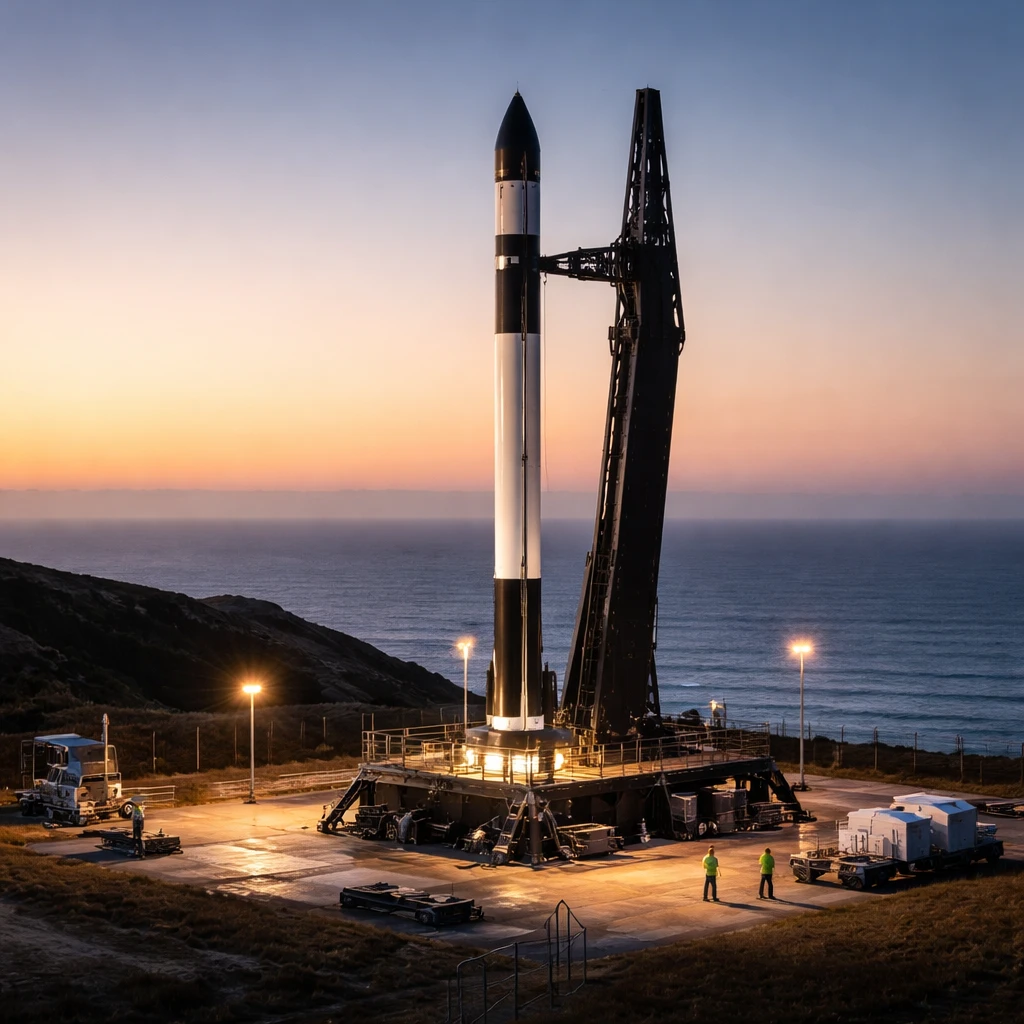
Rocket Lab Corporation (NASDAQ:RKLB) shares climbed 2.6% in after-hours trading on Thursday after NASA selected the company to conduct three Electron rocket launches for two distinct science missions, according to a company press release.
The Long Beach, California-based launch provider will carry out two consecutive Electron launches for NASA's PolSIR mission from Launch Complex 1 in New Zealand, with those flights scheduled to occur no earlier than June 2027. Separately, NASA has booked a third Electron launch for the TSIS-2 mission from the same New Zealand site in early 2027.
Mission profiles
The PolSIR mission - Polarized Submillimeter Ice-cloud Radiometer - will place two identical CubeSats into separate, 52-degree inclination, non-sun-synchronous orbits. The spacecraft will target the tropics and sub-tropics to study ice cloud formation, variability, and ice content. Data collected by PolSIR is intended to feed into Earth system weather prediction models.
The TSIS-2 mission - Total and Spectral Solar Irradiance Sensor-2 - will carry a single satellite designed to measure the Sun's energy output at the top of Earth's atmosphere across ultraviolet, visible, and infrared wavelengths. NASA arranged the TSIS-2 launch within seven months of signing the contract to meet requirements described as time-sensitive.
Company remarks and manifest
Rocket Lab founder and CEO Sir Peter Beck noted that the Electron rocket has become associated with reliability, precise orbital accuracy, and on-demand launch capability, and that the company has been supplying those capabilities to NASA missions for nearly a decade.
In addition to the PolSIR and TSIS-2 assignments, Rocket Lab said its upcoming NASA manifest also includes the Aspera astrophysics mission and the LOXSAT mission. The LOXSAT flight is planned to make use of Rocket Lab's Photon spacecraft to demonstrate in-space refueling technologies.
Market reaction and context
Following the announcement, Rocket Lab's shares advanced 2.6% in after-hours trading on Thursday. The selected launches and the additional NASA manifest items were cited in the company's press release as the basis for the market move.
Outlook
The contracts place several 2027 Electron launches on Rocket Lab's schedule, with specific timing notes included for the PolSIR and TSIS-2 missions. The TSIS-2 booking was expedited within seven months of contract signing to meet mission timing needs, while the PolSIR twin launches are listed as no earlier than June 2027.