
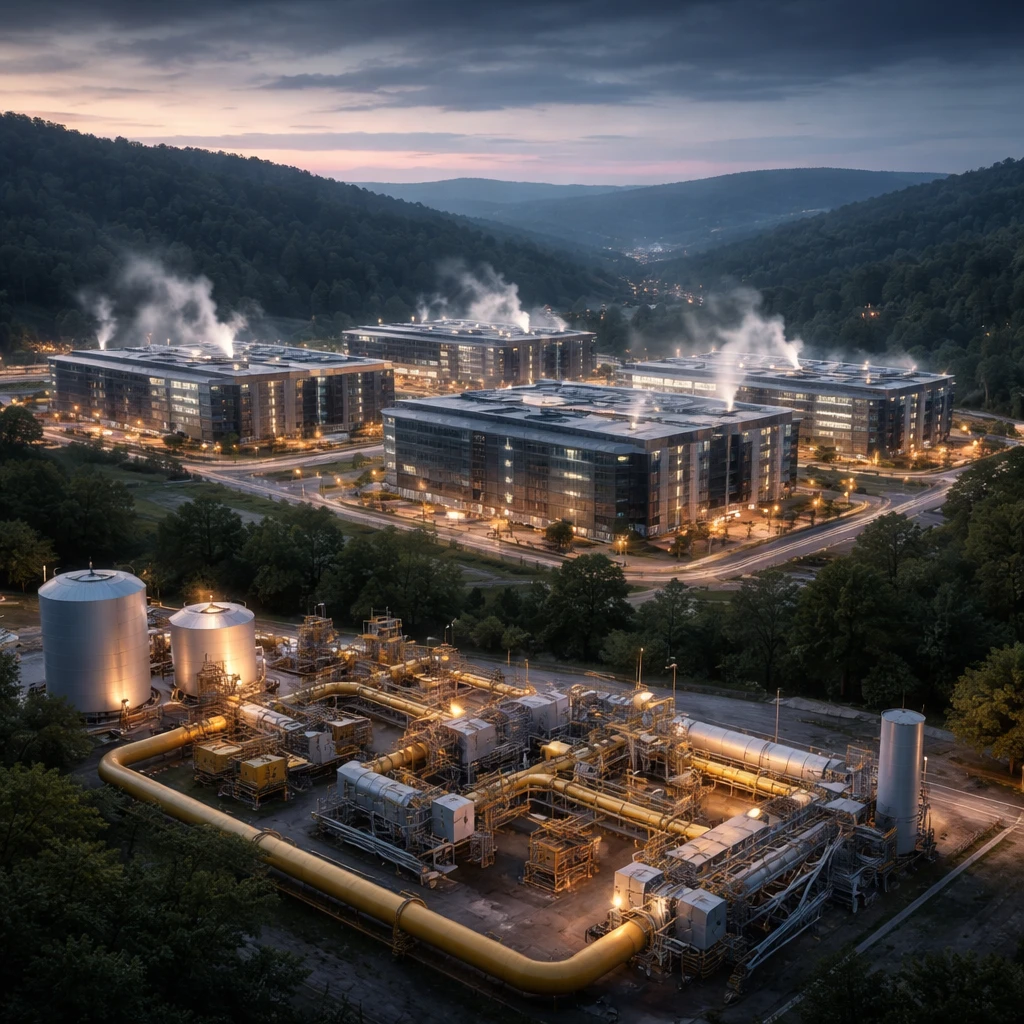
Morgan Stanley's research team is flagging a fresh source of demand for U.S. natural gas tied to the rapid expansion of AI-driven data centers. Using its AlphaWise geospatial work, the bank estimates the buildout could add roughly +4.8 billion cubic feet per day (Bcf/d) of incremental gas demand by 2030, with the bulk of demand growth concentrated in Appalachia and the PJM market.
The analysis began with a mapped universe of 1,272 announced data center projects, which Morgan Stanley says represent about 80 GW of additional power needs. That dataset allowed analysts to identify geographic clusters where increased electricity consumption is most likely to translate into higher gas consumption.
Morgan Stanley notes a theoretical upside scenario in which natural gas supplies the entire incremental load would imply 14-15 Bcf/d of demand. The bank, however, prefers a probability-weighted base case that points to the more modest +4.8 Bcf/d figure as its working assumption through 2030.
Analysts describe this incremental requirement as fitting into an already visible structural trend in the U.S. gas market. They say the market is "on the cusp of a new cycle of demand growth," driven in part by LNG exports alongside the rise in electricity demand from AI computing and other sources.
Geography and company-level implications
Geographically, Morgan Stanley expects most of the projected gas demand increase to cluster in PJM and Virginia, which together account for the majority of the bank's projected growth. That regional concentration informs the firm's preferences across the natural gas value chain.
On the upstream side, Morgan Stanley identifies EQT as the company best positioned to capture this near-term and structural opportunity. The bank cites EQT's acreage position, long inventory life, midstream vertical integration, exposure to regional pricing dynamics and a strategy aimed at seizing power-related demand growth. Morgan Stanley retains an Overweight rating on EQT and lists it as a Top Pick.
Among midstream names, the bank highlights TC Energy as a leading way to participate in grid-connected solutions that support AI and data center expansion, noting the company's pipeline proximity to the new data center sites. Williams is also favored for its progress in building behind-the-meter capabilities that hyperscale cloud operators increasingly require.
Within utilities and power generation, Morgan Stanley expects producers offering long-term supply agreements to benefit as data center operators seek reliable, contracted energy. Vistra is singled out as a primary beneficiary because of its generating capacity located near the projected demand centers.
Additional names the firm views positively across these segments include Enbridge, Kinder Morgan and Talen Energy.
How Morgan Stanley reached its estimate
The bank's estimate relies on a combination of spatial mapping of announced projects and a probability-weighted approach rather than assuming natural gas will supply every megawatt of the incremental load. That produces a base-case forecast that is materially lower than the theoretical maximum but still large enough to influence company and regional exposure to rising power demand.
While Morgan Stanley's work highlights significant upside potential for gas demand tied to AI data centers, the bank frames its +4.8 Bcf/d figure as its central, probability-weighted projection rather than the extreme case.