
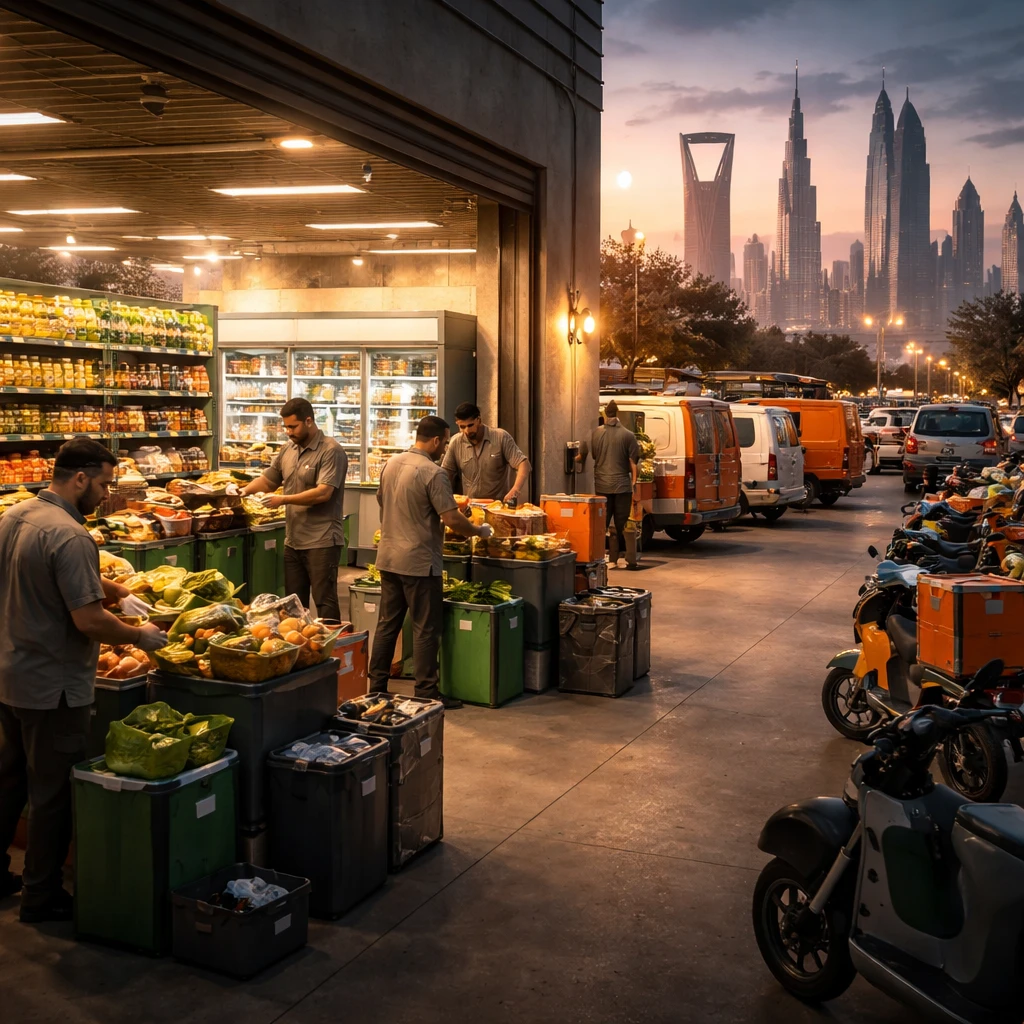
Morgan Stanley's recent MENA Field Trip in Riyadh highlighted a faster pace of competition in the region's dark-store grocery delivery market, with the investment bank identifying Careem and Talabat as the most notable public-market operators navigating this crowded space.
The bank's analysis emphasized that grocery delivery across the Middle East and North Africa represents a broader total addressable market than food delivery, even though grocery orders tend to generate lower profitability on a per-order basis. That combination creates a landscape where volume and scale matter, even as individual order economics remain constrained.
Careem
In its initial group meeting with public market investors, Careem's co-founder and CEO laid out the company's strategy across its ride-hailing and food delivery arms. Careem, which is owned by Uber Technologies Inc (NYSE:UBER), stressed the importance of multi-service customers to its overall value proposition and acknowledged that food delivery competition is set to intensify through Q4 2025.
Executives framed grocery delivery as a larger market opportunity than food delivery in terms of addressable size, but noted lower profitability per order. Despite that, they suggested the aggregate profit pool for grocery could be comparable to food delivery because of the larger number of transactions. Management also discussed the operational and investment decisions required to move beyond the UAE into additional GCC markets, citing logistical hurdles in scaling grocery operations, unit-economics considerations, and potential synergies stemming from its relationship with Uber.
Talabat
During a separate session, Talabat's newly appointed CEO and senior leadership hosted Morgan Stanley, including a guided tour of their dark-store footprint led by the head of tMart UAE. The management team addressed recent earnings and signaled that growth has moderated, while maintaining guidance that implies more than $1 billion in additional gross merchandise value in absolute terms, reflecting the company's larger operational scale.
Talabat's acquisition of InstaShop was described as slightly dilutive to growth rates. Company leadership said they have not baked potential regulatory changes into their guidance, but view possible new regulation in Dubai and Qatar - beyond existing measures in Kuwait - as overall positive if implemented.
Management confirmed elevated competition through Q4 2025 and outlined plans to increase investment to expand the dark-store network across the GCC. They also highlighted that advertising technology could represent up to 7% of grocery GMV in the UAE, pointing to a meaningful profit opportunity despite lower per-order margins compared with food delivery. Talabat's team cautioned that their medium-term margin targets will likely be postponed by roughly 2-3 years as current investment programs continue.
Wider competitive and operational themes
Both firms emphasized that the market is becoming more contested, naming a range of competitors moving aggressively into grocery delivery. The analysis indicates heightened pressure on unit economics as players deploy capital to build dark-store networks and gain customer share across the Gulf Cooperation Council countries.
Morgan Stanley's findings make clear that operators will need to balance distribution strength, disciplined investment, and execution on logistics to defend margins and achieve the scale necessary to make the economics work. Companies are focused on operational excellence and targeted strategic investments to sustain and grow their market position in a sector where order-level margins are slimmer than in food delivery, but where the total transaction pool is larger.
Conclusion
As dark-store grocery delivery expands in MENA, the stakes for execution and capital allocation have risen. Careem and Talabat emerge from Morgan Stanley's field work as leading public-market names to watch, each confronting the same structural trade-offs between market size and unit profitability while expanding across the GCC and preparing for a more crowded competitive environment through Q4 2025.