
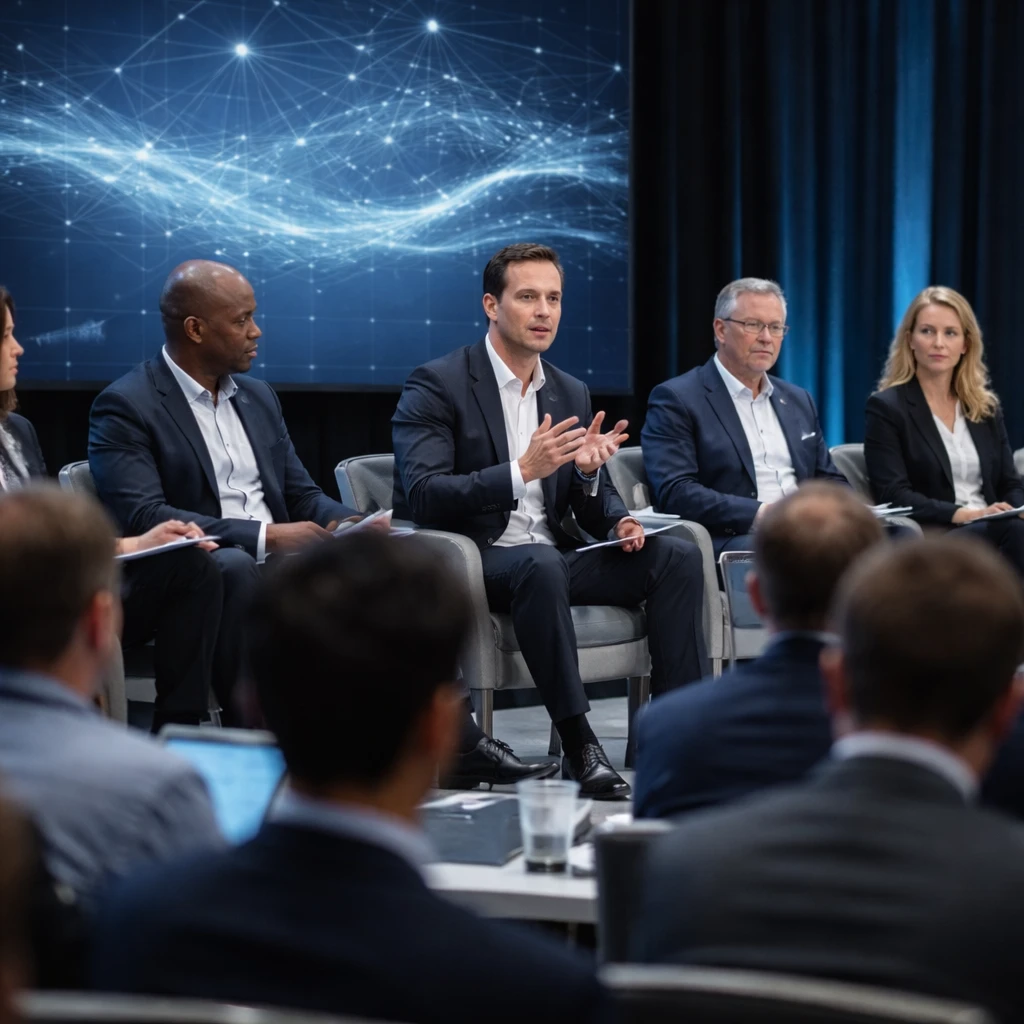
At a recent Morgan Stanley conference, software executives and the bank's analysts outlined a market moving away from broad AI hype toward concrete, governed implementations. Attendees described enterprise adoption as concentrated in selective, high-value use cases where determinism and controls are essential for production deployment.
Across the vendor presentations, a recurring theme emerged: customers are prioritizing platforms that can embed probabilistic AI models inside deterministic operating frameworks and governance structures. Executives argued these capabilities are particularly important within regulated industries and mission-critical processes.
Key takeaways from featured companies
-
Appian - CFO Serge Tanjga framed the company’s strength as delivering a deterministic operating system around probabilistic AI models, a capability he said is crucial for regulated environments. Appian’s pitch centers on orchestrating AI within broader process architectures while layering governance controls that facilitate scalable adoption. Management cited document-centric deployments that have achieved production-grade accuracy and rapid implementation timelines, and described clear expansion pathways as customers scale from initial use cases to higher throughput. The company said it retains substantial runway across four regulated verticals: public sector, financial services, insurance, and healthcare.
-
C3.ai - New CEO Stephen Ehikian laid out a turnaround plan focused on industrial customers and the U.S. federal government, areas where the company reportedly shows the strongest differentiation. Rather than pursuing a broad horizontal platform strategy, C3.ai intends to concentrate investment in differentiated industrial applications such as supply chain optimization, asset reliability, and predictive maintenance. Management highlighted organizational flattening to speed execution and pointed to strong public sector tailwinds, citing momentum in civilian agencies as evidence of land-and-expand potential.
-
Commerce.com - CFO Daniel Lentz described the company’s advantage as a platform-agnostic, API-driven infrastructure layer built for a fragmented commerce discovery landscape. Management argued merchants will require solutions that remain agnostic across channels and that do not cede brand control to singular intermediaries. The company plans to narrow the gap between gross merchandise volume and revenue growth via the BIGC Payments rollout, deeper expansion in its existing install base, and margin inflection achieved through efficiency gains and AI tool adoption.
-
Elastic - CEO Ash Kulkarni and CFO Navam Welihinda emphasized the defensibility of Elastic’s deeply embedded data store and its ability to run mission-critical workloads at scale. Management noted that, despite AI lowering some barriers to writing code, operating production-grade data systems remains complex and costly, reinforcing the value of a platform approach. They reported that about 25% of customers with over $100,000 in spend now use AI-related capabilities. Search and Security demand was described as steady, and management flagged a modern metrics data store expected to launch in mid-2026 that could improve prospects for the Observability business.
-
GoDaddy - VP of Investor Relations Christie Masoner said GoDaddy’s AI advantage comes from scale in domain holdings and small-business data, coupled with broad distribution and a differentiated care model. The company’s Airo.ai platform supports multi-agent, natural-language workflows that execute tasks for micro and small businesses, combining automation with human-in-the-loop support. Management defended recent promotional pricing as an intentional strategy to widen the funnel; cohort indicators were reported to be in line with other one-year cohorts. Over the past five years, margins have expanded by roughly 1,000 basis points, according to management.
-
Intuit - CEO Sasan Goodarzi framed accuracy as Intuit’s primary differentiator versus generic LLM tools, pointing to the liability risk inherent in taxes, payroll, and accounting workflows when errors occur. Intuit’s moat was described as an accuracy engine built from system-of-record data, validated workflows, and domain rules; LLMs are reportedly used primarily for summarization, while deterministic checks gate the final output. Goodarzi highlighted momentum behind an AI-driven expert platform strategy and indicated that product lineup changes can be expected in upcoming quarters as platform capabilities and human expertise are bundled for certain workflows, with corresponding subscription price increases.
-
Nutanix - CEO Rajiv Ramaswami and CFO Rukmini Sivaraman acknowledged server supply constraints that extend the timing between bookings and revenue, but characterized this as a timing issue rather than a sign of demand deterioration. Management maintained that the platform’s value lies in enterprise-grade resiliency required for mission-critical workloads, with AI acting as an incremental catalyst as customers develop inferencing and agentic applications. The company described the VMware displacement opportunity as in the "second inning," implying a multi-year, steady migration rather than an immediate surge. Nutanix said it is balancing investment with operating leverage and seeking AI-driven efficiency improvements.
-
Zscaler - Founder and CEO Jay Chaudhry and CFO Kevin Rubin reported record million-dollar-plus deals and $290 million of Z-Flex total contract value bookings in the recent quarter. Management portrayed AI as a structural tailwind rather than a threat and positioned the Zero Trust Exchange as a key inline policy engine for AI agents. Zscaler said it is building around three pillars - Zero Trust everywhere, Data Security everywhere, and AI/SecOps - and believes this approach expands its total addressable market well beyond core SASE toward a long-term opportunity exceeding $10 billion in annual recurring revenue.
-
Zoom Communications - CFO Michelle Chang pointed to the company’s extensive set of unstructured data across phone, meetings, and other sources as a distinct advantage for AI monetization by connecting historically siloed work. Management reiterated that reaccelerating top-line growth is the top priority and described plans to infuse AI into core Workplace offerings, scale new AI monetization routes across vertical and departmental product portfolios, and drive Contact Center momentum. The company said its strong balance sheet provides capital allocation optionality, with M&A expected to focus on AI and small-to-medium-sized targets.
-
Zeta Global - CEO David Steinberg and CFO Chris Greiner emphasized Zeta’s proprietary dataset of 552 million opted-in profiles, each with roughly 5,000 to 7,000 attributes per person, as a core AI moat. Management described the Athena intelligent agent as capable of converting strategy into activation within a single workflow, enabling customers to expand from single use cases to adjacent opportunities. They noted that multi-use-case customers spend about five times more on average. Management also stated that substantial AI investment occurred between 2017 and 2021, positioning the company to continue funding innovation while expanding profitability and sustaining growth above 20%.
Analysis and context from the conference
Across discussions, executives and analysts signaled that enterprise AI adoption remains methodical and focused on demonstrable business outcomes. The emphasis is on architectures and controls that convert probabilistic AI outputs into deterministic, auditable processes suitable for regulated and mission-critical environments. Where vendors articulated clear governance, data provenance, or proprietary-data advantages, managements suggested they could translate pilot successes into broader adoption and higher average revenue per customer.
Several vendors described tangible metrics and product road maps: Elastic expects to ship a modern metrics data store by mid-2026 that could benefit Observability, Zscaler reported $290 million in Z-Flex bookings and record large deals, and Zeta highlighted its 552 million opted-in profile database as a competitive asset. Other companies emphasized go-to-market motions and monetization levers, such as Commerce.com’s BIGC Payments rollout, GoDaddy’s Airo.ai funnel strategy, and Intuit’s plan to bundle platform capabilities with human expertise in certain workflows.
Conclusion
The market tone at Morgan Stanley’s event was pragmatic: enterprise customers are prioritizing trust, governance, and deterministic outcomes as they move from experimentation to scaled AI deployments. Vendors that can embed AI within governed process architectures, maintain strong data defensibility, or leverage unique proprietary datasets signaled clearer paths to durable customer expansion and monetization.