
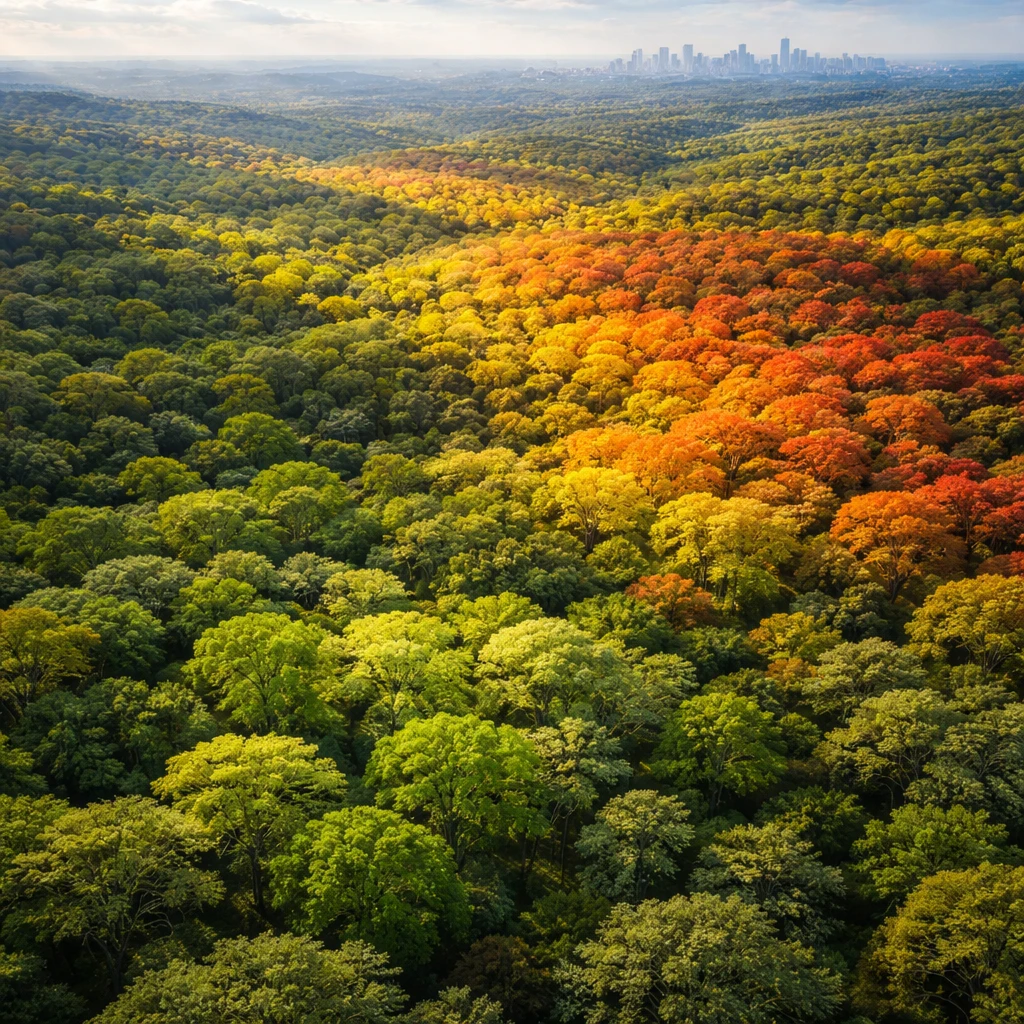
Meta announced the launch of Canopy Height Maps v2 (CHMv2), an open-source global forest mapping system developed in collaboration with the World Resources Institute. The update integrates Meta's DINOv3 self-supervised vision model to estimate tree canopy height, aiming to support monitoring of forest condition, restoration tracking and carbon storage estimation.
The new CHMv2 delivers a marked improvement in predictive accuracy compared with the original model released in 2024. Meta reports an increase in the model's R² metric from 0.53 to 0.86. That improvement follows a change in the model backbone - CHMv2 replaces the prior DINOv2 foundation with DINOv3, which was pre-trained on SAT-493M, a satellite imagery dataset. According to Meta, DINOv3 helps the system learn visual cues from unlabeled imagery - features such as shadows, textures and crown shapes - that are relevant to estimating tree height.
Meta says the revamped model produces sharper canopy maps and reduces bias toward tall trees by leveraging the visual features that DINOv3 extracts from satellite data. To support the updated model, the training set was expanded to include more geographically diverse lidar examples. Meta also developed automated matching tools and a specialized loss function to align satellite imagery with lidar measurements used for canopy-height estimation.
Applications of the original CHMv1 are already underway. Forest Research in the United Kingdom uses CHMv1 for national-scale forest inventory and to track climate-related commitments. The European Commission’s Joint Research Centre incorporated CHMv1 data into its Global Forest Cover map for 2020 and has indicated plans to adopt CHMv2 for future map versions as well as for the 3 Billion Tree Initiative, which targets planting 3 billion trees across the European Union by 2030.
In the United States, CHMv1-based maps are being applied in city planning through the Cities for Smart Surfaces initiative, an agreement signed by mayors of 10 cities including Atlanta, Baltimore, Boston, Columbia, Dallas and New Orleans. The WRI Ross Center for Sustainable Cities is integrating the maps into Cool Cities Lab, a scenario-planning tool initially made available for cities in 11 countries. Meta and WRI present CHMv2 as an upgraded tool intended to broaden those applications through improved accuracy and more geographically varied training data.
The release of CHMv2 highlights advances in applying self-supervised vision models to satellite imagery and in aligning those image-based models with ground-truth lidar measurements. The system remains open source and intended for use by researchers, public agencies and urban planners who are employing canopy-height data for inventory, restoration and planning efforts.