
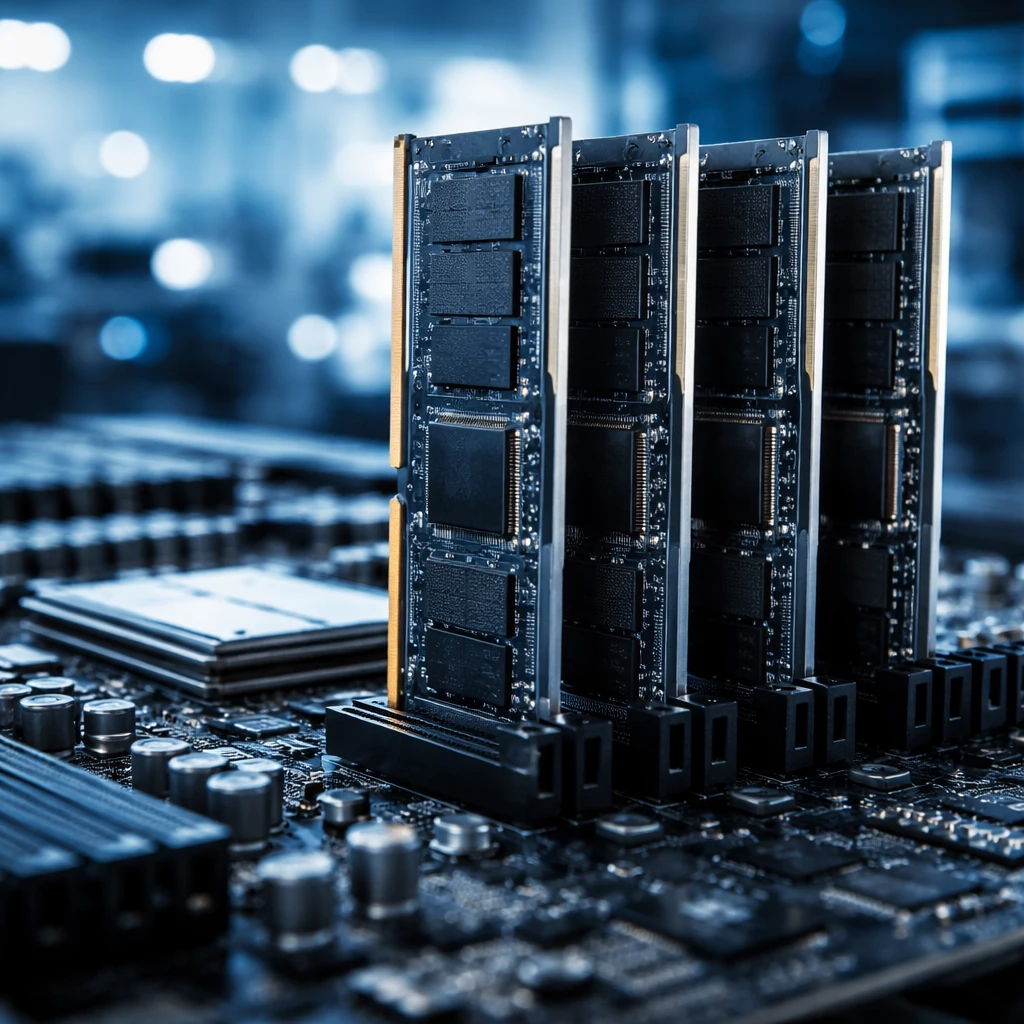
Shares of leading memory-chip manufacturers jumped Monday after reports indicated DRAM prices climbed substantially in the first quarter of 2026, tracking well above market expectations.
According to Digitimes, price moves since the Lunar New Year holiday in China were pronounced across several modules. The report cited a 150% quarter-over-quarter increase in prices for 64GB DDR5 RDIMM modules in Q1 2026 versus Q4 2025. Mobile DRAM also showed large gains, with 12GB LPDDR5X module prices rising 130%, while older 8GB notebook modules saw an increase of 180% over the same period.
Those gains outpaced industry estimates that had anticipated roughly a 100% quarter-over-quarter rise in DRAM pricing for Q1. The stronger-than-expected price trajectory benefited major memory suppliers, with listed shares of Samsung Electronics and SK Hynix in Frankfurt advancing 5.3% and 9.8% respectively, and Micron Technology (NASDAQ:MU) rising 4.8% in New York.
Analysts cited ongoing supply constraints and robust demand dynamics as the key forces behind the pricing strength. Jordan Klein, a TMT specialist at Mizuho, said demand will continue to exceed supply for both AI-oriented HBM products and conventional DRAM through 2026. Klein stated: "Demand is going to continue to materially exceed both AI (HBM) and conventional DRAM in CY26 given no expected supply additions will come until late CY26 at the earliest and mostly not until CY27."
Klein also pointed to manufacturing limits on HBM improvements, noting that "HBM yield progression remains challenging despite being generally on track," which constrains near-term supply growth for HBM4. That limitation, according to Klein, is helping to shift some pricing and margin momentum back toward conventional DRAM, where current pricing and margins now exceed those for HBM.
Within that environment, Samsung - which holds the largest conventional DRAM capacity among major manufacturers - is positioned to capture a disproportionate share of benefits from higher prices. Klein added that Micron and SK Hynix are also set to gain from firmer pricing trends in mobile and PC DRAM across 2026 and into 2027.
The market reaction and analyst commentary underscore the present imbalance between DRAM demand and supply. With reported module prices rising by well over 100% quarter-over-quarter across multiple product categories, memory suppliers have seen near-term revenue and margin dynamics improve, while the timing of meaningful new capacity additions remains a key constraint on bringing supply back into balance.
Contextual note: The pricing moves referenced here follow the Lunar New Year period in China and reflect quarter-over-quarter comparisons between Q1 2026 and Q4 2025 as reported by Digitimes. Observed share-price moves were recorded in Frankfurt for Samsung Electronics and SK Hynix and in New York for Micron.