
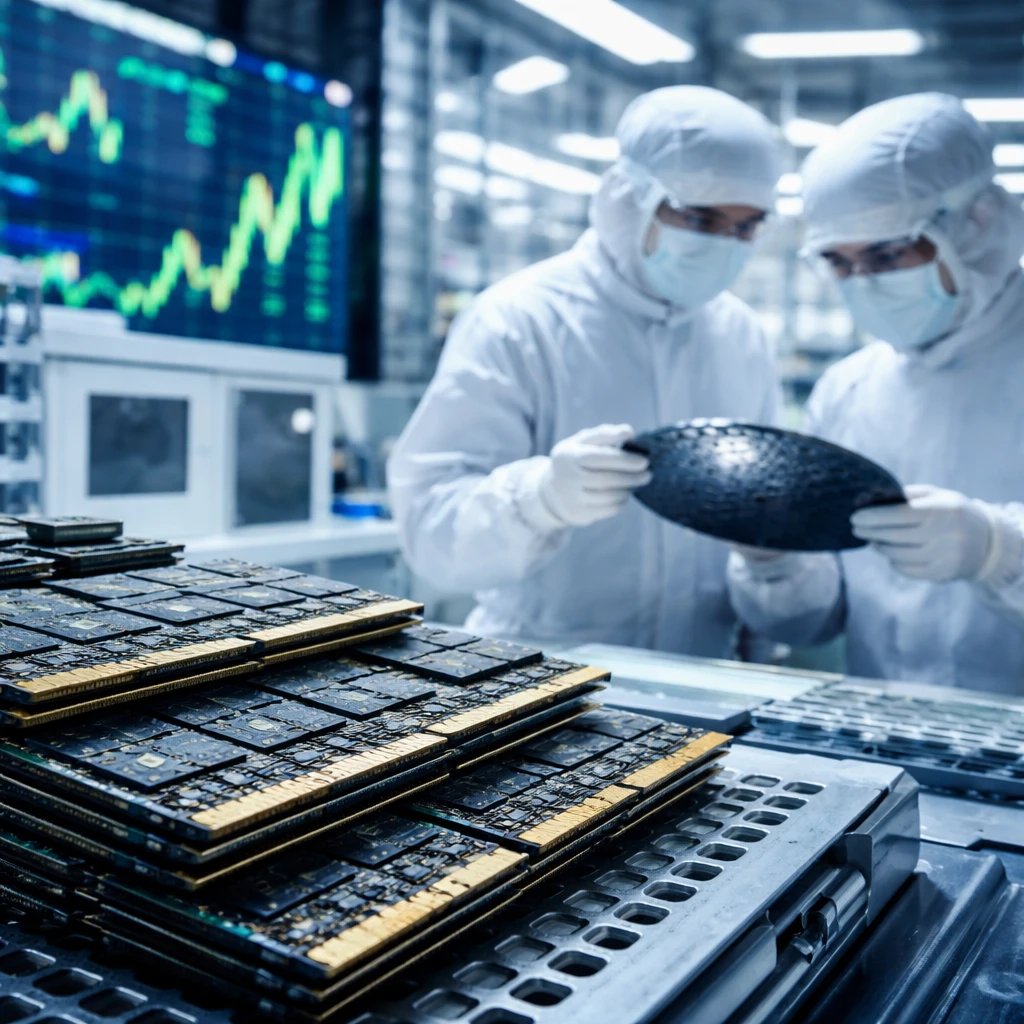
Memory-focused equities rallied on Wednesday after a note from Bernstein highlighted firmer-than-expected pricing trends for memory products and prompted the brokerage to lift its price targets on several leading chipmakers.
Bernstein said it now anticipates that memory prices will rise more in the second quarter of 2026 than it had previously forecast, and it sees little evidence that the current supply-demand imbalance is easing. The brokerage cited channel checks showing continued strong demand from hyperscale customers and persistent supply constraints across multiple segments.
Investor reactions were marked in Seoul, where Samsung and SK Hynix shares closed up 7.5% and 8.9% respectively. In the United States, Micron traded about 1% higher in premarket activity.
What Bernstein found
According to Bernstein's field work, hyperscaler demand remains robust even as sourcing power among buyers has improved. Supply constraints continue to appear despite that improved sourcing. The broker also reported shortages in areas such as automotive and industrial memory, even where long-term contracts exist.
Consumer buying has also held up better than Bernstein had expected because some buyers are accelerating purchases in advance of anticipated further price increases. That behavior has delayed broader demand destruction and enabled suppliers to push through significant price hikes. Server demand, particularly from hyperscalers, was identified as the strongest segment; lower-end handset original equipment manufacturers are under pressure, and some enterprise demand may be weakening as higher prices bite.
Analyst Mark Li highlighted that prices for HBM and some memory SKUs are likely to be steadier, while other SKUs could see dramatic increases. He noted that some SKUs are experiencing close to a 100% quarter-on-quarter increase in 2QCY26 - an outcome he described as an upside surprise. Between DRAM and NAND, Li said NAND currently shows stronger price signals.
Concrete changes to price targets
Reflecting these observations, Bernstein raised its price targets across the major memory names while maintaining Outperform ratings on each. The broker raised Samsung's price target to 225,000 Korean won from 140,000 won, SK Hynix to 1,150,000 won from 750,000 won, and Micron to $510 from $330.
Bernstein also significantly boosted its earnings and pricing estimates for 2026 and 2027, saying these are now considerably above consensus because current market expectations have not fully incorporated the strength in memory pricing. In its modeling, Bernstein assumes DRAM prices will rise about 47% quarter-on-quarter and NAND prices around 60% in 2QCY26.
"We believe this is above buyside expectation and presents a clear upside risk to the stock prices in the near term," Li wrote in the note.
Industry comments and outlook
Commenting elsewhere this week, SK Group Chairman Chey Tae-won said the global wafer shortage could extend through 2030. Speaking on the sidelines of Nvidia's GTC conference, Chey said AI workloads drive demand for a lot of HBM and that producing HBM requires substantial wafer capacity. He estimated it will take several years to build more wafers, suggesting the current shortage could persist until 2030 and that SK Hynix sees a potential greater-than-20% shortfall in wafer supply.
Chey added that SK Hynix is working on measures to stabilize DRAM pricing.
Looking forward, Bernstein expects memory pricing to keep rising through 2026, though at a slower pace in the second half of the year, with prices peaking in the first half of 2027. The brokerage foresees a subsequent cyclical downturn, with prices falling into late 2027 and further in 2028 as new supply from China and capacity added through technology upgrades and new clean rooms comes online. Bernstein characterized the current cycle as stronger and likely longer than prior expectations, noting that while AI may sustain demand growth for a period, persistent shortages are not assumed indefinitely given record capital expenditures and further expansion from China.
Corporate reporting note
Micron is scheduled to report fiscal second-quarter results after the market close on Wednesday, with analysts expecting revenue to increase 148% year over year, according to LSEG.
Investors and market participants will be watching both the earnings release and ongoing price signals closely to gauge whether the recent strength in memory pricing is durable and how it will feed through to supplier margins and valuations.