
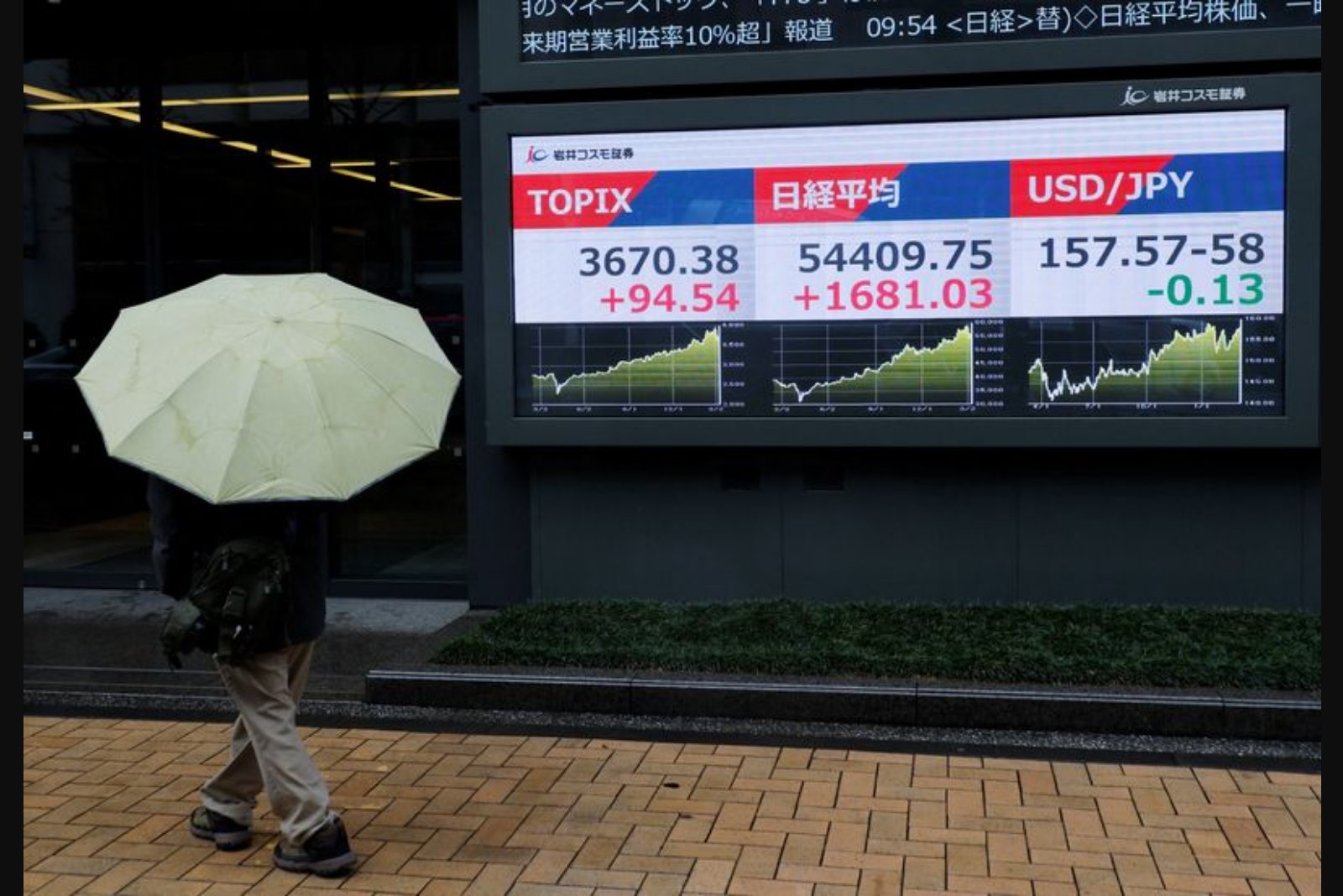
March 12 - Asian equities declined on Thursday as escalating attacks on ships in and near the Strait of Hormuz pushed oil sharply higher and injected renewed inflationary pressure into global markets.
U.S. crude futures climbed 7.5% to $93.80 a barrel, extending gains that had already exceeded 4% overnight. Brent crude futures rose 7.7% to $99.03 a barrel. Those price moves came even though the International Energy Agency planned a one-time release of 400 million barrels from strategic oil stocks, the largest coordinated release in its history, and the United States said it would release 172 million barrels beginning next week as part of that effort.
Security officials in Iraq reported that two fuel tankers in Iraqi waters were struck by explosive-laden boats identified as Iranian, and an Iraqi official told state media that oil ports "have completely stopped operations." Tony Sycamore, an analyst at IG, said: "Multiple tankers loaded with Iraqi crude are now reported burning in the Persian Gulf off the coast of Basra, engulfed in flames and leaking burning oil into the water." Sycamore described the strikes as a direct and forceful Iranian response to the IEA's overnight announcement of a massive strategic reserve release.
Earlier developments included stepped-up Iranian attacks on merchant shipping in the Strait of Hormuz and a statement warning that markets should prepare for oil at $200 a barrel. On Wednesday, reports indicated three vessels had been hit in Gulf waters while Iran's Revolutionary Guards said they had fired on ships that had disobeyed their orders.
The security episode was compounded by a political statement from U.S. President Donald Trump, who on Wednesday declared the war on Iran had been won but said he would remain engaged "to finish the job," adding another layer of uncertainty to markets.
Market response
Across Asia, MSCI's broadest index of shares outside Japan fell 0.8%, while Japan's Nikkei declined 1.6% - moves that reflected sensitivity to higher energy costs given Japan's reliance on imported oil and gas. In the United States, both S&P 500 futures and Nasdaq futures slipped 0.8%. European futures also weakened, with EUROSTOXX 50 futures down 0.6% and DAX futures off 0.8%.
Investors parsed fresh U.S. inflation data even as geopolitical developments overtook the policy narrative. The consumer price index rose 0.3% in February, matching forecasts and exceeding January's 0.2% increase, but markets treated that data as less relevant in light of the Iran-related spike in energy risk.
Bond markets reacted to a greater threat of rising inflation by sending yields higher. The 10-year U.S. Treasury yield rose 4 basis points to 4.2472% on Thursday, after climbing 6 basis points overnight. Fed funds futures extended losses as traders priced in the prospect that elevated inflation could make it harder for the Federal Reserve to loosen policy; at the margin, markets were pricing roughly one more rate cut from the Fed this year.
Heightened energy-driven inflation expectations also shifted rate expectations for the European Central Bank, with market commentary suggesting the next policy move could be a hike, possibly as early as June.
Currency and commodity impacts
Safe-haven demand boosted the U.S. dollar as investors sought liquidity, while currencies of net energy importers underperformed. The euro slipped 0.3% to $1.1536, trading at its weakest close since November of the prior year. The dollar rose 0.1% to 159.12 yen, its strongest level since January when reported Federal Reserve rate checks unsettled yen positions. The Australian dollar, more sensitive to risk appetite, fell 0.4% to $0.7127 after having reached a more than three-year high of $0.7188 on Wednesday amid speculation of an imminent rate increase from Australia's central bank.
Implications for sectors
The combination of shipping attacks and higher oil prices directly affects the energy sector through potential supply disruptions and increased freight risk, while also pressuring importers and broader inflation-sensitive sectors. Financial markets responded through higher bond yields and downward pressure on equity indices, with additional knock-on effects for currencies in energy-importing economies.
At this stage, many market moves reflect immediate risk repricing rather than settled shifts in fundamentals, and further developments in Gulf waters and official responses to the tanker strikes will determine whether the current volatility is sustained.