
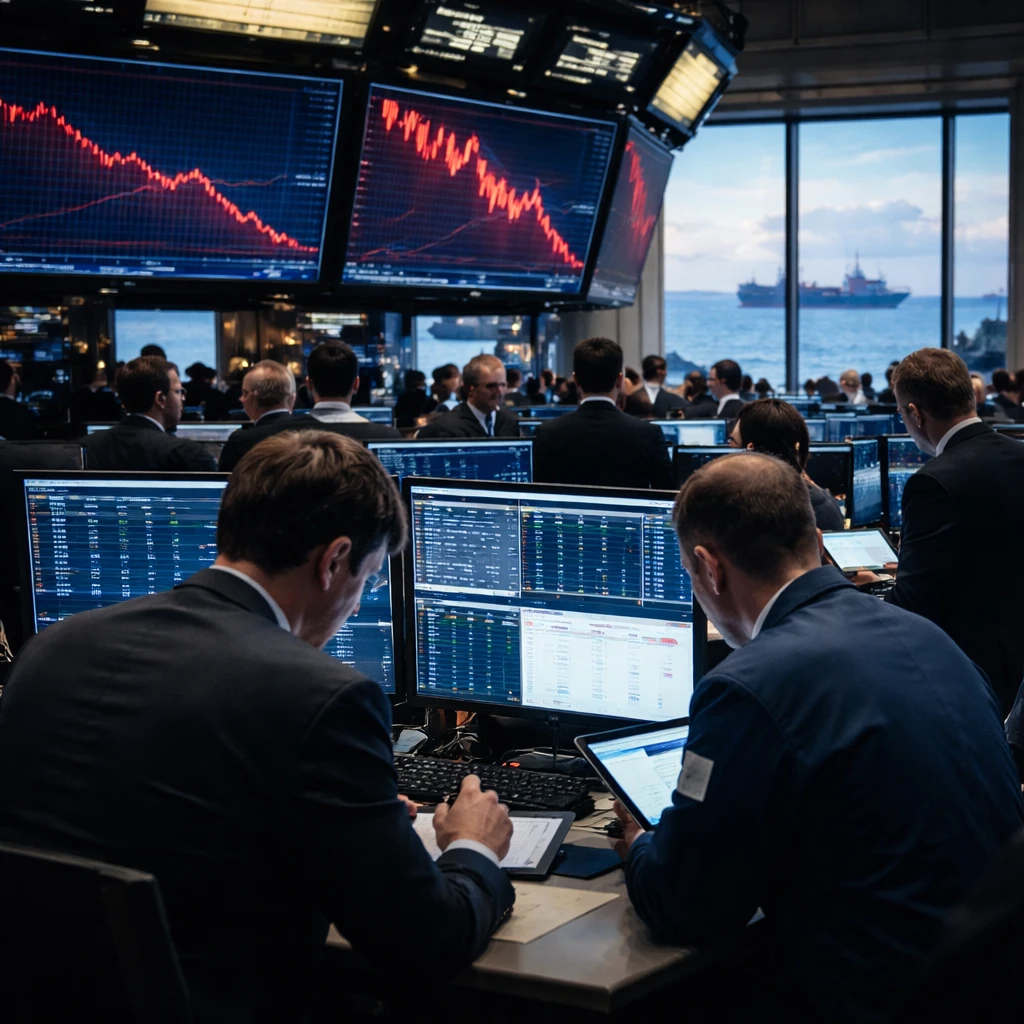
U.S. stock benchmarks slipped on Friday after producer price index (PPI) figures exceeded expectations, adding to a list of factors that have unsettled markets this month.
The Dow Jones Industrial Average fell 521.28 points, or 1.05%, to close at 48,977.92. The S&P 500 dropped 0.43% to 6,878.88, while the Nasdaq Composite declined 0.92% to 22,668.21. Both the S&P 500 and the Nasdaq finished February with losses amid rising concern about how developments in artificial intelligence could reshape particular industries and the broader economy.
Those anxieties are likely to keep U.S. equities vulnerable in the near term as investors search for clearer signals about the pace and distribution of AI-driven disruption.
At the same time, the geopolitical backdrop has deteriorated rapidly. Iran's Supreme Leader Ayatollah Ali Khamenei was killed in U.S. and Israeli strikes on Saturday, and Iran has responded by launching missiles and drones across the region. The strikes and subsequent Iranian actions have targeted Israel, Bahrain, Kuwait, Qatar, the United Arab Emirates, Jordan, Saudi Arabia, Cyprus and vessels transiting the Strait of Hormuz. The surge in tensions has pushed oil prices higher and lifted shares in energy and defense sectors.
Market focus this week is squarely on Friday's U.S. employment report. Wall Street economists are forecasting nonfarm payrolls increased by 60,000 in February, following January's stronger-than-expected rise of 130,000 jobs and a drop in the unemployment rate to 4.3%. Traders and strategists will scrutinize the report for implications about the durability of labor-market strength and any signaling value it provides for the Federal Reserve's interest-rate path.
Fed funds futures currently price the next policy rate cut for June or July. This outlook comes against the backdrop of Federal Reserve Chair Jerome Powell's term ending in May and the potential transition to nominee Kevin Warsh, should he assume the role.
Strategists at JPMorgan framed the near-term market reaction to the weekend's geopolitical events as likely to drive risk-off behavior, but counseled a longer-term perspective. In their note, JPMorgan strategists led by Mislav Matejka said: "U.S. activity remains robust, the tax bill impact is a net positive for '26, and Fed could stay dovish." They added: "U.S. inflation is weathering trade headwinds well, and is helped by reducing wages and services inflation. The question is over the labour market and the relatively elevated investor positioning, together with full valuations and the AI trade potentially having risks of commoditization."
Other market participants emphasized near-term opportunities created by recent weakness. Evercore ISI said that while the situation with Iran remains fluid, a pullback toward S&P 500 support at 6,520 is likely to hold and could present a chance to add exposure to names hit by both AI-driven selling and geopolitically induced declines.
RBC Capital Markets highlighted valuation dynamics in sectors central to recent market turbulence. The firm noted that software stocks, which have been at the center of AI-related selling pressure, have already seen sharp declines on a price-to-earnings basis. By contrast, the Capital Markets industry's valuations have improved and now sit near long-term averages on both absolute and relative P/E measures. RBC cautioned that while there is no singular valuation threshold that must be reached, important bellwether names are not, collectively, at particularly compelling valuations on their own. The firm said these sectors will be important to watch should a broader growth scare materialize, though that is not its base case.
Economic data beyond the employment report will also influence market direction. Investors will receive updates on manufacturing and services activity, and the January retail sales report is due on March 6. These releases will be parsed for signs of momentum in consumer spending and broader demand trends.
Corporate earnings continue to provide fresh inputs as the fourth-quarter reporting period winds down. Semiconductor heavyweight Broadcom is scheduled to report results on Wednesday and is the most closely watched quarterly disclosure this week. Other companies slated to announce include retailers and technology-related names such as Best Buy, MongoDB, CrowdStrike and Costco.
Market participants are particularly focused on corporate reports for evidence of how the adoption of artificial intelligence is influencing revenue growth, margins and capital spending plans across sectors. Investors will be looking for confirmation that AI-related demand is either broadening or, alternatively, becoming more narrowly concentrated in a set of winners and losers.
Promotional and analytical services continue to offer tools for investors evaluating individual stocks amid this volatility. One such service, ProPicks AI, says it evaluates Costco alongside thousands of other companies every month using more than 100 financial metrics and uses that analysis to generate stock ideas based on fundamentals, momentum and valuation. The service highlights its historical identification of notable winners, and invites subscribers to review whether Costco features in any of its strategies or if there are alternative opportunities in the same space.
As the week progresses, market direction will likely hinge on a combination of data-driven signals from the labor market and other economic releases, corporate earnings that shed light on AI-related demand trends, and the evolution of geopolitical tensions in the Middle East. Together, these elements are shaping a near-term landscape in which volatility may remain elevated and sector positioning - particularly in energy, defense, and technology - will be closely monitored by investors.