
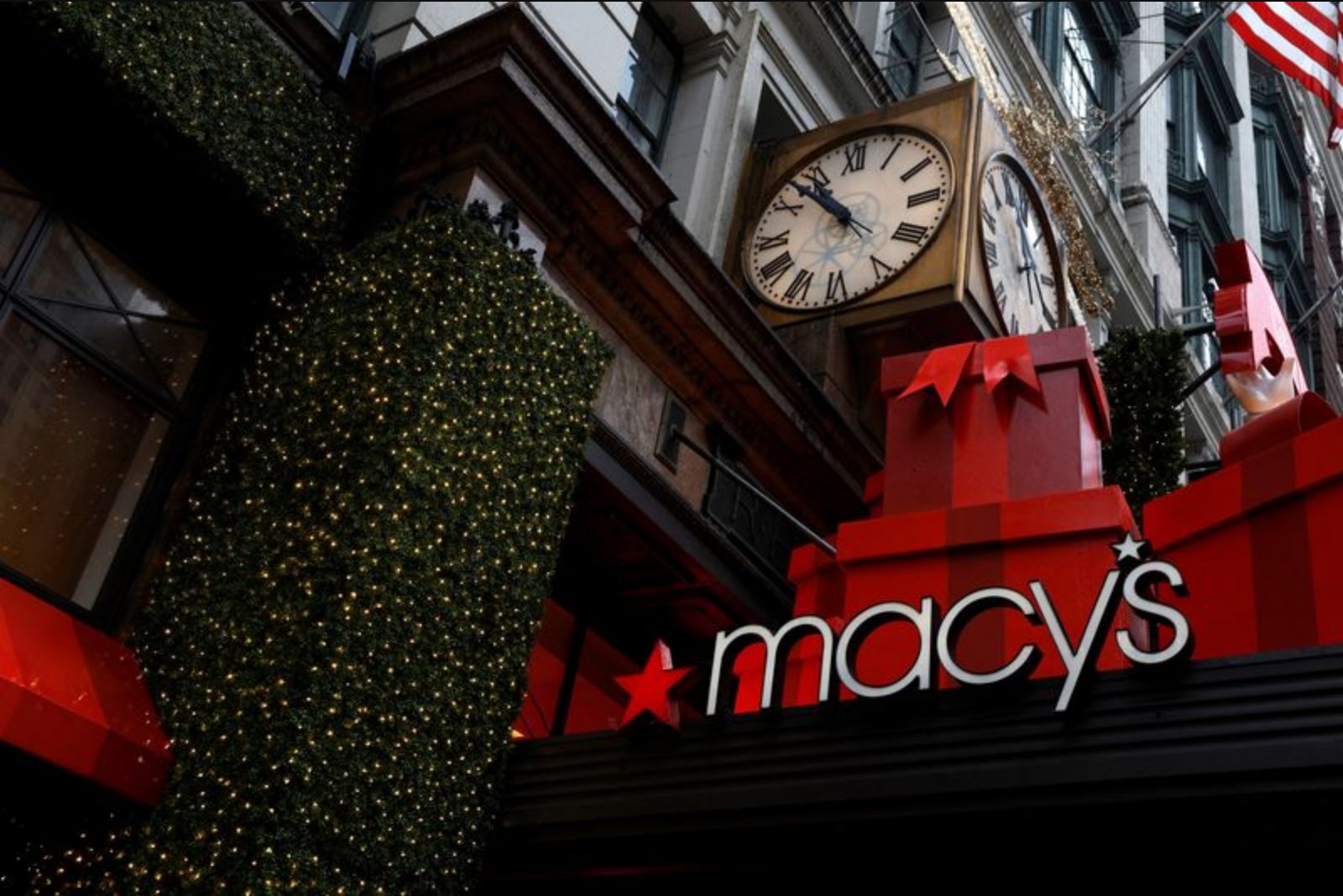
March 18 - Macy’s on Wednesday issued guidance that points to weaker revenue and profit for the coming fiscal year, attributing the outlook to constrained consumer spending and near-term tariff-related costs. The company also said it expects the effects of U.S. import duties to moderate in the second half of the year.
Executives described their approach to planning as a "prudent approach," citing macroeconomic and geopolitical risks that could influence household demand. Macy’s Chief Executive Tony Spring continues to push a strategy that targets more affluent shoppers in an effort to reignite demand, even as price-sensitive consumers face pressure from inflation and broader economic uncertainty.
For fiscal 2026, Macy’s projected net sales in a range of $21.4 billion to $21.7 billion, which compares with $21.8 billion reported in 2025. Analysts had been expecting $21.42 billion, based on data compiled by LSEG. The company also forecast annual adjusted earnings per share between $1.90 and $2.10, down from $2.15 a year earlier and below the analysts’ average estimate of $2.17.
Macy’s warned that tariff pressures could drag on margins in the first half of its fiscal year, with the largest effects concentrated in the first quarter. The firm’s reliance on manufacturing in China leaves it exposed to import duties. While Washington has moved to a uniform 10% tariff following a Supreme Court ruling that struck down broader U.S. levies, companies including Macy’s may continue to face short-term headwinds from inventories that were sourced when higher duties were in effect.
During the fourth quarter, Macy’s reported sales of $7.64 billion, a 1.7% decline from the prior year, though the figure marginally exceeded analysts’ average expectation of $7.62 billion thanks in part to holiday demand. Sales at the Macy’s brand fell 3.2% when accounting for the impact of store closures, but comparable-store sales increased by 0.4%.
Performance varied across the company’s banners. Bloomingdale’s delivered stronger results, with sales rising 8.5%, and beauty chain Bluemercury posted a 2.5% sales increase, underscoring that higher-end offerings fared better in the quarter.
The company joins other retailers - from Walmart to Kohl’s - in adopting a cautious tone for the year amid what they describe as a fragile U.S. consumer. Macy’s emphasized that its conservative outlook reflects uncertainties in consumer behavior and external risks that could affect spending patterns.
Some market commentary included promotional material noting tools that evaluate Macy’s relative to other stocks, but the company’s own forecast and reported results remain the principal drivers of investor focus for now.
Key points
- Macy’s expects 2026 net sales of $21.4 billion to $21.7 billion and adjusted EPS of $1.90 to $2.10, both lower than the prior year and below some analyst estimates - sectors impacted: retail, consumer discretionary.
- Tariff-related costs are anticipated to hit margins in the first half of the year, especially in Q1, with relief expected in H2 when uniform 10% duties take effect - sectors impacted: retail, apparel, import-dependent supply chains.
- Brand performance in Q4 was mixed: overall sales slipped 1.7% to $7.64 billion but beat consensus; Bloomingdale’s and Bluemercury showed growth while the Macy’s brand declined.
Risks and uncertainties
- Tight consumer spending could continue to depress sales and profitability - affecting retail and consumer discretionary equities.
- Tariff pressures from inventories purchased under higher duty rates may compress margins in the near term - impacting import-heavy retailers and supply-chain reliant sectors.
- Macroeconomic and geopolitical risks cited by management could alter consumer behavior or supply dynamics, introducing further volatility to sales and margins - relevant to broader retail and apparel markets.