
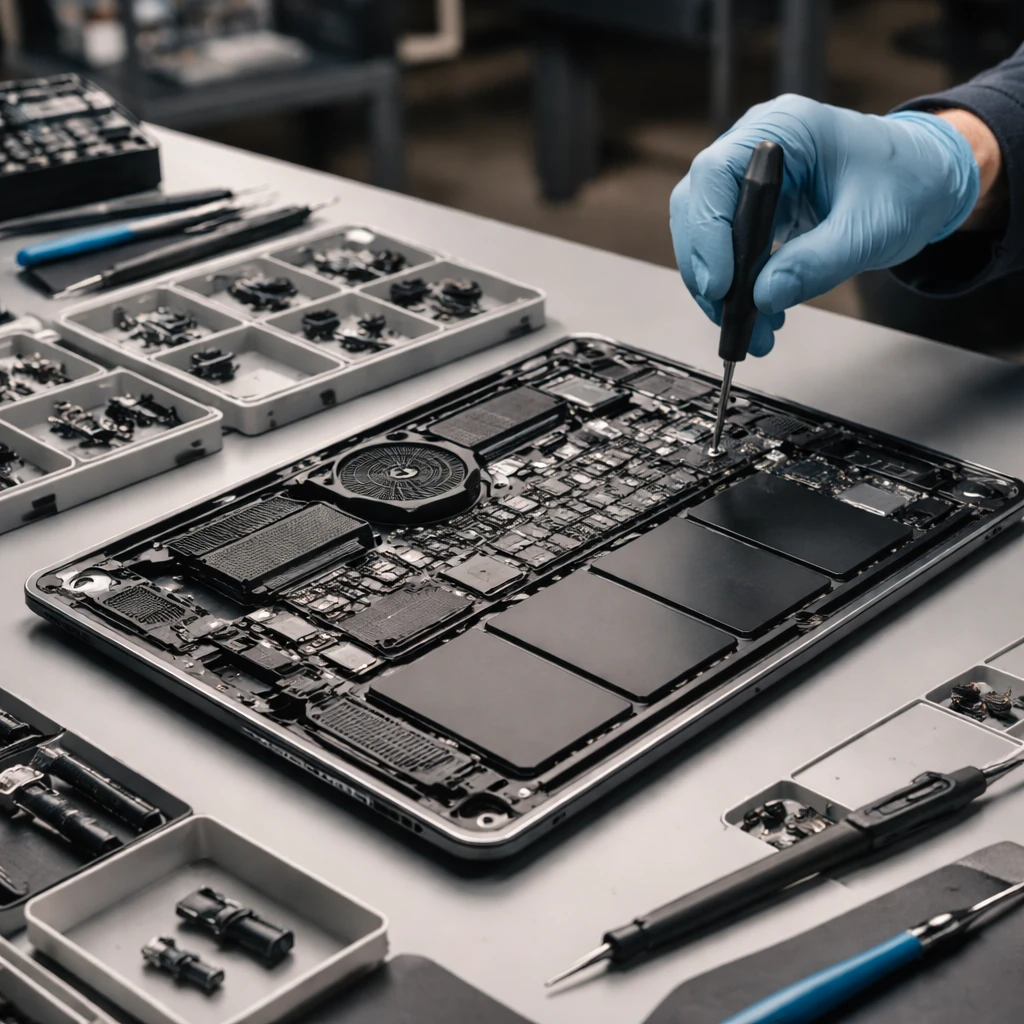
Apple’s MacBook Neo, the entry-level laptop the company unveiled last week with a student price starting at $499, represents the firm’s most repair-friendly notebook offering since 2014, according to an analysis released by repair specialist iFixit on Friday.
iFixit, which publishes step-by-step repair guides and sells parts and tools for consumer electronics, also produces repairability ratings used by some manufacturers to refine product serviceability. In its teardown of the MacBook Neo, the group identified a number of substantive changes from recent Apple laptop designs that improve access for technicians and end users.
Among the changes noted, iFixit highlighted that Apple fastened the MacBook Neo’s batteries and keyboard with screws rather than relying on adhesive or rivets. The teardown also found that components such as the device’s camera and its fingerprint sensor are designed to be swapped out more easily than in many prior Mac models.
Those shifts in construction align with the market Apple appears to be addressing with the MacBook Neo - education customers who have traditionally been served by low-cost Chromebooks. Kyle Wiens, chief executive at iFixit, told the teardown audience that Chromebooks are often repaired in school districts, with some districts, including those in Oakland, California, engaging student interns to perform fixes.
Despite the hardware changes, iFixit assigned the MacBook Neo a repairability score of 6 out of 10 on its scale. For context, the teardown noted other laptops such as a recent Lenovo ThinkPad have earned scores of 9 or 10 under the same evaluation criteria.
iFixit also pointed to design decisions that Apple has retained from its recent Mac lineup. The report notes that the MacBook Neo ships with 8 gigabytes of DRAM soldered directly to the system board - a construction choice that mirrors the company’s other contemporary Mac designs and that makes installing additional memory modules impractical or impossible.
Wiens said that the soldered memory could create an obstacle if the MacBook Neo is expected to run increasingly complex artificial intelligence applications on-device in the years ahead. Apple has publicly discussed the privacy advantages of running such workloads locally on a laptop rather than in the cloud, but the iFixit analysis suggested the fixed memory capacity may limit those ambitions. Wiens recommended that Apple consider providing an additional, user-upgradeable layer of memory chips as a path to greater future-proofing.
"Apple’s future for privacy-centered AI has to be local models," Wiens said in the teardown. "I would argue this is a flaw across Apple’s entire Mac product line."
Apple did not immediately respond to a request for comment on the iFixit findings.
Separately, the MacBook Neo’s announcement has drawn retail and investor-focused interest. An evaluation tool referenced in promotional material examines AAPL alongside other companies using a wide range of financial metrics and uses automated analysis to highlight stocks with promising risk-reward profiles. That material states the tool applies no editorial bias and reports examples of notable past winners in its strategies; it also invites readers to explore whether AAPL appears in current strategy sets.
The iFixit teardown frames the MacBook Neo as a more serviceable Apple laptop than recent models while underscoring limits that remain due to soldered memory and a mid-range repairability rating. For education buyers and repair shops, the move toward screws and replaceable modules should simplify routine maintenance, even as upgrade paths for performance-focused workloads remain constrained.