
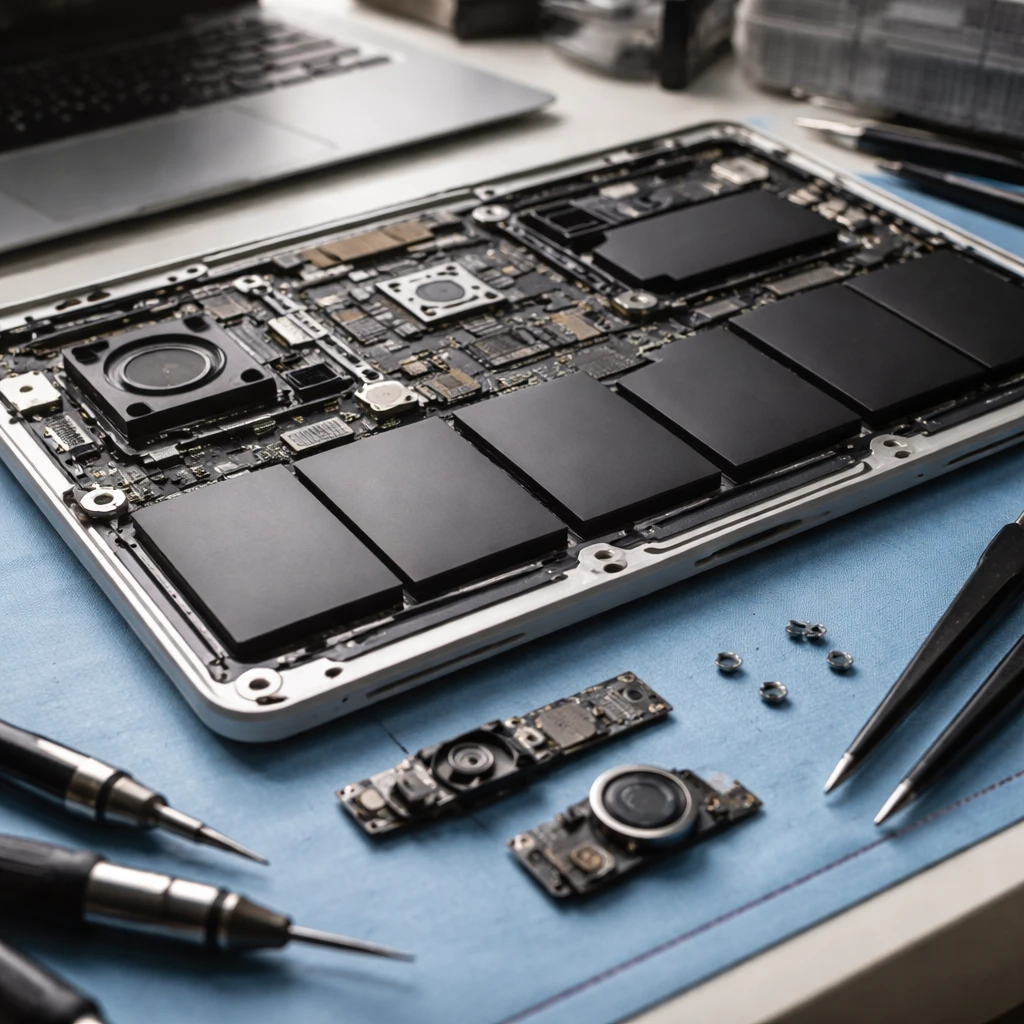
Apple’s MacBook Neo, the low-cost laptop introduced last week with a student starting price of $499, represents the company’s most repair-friendly design in more than a decade, according to a detailed teardown and analysis published Friday by iFixit. The repair-focused group said the MacBook Neo includes several structural changes that make servicing and part replacement easier than on many recent Apple laptops.
In its teardown, iFixit highlighted that Apple moved away from the extensive use of adhesives and rivets in several areas. The battery and keyboard are now secured with screws rather than being glued in place, and components such as the unit’s camera and fingerprint sensor can be swapped without extensive disassembly. Those changes contrast with design choices Apple has favored during the past decade as it pursued thinner and lighter consumer devices.
Still, iFixit’s assessment was not uniformly positive. The organization assigned the MacBook Neo a repairability score of 6 out of 10. That places the new model below certain recent laptops from other manufacturers - iFixit cited recent ThinkPad models from Lenovo that have earned 9s and 10s - and indicates room for further improvement in ease of service and upgradeability.
Kyle Wiens, iFixit’s chief executive, noted a specific limitation that persists across Apple’s recent Mac designs and affects the MacBook Neo: its 8 gigabytes of DRAM are soldered directly to the device’s circuit board as part of a package with the machine’s primary processing chip. Because the memory is integrated in this way, users cannot easily upgrade or add more DRAM to the device.
Wiens warned that the fixed memory configuration could complicate the MacBook Neo’s ability to run increasingly complex artificial intelligence applications over time, even as Apple has emphasized privacy advantages from processing AI tasks locally on a laptop rather than in remote servers. He suggested a possible engineering improvement - adding a separate layer of memory chips that would permit user upgrades - but noted that the current design is consistent with Apple’s broader Mac lineup.
iFixit also pointed to the role of low-cost laptops in education. The group said Chromebooks are frequently repaired in schools, and some districts make use of student interns to perform work on those devices. Apple appears to be targeting similar education markets with the MacBook Neo, but the 6/10 repair score indicates the Neo is not yet on par with the most serviceable designs available.
The teardown noted that other laptop makers, including Dell Technologies and Lenovo Group, have used iFixit’s repairability ratings as input when improving their hardware. Apple did not immediately respond to a request for comment on iFixit’s findings.
Context and implications
The MacBook Neo shows an observable shift toward more repair-friendly assembly practices in specific areas, reducing barriers to common repairs. However, the continued use of soldered memory constrains user-driven upgrades and could limit usable lifespan and capability for resource-intensive local workloads. The mixed result underscores a trade-off between compact device integration and modular serviceability that remains unresolved in Apple’s Mac lineup.