
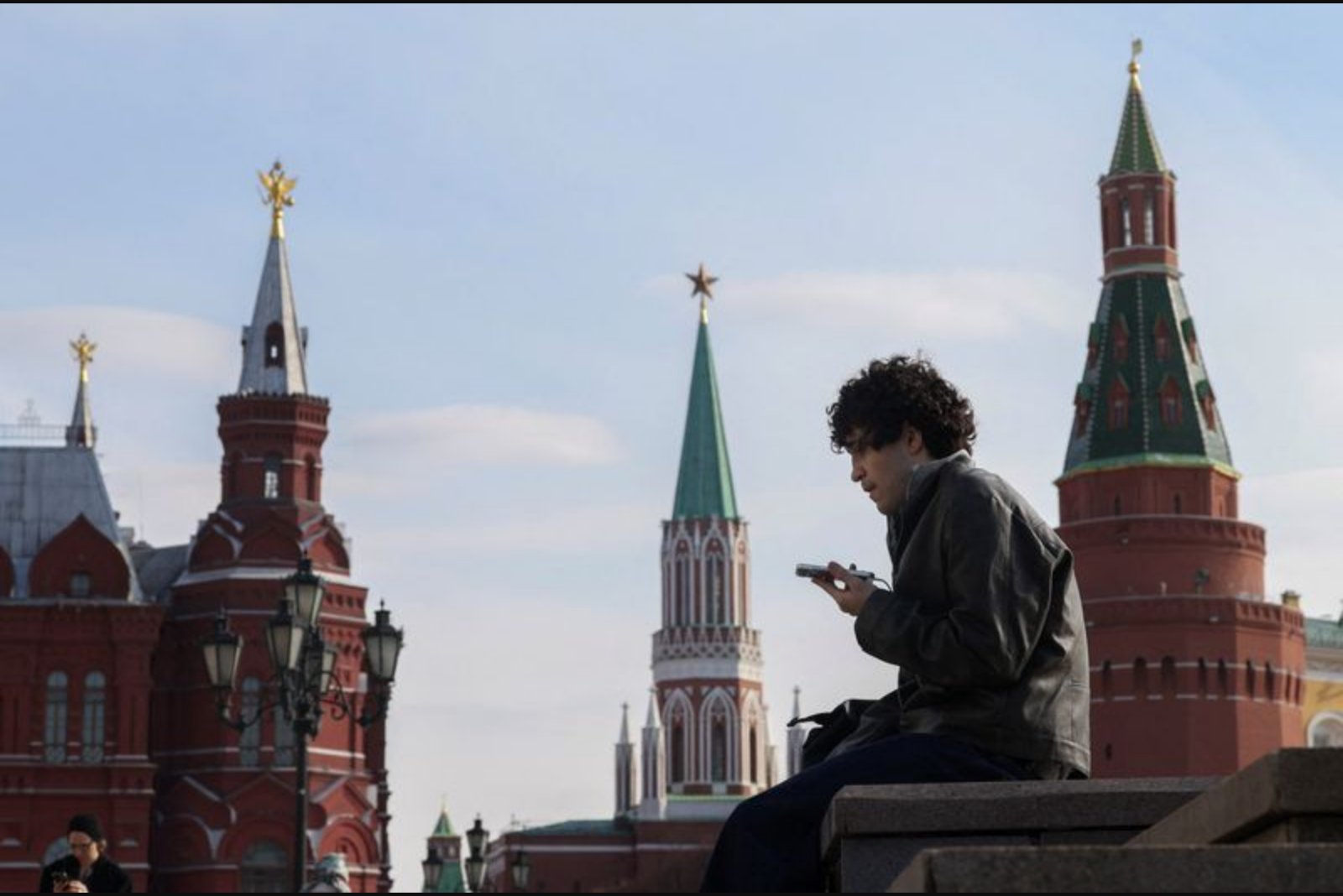
Office workers finding corporate networks inaccessible, teenagers repeatedly cycling through new VPN services, and drivers in Moscow losing access to mobile navigation are among the daily disruptions now characterising life in parts of Russia’s largest cities. Over the past week, mobile internet has been completely down every day in sections of central Moscow, St Petersburg and other major urban areas, according to reporters in those locations and eight senior foreign diplomats based in Russia.
These interruptions form part of a broader tightening of online controls by the Kremlin. Authorities have periodically jammed mobile internet in a number of regions, restricted widely used messaging platforms such as Telegram and WhatsApp, and removed dozens of virtual private network services that have been used to evade bans on websites and apps.
When asked about recent limits on messaging applications and internet service, Kremlin spokesman Dmitry Peskov confirmed that measures are being taken and said they are partly aimed at enforcing compliance with Russian legislation by foreign companies and partly intended as security precautions against the threat posed by Ukrainian drones. He noted that attack drones can use cellular networks to aid navigation.
New legal steps this year have reinforced state powers over mobile operators and online communications. Legislation obliges mobile carriers to disconnect any client at the demand of the Federal Security Service (FSB), while granting the agency authority to establish a network of pre-trial detention centres under its own jurisdiction. Diplomats who spoke on condition of anonymity to discuss sensitive matters said these expanded digital powers are intended to strengthen domestic control amid the ongoing war in Ukraine.
Those diplomats suggested the Kremlin is preparing for several scenarios tied to the war. If the conflict continues, it could increasingly strain popular support, they said. If the war ends, officials may be seeking to pre-empt dissent that could follow. One diplomat said the authorities have assembled a set of powers that would enable a "great crackdown" online.
Russian investigative journalist Andrei Soldatov, an expert on the security services, pointed to historical precedent as informing current strategy. He argued that leaders and security officials remember the aftermath of Moscow’s withdrawal from Afghanistan in 1989 and the collapse of the Soviet Union in 1991 - episodes that led to social upheaval and the fragmentation of security agencies. Soldatov said the security services are aiming to avoid a repeat scenario by creating controls that would prevent either a negotiated end to the war or a protracted conflict from precipitating a breakdown.
Two sources within Russia with knowledge of the online measures said Moscow has studied the approaches taken by other countries, particularly China and Iran, and directed authorities to develop tools to block extensive portions of both mobile and fixed-line internet while maintaining control over communications platforms.
Since the 2022 invasion of Ukraine, Russia has enacted some of the most repressive laws seen in the country since Soviet times, expanding censorship capabilities and the influence of the FSB, which is the main successor body to the KGB. This year, Moscow has further tightened security measures. President Vladimir Putin, a former KGB officer, attended the FSB’s annual meeting on the fourth anniversary of the Ukraine conflict and instructed the agency to intensify counter-terrorism efforts - including threats identified as coming from Ukraine - while strengthening the "information and digital space." Peskov reiterated that all steps are being taken lawfully to ensure security amid the Ukraine conflict, which Putin frames as a confrontation with the West.
Two Russian officials close to the Kremlin disputed characterisations of the internet measures as repressive. They described the actions as necessary steps to bolster security and preserve national unity against what they view as Western attempts to sow discord.
Russia’s communications regulator, Roskomnadzor, has not provided public comment on recent enforcement moves.
Diplomats and reporters said that in scale and intensity the internet restrictions this year have been greater than previously observed. Mobile internet has been periodically shut down in several regions for months, frequently following major Ukrainian drone strikes. By mid-January, Russia had blocked more than 400 VPNs - a figure that Kommersant newspaper reported as 70% higher than in late last year. In recent weeks the clampdown has intensified in Moscow, and the authorities have moved against Dubai-based Telegram and U.S.-based WhatsApp.
Last month, authorities slowed Telegram, an app with over 1 billion active users that is widely used in Russia and Ukraine, and launched an investigation into its founder, Pavel Durov, as part of a criminal case involving accusations tied to terrorism. Russian officials alleged Telegram had been infiltrated by Ukrainian and NATO intelligence services and claimed some Russian soldiers had died as a result; Telegram denied it had been penetrated. Durov said authorities are attempting to force Russians to use MAX, a state-backed messenger app that schools and universities have been told to adopt for parent and student communications. "Each day, the authorities fabricate new pretexts to restrict Russians’ access to Telegram as they seek to suppress the right to privacy and free speech," Durov said, describing the restrictions as a sign of a state fearful of its own people.
The Kremlin also moved to block WhatsApp last month, citing the app’s failure to comply with local law. The app’s owner, Meta, criticised the decision as a step back for user security in Russia.
For many Russians, the practical effect of restrictions has not been limited to political speech. Young people have said they switch between VPN services as providers are blocked, often simply to access restricted Western social platforms such as Instagram and Snapchat. One young Moscow resident, who asked to be identified only as Andrei because of the sensitivity of the topic, questioned why officials have not produced compelling domestic alternatives: "If these quite old politicians want to block everything, why have they not made any Russian apps that are interesting?"
Summary of Observations
The recent wave of internet restrictions in Russia blends legal, technical and enforcement measures: daily mobile blackouts in key cities; targeted slowdowns and investigations of major messaging apps; mass takedowns of VPN services; and new laws granting the security services greater powers over communications and detention facilities. Officials frame these steps as lawful security measures and enforcement of national legislation, while diplomats and some analysts see them as instruments to consolidate domestic control during and after the war in Ukraine.