
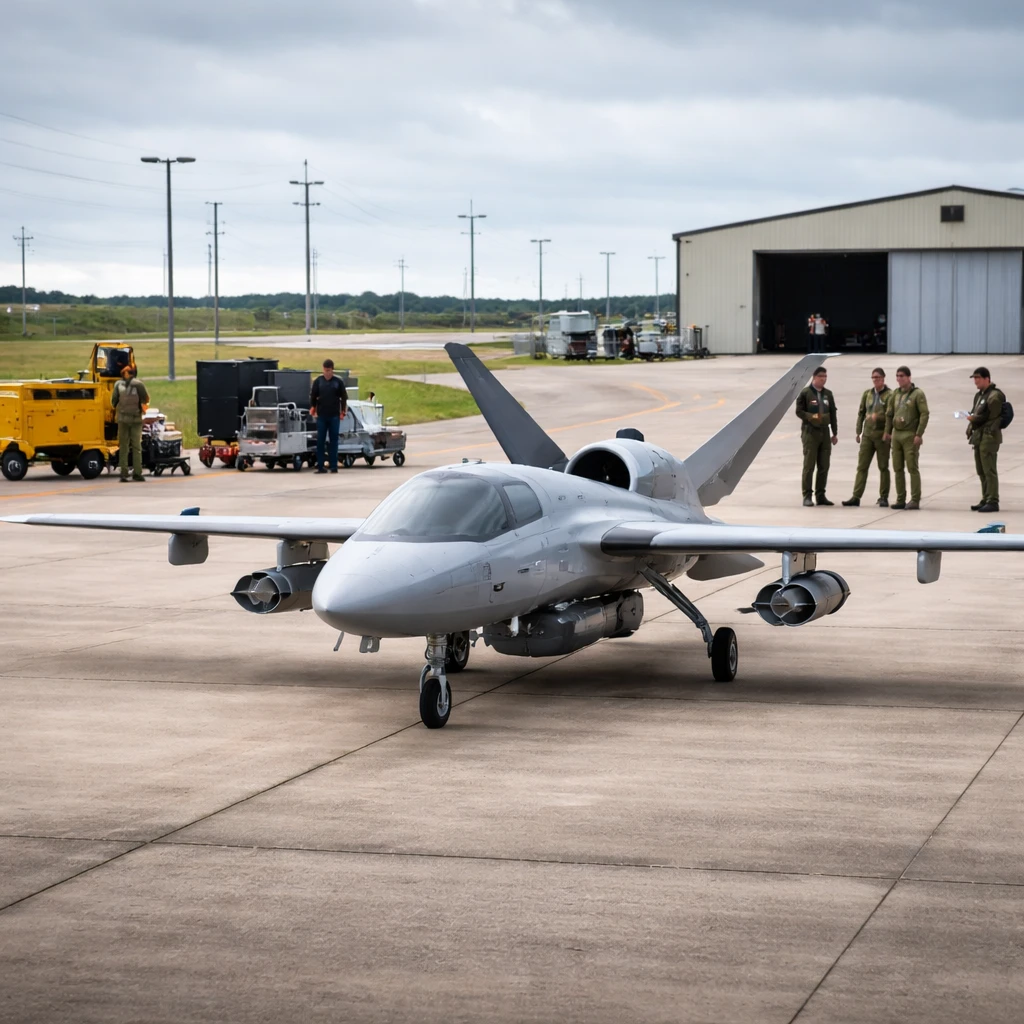
U.S.-based Kratos Defense and Taiwan’s military engineers ran a recent test program at Kratos’ Oklahoma City facility that confirmed a Taiwanese mission payload can be integrated successfully into the jet-powered Mighty Hornet IV attack drone.
The company described the tests as a "milestone" that could open the door to deeper collaboration with Taiwan’s main defence research organization, the National Chung-Shan Institute of Science and Technology (NCSIST). NCSIST characterized the outcome as a "new milestone in U.S.-Taiwan defence technology collaboration," and said such joint work can shorten development timelines and help meet Taiwan’s needs for "rapid countermeasures and long-range preemptive strikes."
Kratos outlined the Mighty Hornet IV as a low-cost, cruise missile-like weapon that the partners intend to base in significant numbers on the island. The plan is to field the systems both as a deterrent and as assets for wartime use, with an emphasis on fielding "large numbers" of the drone to provide cost-effective strike capacity.
The development comes as Taiwan pursues expanded security ties with the United States, including cooperative development and manufacturing of weapons. That push is occurring against a backdrop of intensified Chinese military activity around Taiwan. Taipei has reported near-daily incursions by Chinese warplanes and warships into nearby airspace and waters, actions Taipei describes as "grey zone" tactics. China also held large-scale military exercises near Taiwan in late December.
Taiwan’s defence minister reported this week that the number of detected Chinese military aircraft, including fighters and drones, operating near Taiwan rose 23% in 2025 compared with the prior year. That increase underpins Taipei’s stated need for cheaper, more numerous unmanned systems to complicate any potential attack and to provide options for both deterrence and rapid response.
The test campaign in Oklahoma validated the technical integration of the Taiwanese payload on Kratos’ platform and signals a possible acceleration of cooperation between the company and NCSIST. Both organisations highlighted the potential to compress development schedules through collaboration, reflecting Taiwan’s requirement for quickly deployable countermeasures and extended-range strike options.
While details about production plans, basing numbers, or timelines for full deployment were not provided in the testing announcements, the stated intent is to place a "large quantity" of Mighty Hornet IV systems in Taiwan as part of broader efforts to expand unmanned capabilities.
Contextual note: The announcement frames the tests as a technical validation and a cooperative milestone; it does not include specific procurement commitments, production-rate projections, or delivery schedules.