
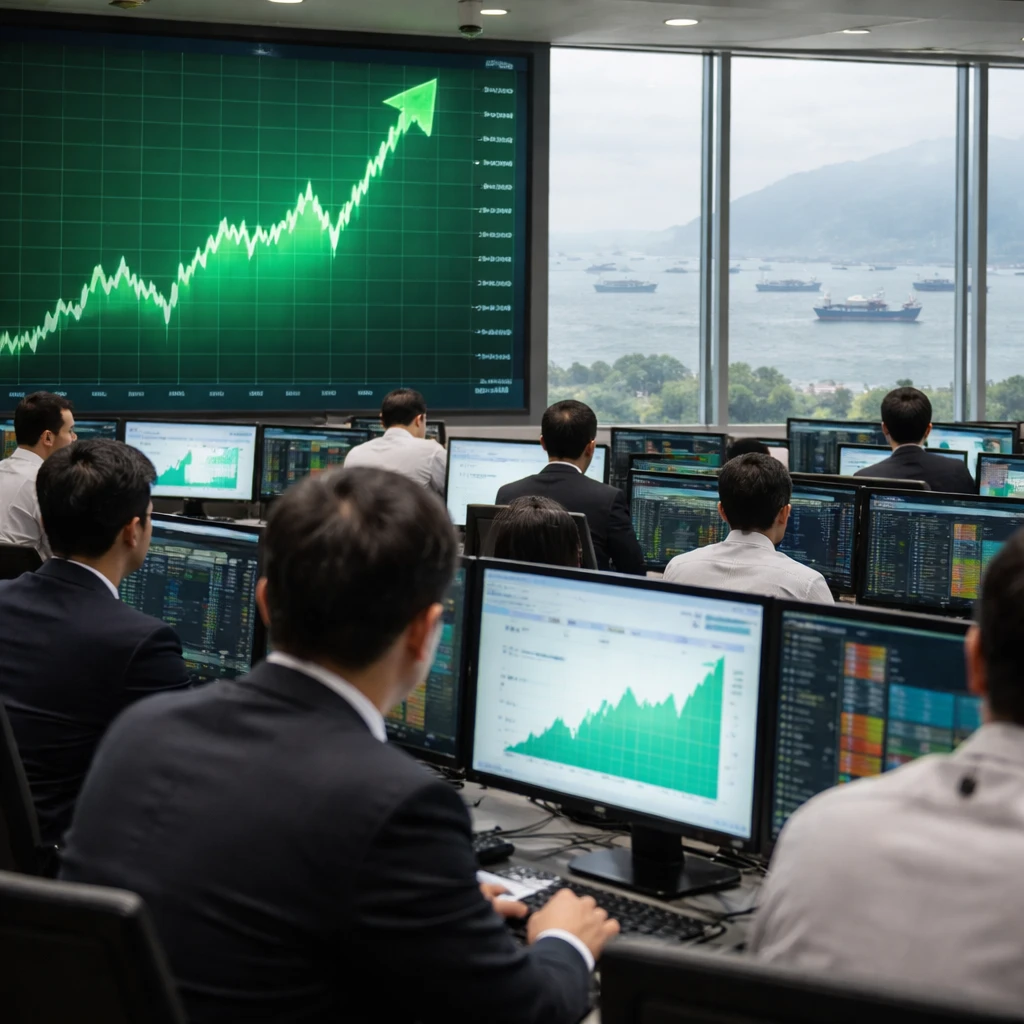
South Korea's benchmark Kospi rallied 9.6% on Thursday, reversing part of a dramatic sell-off that had sent the index down 12% in the prior session - the largest one-day drop on record. Investors spent Thursday reassessing market exposure to disruptions stemming from ongoing U.S.-Israeli air strikes on Iran.
Market participants and analysts have focused on the potential for chokepoints in energy flows through the Strait of Hormuz - the waterway south of Iran that channels a large share of the world's oil and liquefied natural gas (LNG) shipments. Reports indicated a build-up of tankers and concerns that attacks on vessels attempting to cross the strait could interrupt roughly one-fifth of the oil and LNG consumed globally each day. Much of that cargo is destined for import-heavy Asian economies, including South Korea and Japan.
The surge on Thursday followed energy-driven volatility that pushed equities sharply lower on Wednesday. The preceding sell-off was attributed to fears that the joint U.S. and Israeli strikes could curtail vital fuel deliveries through the narrow strait, prompting broad risk-off moves across Asian markets and deep losses for South Korean stocks.
Energy markets reacted to the escalation as well, with oil prices moving higher after the start of the attacks late last week. Prices showed some relief, however, after President Donald Trump said the United States could insure and escort ships through the Strait of Hormuz, a comment that helped temper immediate market anxiety.
On the stock level, semiconductor maker SK Hynix climbed by more than 10% as chip names benefited from the rebound. Observers note that South Korea's large semiconductor companies depend on steady LNG supplies to power manufacturing facilities, linking energy security directly to production continuity. Other heavyweight South Korean companies such as Samsung Electronics and Hyundai Motor also participated in the rally.
Domestic authorities moved to assess the market situation. Media reports said Korea's financial regulators convened an emergency meeting this week to review conditions. Among the measures discussed was the possible reactivation of a stock market stabilization fund similar to a pool established during the COVID-19 pandemic - a fund that, according to analysts at Morgan Stanley, had not been deployed previously.
Morgan Stanley strategists, in a late Wednesday note, judged inflationary and growth pressures stemming from Middle East supply disruptions to be "manageable." The team maintained a cautious near-term stance on Korean equities but indicated that the index's downside appeared limited.
The strategists recommended a defensive tilt for the immediate period - highlighting financials and high yield stocks - while suggesting that certain areas could be attractive after the correction, specifically memory, defense, and assets tied to powering artificial intelligence.
Is 005380 a bargain right now? The fastest way to find out is with our Fair Value calculator. We use a mix of 17 proven industry valuation models for maximum accuracy. Get the bottom line for 005380 plus thousands of other stocks and find your next hidden gem with massive upside. See Undervalued Stocks