
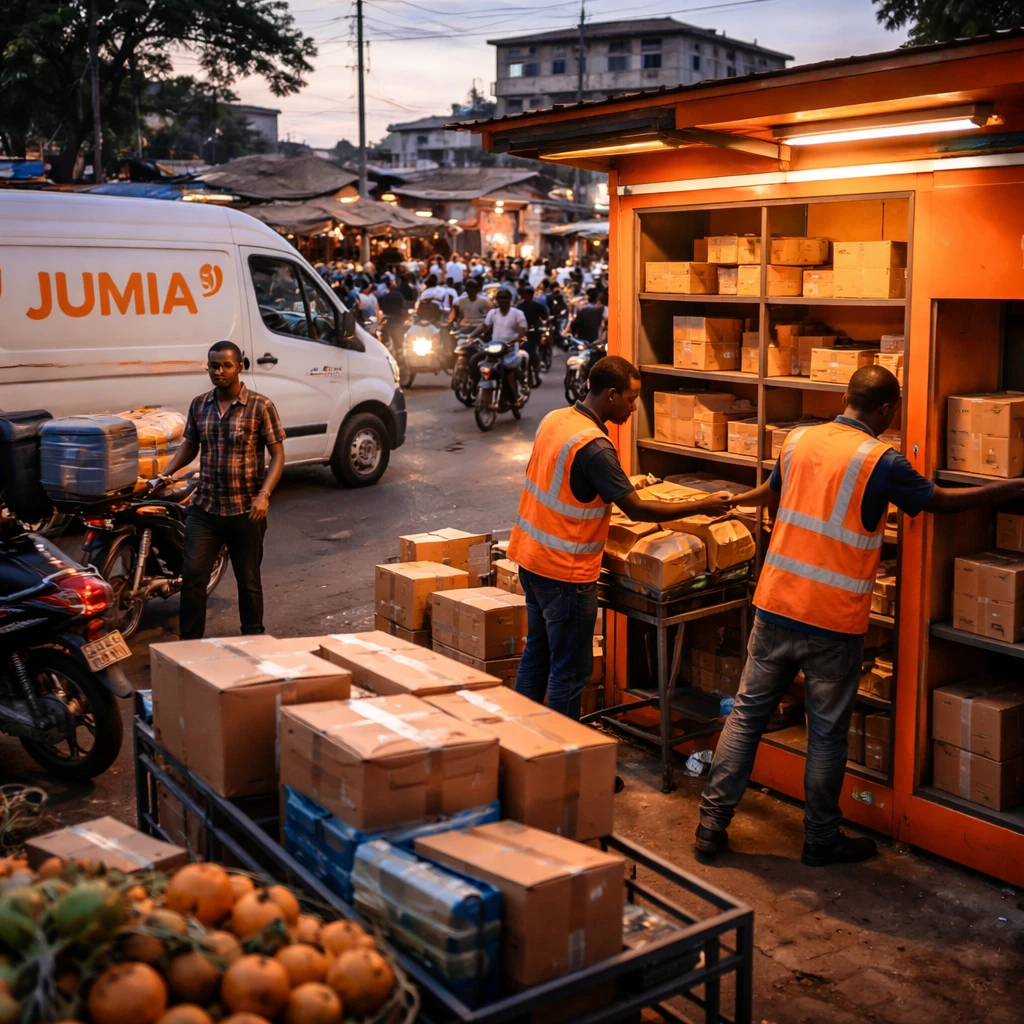
Jumia Technologies AG delivered a fourth-quarter 2025 earnings report that management says represents a pivotal change in the company's financial and operational arc. The marketplace posted a 36% year-over-year increase in Gross Merchandise Value (GMV) and reported a marked reduction in Adjusted EBITDA losses, signaling what executives described as a movement away from a turnaround stance and toward scaling operations across core African markets.
Chief executive Francis Dufay framed the results as evidence that improved execution, rather than a one-time macro boost, is powering the recovery. While macro stabilization in some regions has helped restore consumer confidence, Dufay told an interviewer that internal changes and market-share gains are the primary drivers: "Demand has always been there in those markets. What’s changing has been our execution."
Financial and market highlights
- GMV rose 36% year-over-year in Q4 2025.
- Adjusted EBITDA losses were reduced by nearly half compared with prior periods.
- Nigeria delivered a 50% GMV increase, identified as one of Jumia's strongest market performances.
- Ghana saw a breakout in physical goods GMV, up 124% year-over-year.
- Egypt, which had previously been weakened by falling corporate sales and currency devaluation, stabilized and was cited by management as a "confirmation" of recovery.
Despite these operating improvements, the stock reacted negatively in the market. Shares slumped 17.4% on Tuesday, after reported earnings per share and revenue missed analyst expectations and the company altered the metric it will use to guide investors.
Historically, Jumia has targeted breakeven by Q4 2026 and full profitability by 2027 using a guidance framework based on loss before income tax. On Tuesday, the company shifted that public guidance to Adjusted EBITDA. Management characterized the change as a means to better highlight Jumia’s underlying economics and operational leverage, noting that Adjusted EBITDA excludes items such as share-based compensation, depreciation, and amortization.
The difference between the two metrics was visible in Q4 2025 results: Adjusted EBITDA showed a loss of $7.3 million versus a $9.7 million loss before income tax, a gap of $2.4 million. Dufay explained the rationale for the switch, arguing the new measure strips away volatile items - including finance costs tied to previously prioritized corporate sales - and therefore presents a clearer picture of operational improvement. He said, "This business has changed. Over the past two years, we had significant amounts that came from corporate sales mostly in Egypt. That generated a significant amount of finance costs for cash penetration below the EBITDA, so included in the net loss. This business has been completely deprioritized and is now accounting for negligible volumes. It makes a lot more sense given our push for operational leverage to focus on the EBITDA that doesn’t include some volatile items like finance costs or share-based compensation, and gives a much better representation of our operational improvement."
Portfolio focus and market exits
As part of a broader push to concentrate resources, Jumia is planning an exit from Algeria. The move follows departures from Tunisia and South Africa last year and reflects management’s stated desire to refocus on higher-potential markets such as Nigeria, Ghana, and Egypt. Dufay described Algeria’s consumer and supply environment as structurally challenging and cited difficulties securing supply at competitive prices and competing with local informal offline channels as reasons for the withdrawal: "It’s both. It’s been very hard for us to have access to the right supply, at the right price, and fight against the local, informal, offline market, and that’s very structural to the Algerian market. As part of this move, it enables us to streamline the organization, refocus on the eight core markets, and give those markets a bit more attention and a bit more focus."
When asked whether the current footprint represents the company's "final form" prior to profitability, Dufay answered in the affirmative while emphasizing ongoing rigor: "We believe so, yes… But we remain ruthless in the way we reevaluate and assess our footprint." He added that Jumia does not plan to enter or re-enter markets until it records a full year of profitability.
Operational playbook and market execution
Management highlighted execution playbooks used to accelerate growth in priority markets. Northern Nigeria was singled out as a target for expansion that began in the second half of 2025. Dufay described tactical steps the company took there: opening dozens of new pickup stations, increasing delivery frequency, and deploying a focused advertising push. "That’s kind of our standard playbook… We know that it works and it’s starting to show results," he said.
Jumia intends to apply similar tactics in Ghana and Egypt. The strategy includes the deployment of Buy Now, Pay Later (BNPL) services, which have supported growth in Egypt even as the corporate segment declined. On Monday, Jumia announced an expanded financing arrangement in Egypt with fintech partner Mogo to introduce a "triple zero" installment plan featuring no down payment, no interest, and no administrative fees.
Lean structure and AI-driven efficiencies
Under the current leadership, Jumia has pursued a leaner cost base through a combination of market exits, headcount reductions, and cuts to marketing and general and administrative expenses. Artificial intelligence has been positioned as a central tool to drive productivity and lower costs across functions.
According to a source familiar with the matter, by May 2025 the company had rolled out 150 AI tools and 100 custom assistants across 12 departments. Those implementations were reported to have produced a 25% increase in development efficiency and a 30% improvement in customer service resolution times. Management argued that AI complements Jumia’s asset-backed model rather than threatens it, saying it improves productivity across tech and G&A functions.
Revenue mix and regional dynamics
Upcountry orders - shipments to rural and secondary cities - expanded to 61% of total volume from 56% a year earlier, a shift management highlighted as a sign of growing customer stickiness. Dufay dismissed concerns that this trend would erode margins, noting that many deliveries to these regions are handled via pickup stations with fixed-cost structures that scale without proportionally increasing variable delivery costs.
First-party sales also strengthened, rising 33% year-over-year and accounting for 49% of total revenue. These direct sales are increasingly supported by international partnerships. Jumia distributes Starlink in Nigeria and Kenya and said it hopes to broaden that relationship into other overlapping markets in 2026 as Starlink obtains necessary licences. Management did not quantify Starlink’s revenue contribution but confirmed the company sees potential to expand distribution as regulatory approvals are secured.
Market reaction and path to profitability
The combination of a revenue shortfall, EPS miss, and the shift in guidance metric created near-term market friction, evidenced by the share-price decline on Tuesday. Nonetheless, management argued the quarter shows a stable company moving beyond turnaround dynamics and toward scalable growth. Dufay concluded by reiterating the timeline to profitability and the rationale behind it: "It’s clear, it’s in the numbers, and it’s obvious it’s going to happen in a reasonable time frame. And I believe it will happen in Q4 2026. The growth rate we’re delivering today is nothing exceptional, there’s largely enough room in our markets to sustain it. And with that growth rate, we’re managing to get amazing operating leverage across the PnL. That takes us to breakeven."
In sum, Jumia’s Q4 results combine faster top-line activity in several markets, a narrowing of Adjusted EBITDA losses, and a concerted push to concentrate capital and managerial attention on a smaller set of priority countries. Those elements underpin management’s argument that the business is moving from recovery into a phase where sustained growth and operating leverage can drive a return to profitability within the stated timeline.