
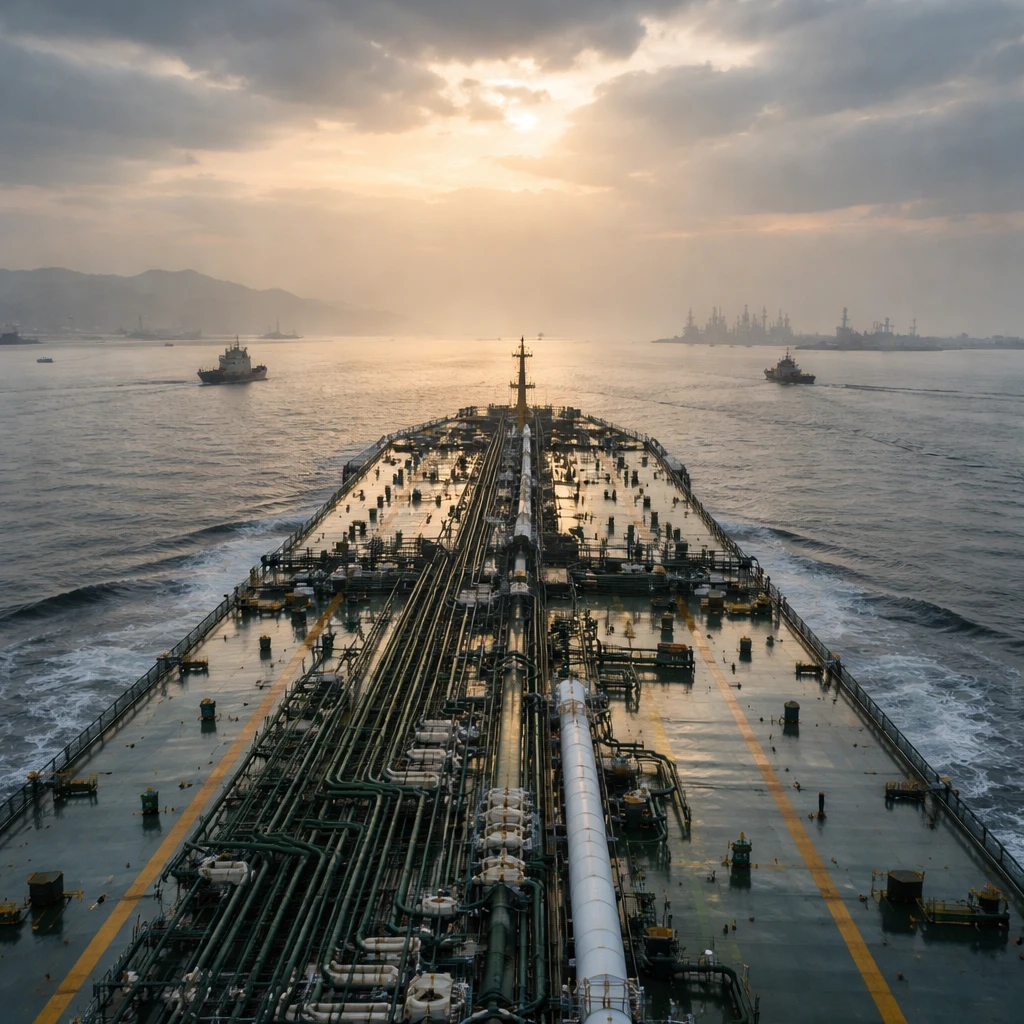
J.P. Morgan revised its recommendations on a group of European oil and gas producers on Thursday following Iran's announcement that the Strait of Hormuz was closed. The brokerage said the closure threatens roughly 30% of seaborne crude supplies and about 20% of global liquefied natural gas (LNG) flows, prompting the bank to lift its 2026 Brent oil price assumption by $10 to $72 per barrel.
The research house increased its rating on EnQuest to "overweight" from "neutral" and moved Aker BP to "neutral" from "underweight." It retained an "overweight" stance on Var Energi and kept Harbour Energy at "neutral." Price targets for the four companies were raised by an average of 21% across the set, according to the note.
J.P. Morgan highlighted the strategic significance of the Strait of Hormuz, calling it a chokepoint that handles roughly 17% of global LNG flows and warning that the closure could put as much as 23% of global LNG supply at risk. The bank's commodities team modelled potential supply losses of 3.3 million barrels per day by day eight of a closure and 4.7 million barrels per day by day 18.
The note said that approximately 1.5 million barrels per day of Iraqi production had already been taken offline as of March 3. In a scenario of a complete Gulf production shutdown, J.P. Morgan estimated Brent could surge to between $100 and $120 per barrel, compared with about $81 at the time the note was written.
On European gas, the brokerage set TTF assumptions at $13 per million British thermal units (mmbtu) for 2026 and $9.50/mmbtu for 2027. It also pointed to European gas storage levels sitting near decade lows, at about 18% full in Northwest Europe.
"The conflict materially shifts the near-term risk distribution for oil and gas prices, increasing the likelihood that a geopolitical risk premium persists even if physical disruptions prove temporary," J.P. Morgan said.
The bank's historical analysis in the same research note showed that oil prices have tended to rise by roughly 30% on average in the three months following episodes of major producer unrest, with supply losses averaging about 23% over a six-month horizon.
EnQuest was the biggest beneficiary in percentage terms in J.P. Morgan's revisions. Its price target was increased to 25 GBp from 11 GBp, a 127% uplift, versus a closing share price of 17 GBp that implied around 47% upside to the new target. The brokerage cited settlement of the Magnus contingent payment, which secures 100% of Magnus cash flows and contributes an estimated 3p per share net asset value uplift, as well as a refinancing of the November reserve-based loan (RBL). The note also flagged that EnQuest carries the highest oil-price leverage in J.P. Morgan's coverage, with cash flow from operations sensitivity of $85 million for each $10/barrel move. J.P. Morgan's 2026 EBITDA estimate for EnQuest is $508 million.
Var Energi remained on "overweight" with a raised target of 44 Norwegian kroner versus a 38 NOK close, offering about 17% price upside alongside an approximately 12% dividend yield. The brokerage's 2026 estimates place Var Energi's EBITDA at $8.82 billion, up 26% year over year, and free cash flow at $2.58 billion, up 75%. J.P. Morgan noted the stock's roughly 26% exposure to European gas.
Aker BP saw its target lifted by 35% to 308 NOK from 228 NOK, against a 300 NOK close. J.P. Morgan cautioned that near-term free cash flow will be constrained by sizeable capital expenditure of $6.52 billion in 2026, with key projects Yggdrasil and Valhall expected to come online in 2027. The bank's 2026 EBITDA estimate for Aker BP stands at $9.03 billion, a rise of 22%.
Harbour Energy's target was increased by 17% to 270 GBp from 230 GBp, versus a 261 GBp close. The note highlighted BASF's declared intention to "gradually monetize" its 47% stake in the company, and flagged Harbour Energy's rising net debt of $9.30 billion after the LLOG acquisition. J.P. Morgan's 2026 EBITDA estimate for Harbour Energy is $7.24 billion, up 22% year over year.
Overall, the broker's adjustments reflect a reweighting of risk and valuation assumptions across its European upstream coverage in light of a potential, sustained geopolitical premium on oil and gas prices and constrained European gas inventories.
Summary
J.P. Morgan reshuffled European E&P ratings and raised price targets after Iran declared the Strait of Hormuz closed, a move that endangers a sizable share of seaborne crude and global LNG flows. The bank increased its 2026 Brent forecast, updated European gas assumptions, and raised targets for EnQuest, Aker BP, Var Energi and Harbour Energy while quantifying potential supply losses and stressing the elevated near-term geopolitical risk premium.