
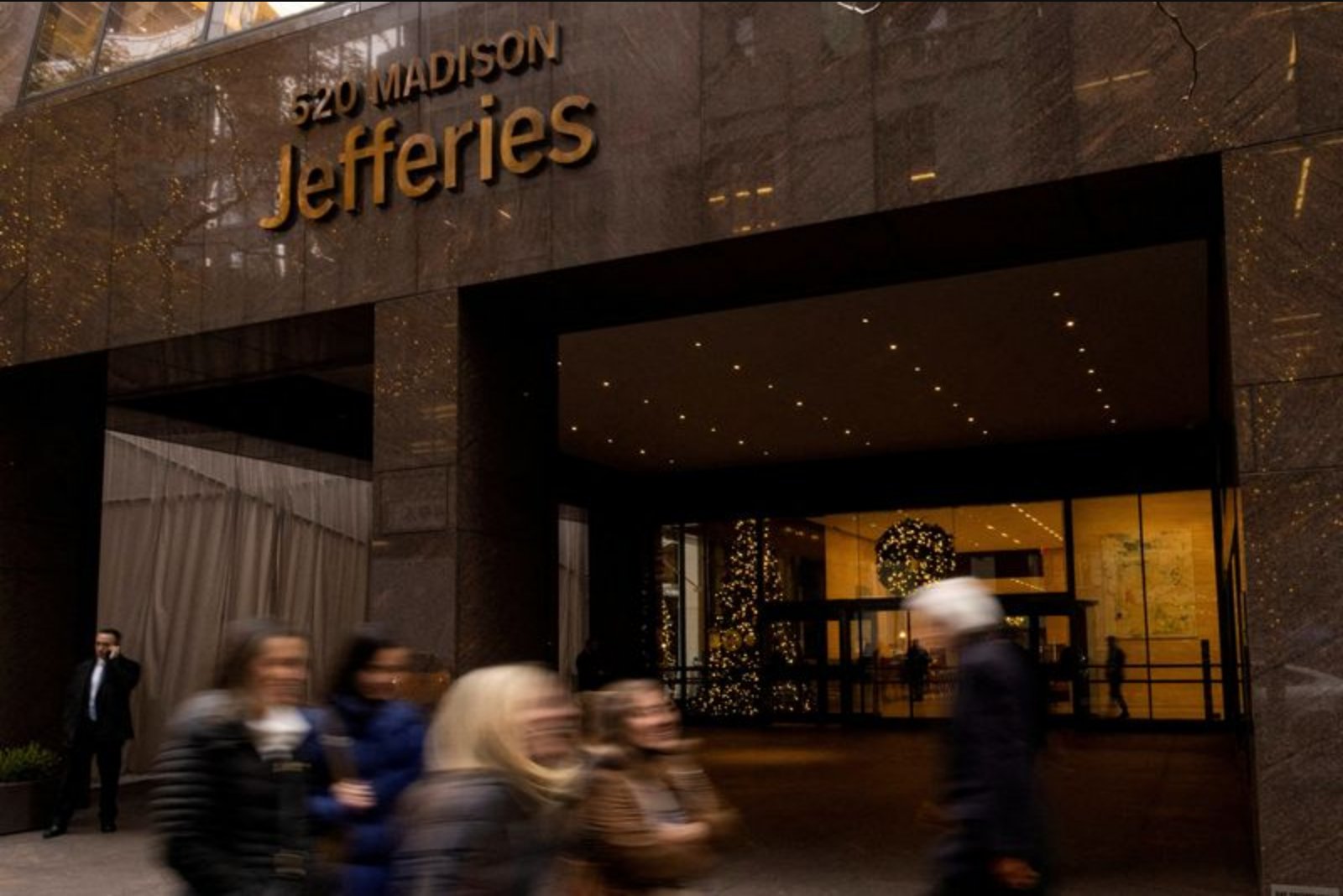
NEW YORK, March 4 - Jefferies Financial Group has drawn intensified attention over its risk-taking and credit controls after two separate collapses implicated exposures tied to the firm.
Investors punished the independent investment bank last week when its stock plunged 9% following reports that it held 100 million pounds ($134.02 million) of exposure to failed British lender Market Financial Solutions (MFS). Shares recovered partially on Monday but slid another 2% on Tuesday. The recent losses added to earlier declines seen after a unit connected to Jefferies' asset management arm became entangled in the bankruptcy of U.S. auto-parts supplier First Brands.
Despite continued indications that Jefferies' overall finances remain healthy, the company has underperformed relative to mid-cap financial peers as analysts and investors probe the bank's apparent willingness to accept higher levels of borrower and counterparty risk.
Market reaction and immediate exposures
The market move followed disclosure of Jefferies' involvement in a about $2 billion structured loan associated with MFS, in which the firm had a direct exposure of 100 million pounds. UBS analyst Michael Brown noted the loan was linked to asset-backed securities and emphasized that the quality and enforceability of collateral would be a key determinant of the size of any reserve Jefferies would need to set aside.
A source familiar with the situation told analysts the exposure is small enough that any charge taken against earnings would likely be limited. Brown added that the funds Jefferies provided were routed straight to law firms to complete specific, registered property transactions in the U.K., meaning the payments can be traced to particular loans that are registered there. He said while it is still early and fraudulent matters can be complex to unwind, a total loss scenario could be unlikely.
Investor litigation and First Brands link
Jefferies is also facing lawsuits from investors who allege they were misled into investing in a fund that had exposure to First Brands. The company has denied those allegations. First Brands owed about $715 million of receivables to the asset management unit tied to Jefferies, and earlier in the bankruptcy process Jefferies posted a fourth-quarter pre-tax loss of $30 million related to its investment in Point Bonita, the fund with exposure to First Brands.
At the same time, Jefferies' earnings beat estimates in the most recent quarter, supported by a resurgence in dealmaking activity and strong underwriting performance. The firm also ranked sixth among primary underwriters for marketed leveraged finance loans in the United States last year, according to Dealogic data, and was advising First Brands on refinancing its debt prior to the company's collapse.
Analyst views on risk appetite and controls
Observers say Jefferies' commercial approach - working extensively in leveraged lending, underwriting and distribution of higher-yielding credit, and partnering with specialized managers, credit funds, hedge funds and other institutional investors - positions it as more exposed to intermittent credit losses than more conservative mid-market banks.
Sean Dunlop, a banking analyst at Morningstar, captured that tension, saying: "My gut take is still that these are isolated issues, but management matters, and a hard-charging culture at Jefferies comes with a higher risk of adverse outcomes. This would mean that risk management issues - relaxing lending standards to drive growth, for example - are probably the bigger fundamental concern."
Other analysts offered a different perspective on the gravity of the losses. Oppenheimer analyst Chris Kotowski said: "Anybody can be a victim of crime and fraud and I do not think having two losses due to fraud in two years is shocking, nor necessarily a sign of a bad credit portfolio." Kotowski added that while increased fraud would prompt banks to be more cautious about collateral, Jefferies' potential losses are small relative to its capital.
Collateral, loss potential and reserves
UBS' Michael Brown emphasized that the recoverability of the MFS exposure will hinge on collateral strength. Because the loan was associated with registered property transactions in the U.K. and funds flowed through law firms to close those deals, the payments can be traced to specific registered loans. That traceability, Brown wrote, may reduce the likelihood of a complete loss, though he cautioned that fraudulent schemes can be complicated and slow to resolve.
Sources say that if Jefferies were to take a charge for any losses tied to these matters, the amount would be limited given the size of the exposures relative to the bank's capital base.
Risk management and industry implications
Agencies that monitor financial institutions have noted a broader trend of growing exposure to non-bank lending entities and some opacity in that market segment. Michael McTamney, senior vice president for North American Financial Institutions ratings at Morningstar DBRS, said: "There is growing exposure to non-bank lending entities and some opacity, but it does not seem to be worrying now," adding that banks are likely to increase disclosure to reassure investors.
McTamney also said the agency is comfortable with the largest banks' risk management and potential losses through the credit cycle, and while Jefferies is not directly rated by that agency, the firm is examined as a peer competitor to the largest U.S. banks. He noted: "The circumstances are not good, but they can absorb losses" given Jefferies' recent financial results.
Where this leaves Jefferies
Analysts widely note that Jefferies' business model - active participation in leveraged finance and close ties with alternative credit managers - makes intermittent borrower problems more likely. That positioning has drawn investor scrutiny amid wider market concerns about private credit businesses in recent weeks, which some market participants say have shaken confidence in parts of the alternative lending sector.
While questions remain about the bank's risk controls and exposure to higher-risk counterparties, the consensus from several analysts quoted is that Jefferies' capital position and the traceability of some of the transactions reduce the likelihood of a material hit to the firm's solvency from these particular cases.
The bank is observing a quiet period ahead of its first-quarter earnings announcement later this month and declined to comment on the matters under scrutiny.
Exchange rate: ($1 = 0.7462 pounds)