
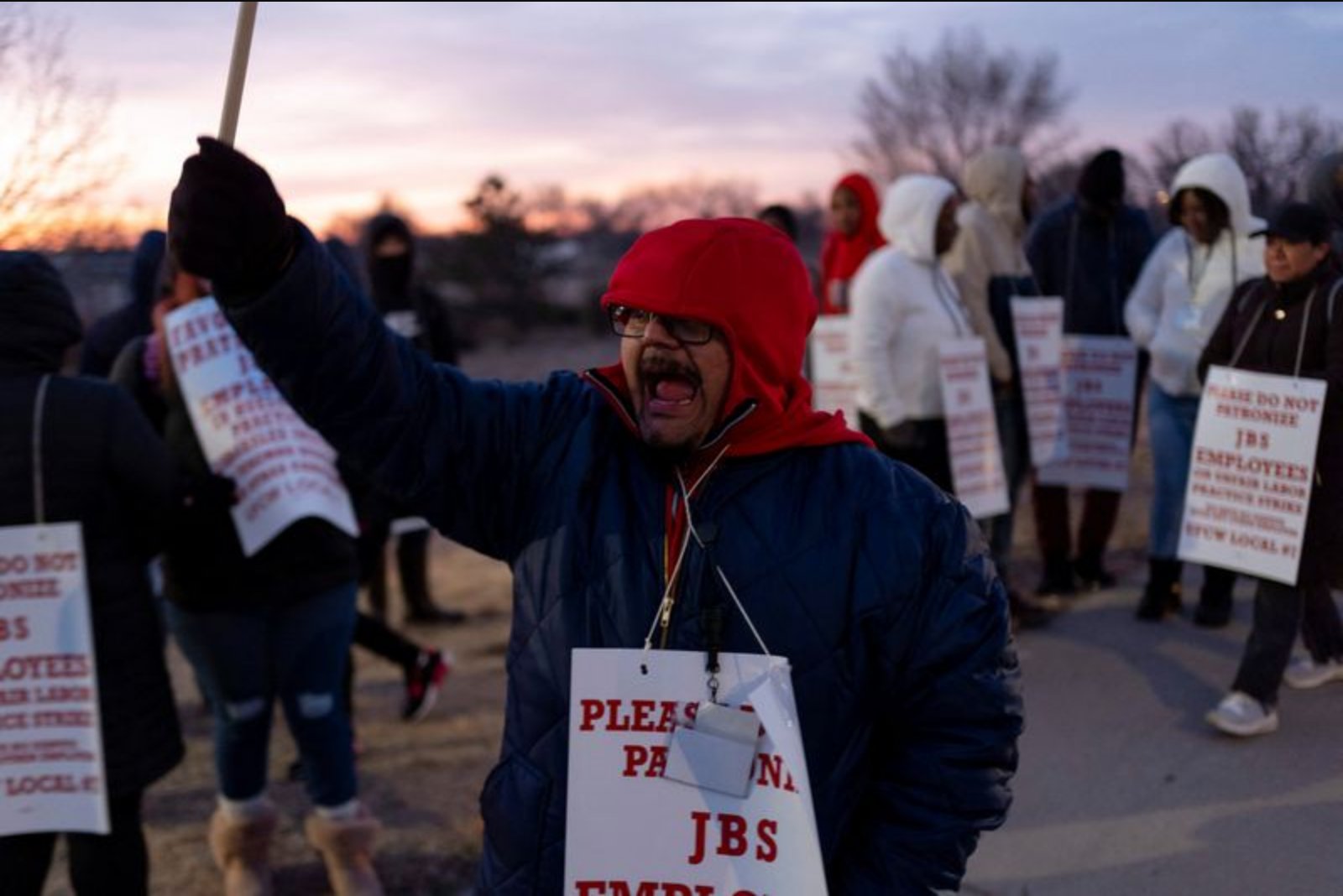
CHICAGO, March 16 - Workers at JBS’s Greeley, Colorado, beef processing plant took to the picket lines before dawn on Monday in what the union describes as the first strike by U.S. meatpacking workers in 40 years. The United Food and Commercial Workers Local 7 said about 3,800 production employees are represented and that the walkout is planned to run for two weeks, with picketing to continue until the company returns to negotiate what the union calls fair terms for workers.
Labor dispute and worker demands
The dispute centers on wage increases the union says do not keep pace with inflation, along with charges workers say they face for safety equipment. The union published video of marching employees carrying red and white signs reading "Please do not patronize JBS" and quoted production worker Deborah Rodarte saying, "We want to be treated like human beings." JBS has maintained that it put forward a fair offer during negotiations.
Operations and company response
JBS reduced output at the Greeley plant prior to the strike and announced plans last Friday to operate one of two shifts on Monday. The union, which states it represents all production staff, said the company’s processing capacity at the site was uncertain. JBS spokesperson Nikki Richardson said many team members chose to report to work rather than join the strike and that the company expects that number to rise in the coming days. The company also said it will shift production as needed to other facilities with excess processing capacity.
Meatpacking operations typically carry high fixed and operating costs, making peak utilization important to efficiency. That cost structure factors into JBS’s operational calculus during the stoppage and underlies processors’ general incentive to keep plants running full-time.
Industry context: supply, prices and margins
The strike reduces U.S. beef processing capacity at a time when the beef market is already tight. Retail prices for 100% beef ground chuck reached a record $6.70 per pound last month, about 17% higher than a year earlier, according to U.S. government data cited by industry sources. The article notes that consumers have faced record prices for hamburgers and steaks, and that President Donald Trump has struggled to deliver on a pledge to cool costs.
A years-long drought that damaged grazing lands pushed ranchers to reduce herds to their smallest size in 75 years, constraining the supply of cattle for slaughter. With fewer cattle available, processors have been paying higher prices for animals, a dynamic that has weighed on plant-level economics.
Analysts and industry data cited in the report show processors were losing money on each animal slaughtered in recent months. A Denver-based livestock marketing advisory service estimated that processors last month were losing more than $300 per head on each animal processed. By contrast, estimates for Monday put profits at about $60 per head, indicating a recent improvement in margins. That improvement was attributed in part to the looming strike, which helped push down cattle prices while beef demand stayed strong.
Altin Kalo, an economist with Steiner Consulting Group, is quoted asking, "Why would you be in a hurry if you’re already losing money on running that plant?" The observation underscores how negative or thin slaughter margins can influence the speed and incentives for a company to resolve a labor stoppage.
Wider capacity impacts and market leverage
The Greeley strike compounds capacity losses after Tyson Foods closed a Nebraska beef plant earlier in the year and scaled back operations at a Texas facility. Reduced processing capacity can shift leverage within the supply chain: analysts in the report say lost plant hours increase packer bargaining power relative to cattle feeders when negotiating livestock deals. Some feeders were rerouting shipments to other plants during the dispute.
The National Cattlemen’s Beef Association warned that limiting the number of available processing plants, even with a smaller national herd, could unsettle markets, squeeze producers holding market-ready cattle and push beef prices higher for consumers. The U.S. Department of Agriculture said it was monitoring the effects of the strike on the national beef supply.
Demand and consumer substitution
Despite higher retail prices, demand for beef is described in the report as remaining robust. Some consumers have shifted toward less expensive meats in response to rising prices, but overall beef consumption has not collapsed. Market participants cited in the article noted that the combination of steady demand and constrained processing capacity contributed to recent improvements in processor margins.
Outlook and immediate implications
In the near term, the strike reduces output from one of the country’s major beef plants and adds to pre-existing capacity constraints. That combination has the potential to maintain upward pressure on retail beef prices unless processing capacity elsewhere can absorb the displaced supply. The dispute also highlights tensions between labor costs, worker safety charges and the narrow economics processors face when cattle acquisition costs are elevated.
This article summarizes the strike, operational responses, and market implications based on information provided by labor representatives, company statements and industry data. It does not introduce facts beyond those presented in the reporting.