
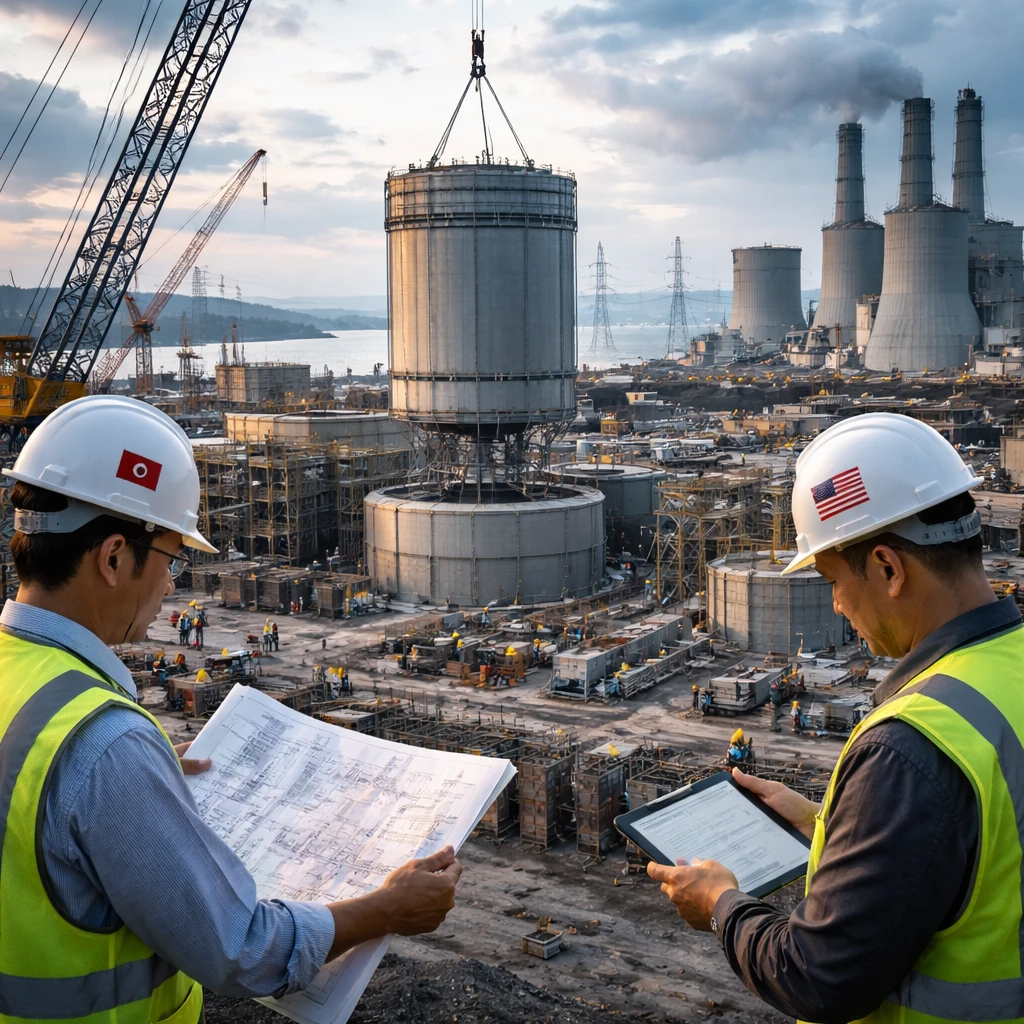
Japan and the United States are preparing a joint statement to announce a coordinated strategic investment totaling $73 billion in energy-related projects located in the United States, according to Jefferies. Within that package, up to $40 billion is designated for small modular reactors - to be deployed through a Hitachi-GE Vernova joint venture - while as much as $33 billion is allocated for gas-fired power plants intended to help meet growing electricity demand associated with artificial intelligence applications.
Government posture and domestic targets
At the 4th Nuclear Supply Chain Symposium on March 9, Japan's Ministry of Economy, Trade and Industry stated that nuclear power will be indispensable to both decarbonization and Japan's energy security objectives. The ministry set out the dual priorities of restarting existing nuclear reactors and developing next-generation reactor technology. Those measures are intended to support a long-term goal of achieving roughly 20% contribution from nuclear power by 2040.
METI's published targets include an interim objective of raising nuclear contribution to 20-22% by 2030. Since mid-2023, the share of electricity generated by nuclear plants in Japan has remained in the 10-12% range, illustrating the gap between current output and stated targets.
Operational status and contractors
As of Tuesday, 10 nuclear power plants in Japan were operational and five were temporarily offline for regular maintenance, giving a total of 15 active facilities referenced in government reporting. The article lists contractors associated with those 15 plants: Mitsubishi Heavy Industries (TSE:7011) is contractor for 12 plants; Hitachi (TSE:6501) is contractor for one plant; Toshiba/IHI (TSE:7013) for one plant; and a combined Hitachi/Toshiba/IHI team for one plant.
Industry dialogue and expert review
Jefferies plans an online session with Hiroaki Nishi from the Japan Nuclear Safety Institute, scheduled for Tuesday from 21:00 to 22:00 JST. The session will examine the practical feasibility of Japan's energy policy trajectory through 2040 and will discuss how firms such as Mitsubishi Heavy Industries and Mitsubishi Electric (TSE:6503) fit into the nuclear supply chain and value chain more broadly.
Nishi is identified as a team leader at the Japan Nuclear Safety Institute, where he leads peer reviews for nuclear power plants across Japan. Prior to joining the institute, Nishi worked on electrical and instrumentation and control maintenance at nuclear power plants and at the head office of Kansai Electric Power Company (TSE:9503).
Note: This article presents reported plans and public statements as described by the referenced parties and media reporting. It does not introduce additional claims beyond those described above.