
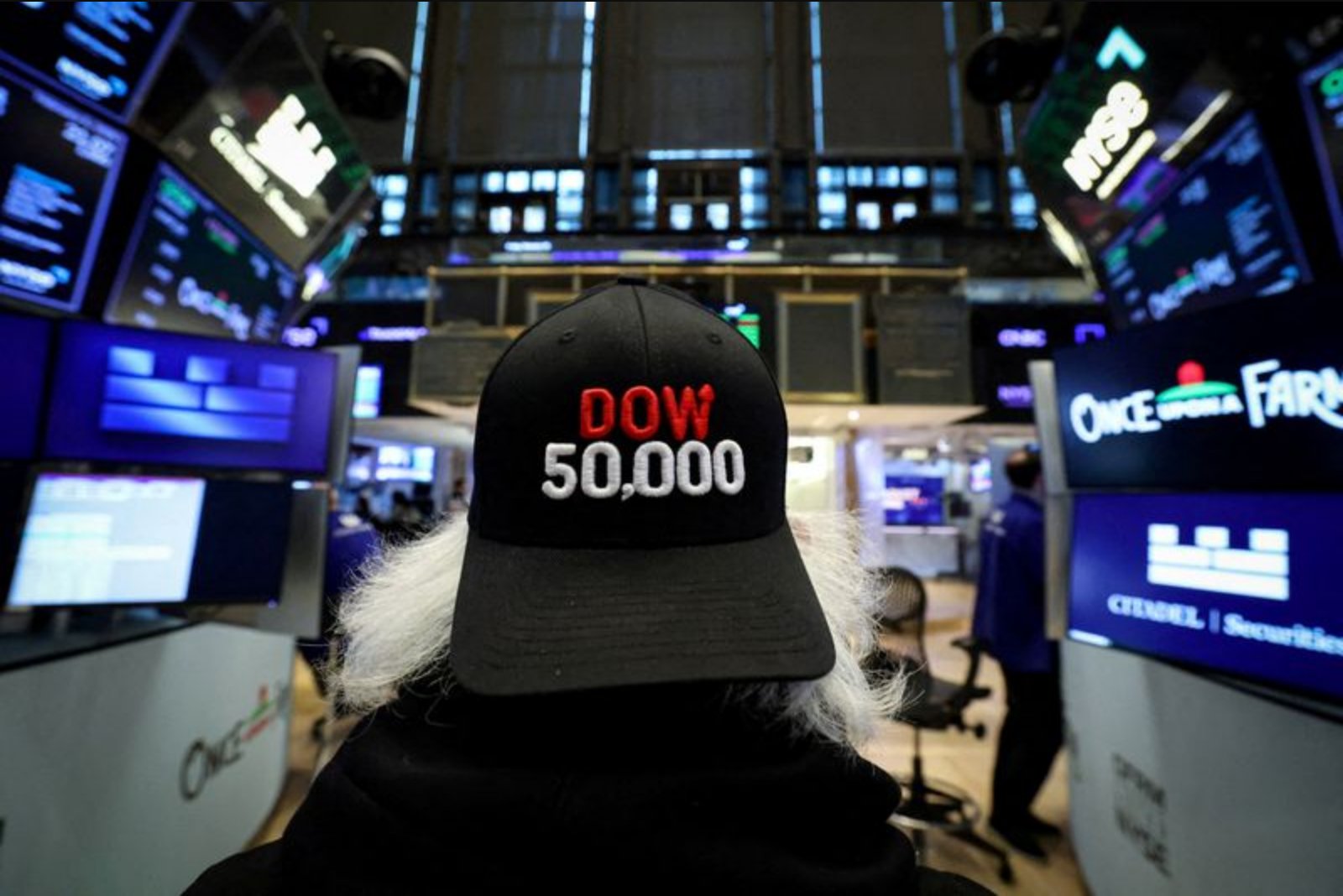
Investors are pulling capital into lower-priced, smaller companies and reassessing their appetite for volatile assets after sharp moves across market segments rattled some of the recent market leaders. The reallocation has coincided with the Dow Jones Industrial Average reaching a record high on Friday even as software stocks shed about $1 trillion in market value over the course of the week.
“The selloff in the names that carried markets higher may have paused, but we’re instead seeing a wave of aggressive buying of altogether different stocks,” said Tim Murray, head of capital markets strategy at T. Rowe Price. Murray added that investors are weighing both the downside risk to companies whose businesses AI could disrupt and the uncertainty around the profits of large AI-oriented platforms - referring to hyperscalers such as Amazon.com, Microsoft and Alphabet - that underpin the rollout of artificial intelligence.
Across market measures, the divergence was stark. The S&P 500 rallied 1.78% on Friday and the Nasdaq 100 rose nearly 2%, but the broader Russell 2000 index outpaced those gains with a 3.5% jump. Not all of the elite technology names joined the rebound. Amazon shares plunged amid investor concern about how the company will generate returns on its proposed $200 billion of AI capital spending.
Small-cap and cyclical sectors gain
In recent weeks, investors have been positioning for a more broadly based rally after a prolonged stretch in which technology stocks dominated the U.S. market. The buying has reached industrials, healthcare and small-cap stocks, with portfolio managers and strategists saying dividend growers, equal-weighted indexes and smaller companies stand to benefit from the rotation.
“I think the broadening we started to see back in the fall and saw most dramatically in the last few days is here to stay after a very protracted period where anything that wasn’t megacap technology was pushed to the sidelines,” said Simeon Hyman, global investment strategist at ProShares. That rotation is visible in money quietly moving into energy stocks, materials companies, staples and industrials, according to Citigroup’s U.S. market strategist Scott Chronert.
Chronert noted that those economically sensitive sectors are posting double-digit gains year-to-date, a contrast with the S&P 500’s 1.3% rise so far this year. The change has not been smooth: strategists describe the move as turbulent and numbing at times as investors search for alternatives to crowded trades.
Speculative assets and volatility
Investors have also been reexamining exposure to other assets that benefited during the recent bull run, including precious metals and speculative instruments such as bitcoin. Bitcoin briefly slipped to a 16-month low of $60,017 before recovering to just under $70,000 on Saturday afternoon, a level still far below its October all-time high of $126,000. Silver bounced as well, but remains well below recent highs above $90 an ounce.
“People are reacting to the various reasons that have hurt all of these assets by looking for ways to rebalance their portfolios and move away from the most crowded trades,” said Jim Carroll, a wealth adviser at Ballast Rock Private Wealth. Carroll, who monitors market swings, described intraday volatility as staggering while noting that investors appear to seek shelter until conditions stabilize.
Lingering doubts about AI spending and durable demand
Despite the late-week rally in broad indices, traders caution that the market’s new stance on risk may persist. Some of the buyers who previously stepped in on dips have been slower and more cautious to re-enter positions, underscoring a change in investor behavior.
“People are going to have strong doubts and questions going forward,” said Thierry Wizman, global FX and rates strategist at Macquarie Group. Those doubts center on how hyperscalers will earn returns on expanded capital spending tied to AI and on the extent to which new investments will erode the businesses of companies that the technology could displace.
Evidence of that uncertainty appeared in sector flows and ETF performance. The iShares Expanded Technology Software ETF rebounded 3.5% on Friday, but finished the week down 9.1%, indicating that the rally did not erase the week’s losses. Travis Prentice, chief investment officer and portfolio manager at the Informed Momentum Company, said defensive stocks have strengthened, which he interprets not merely as a short-term trade but as part of the unwinding of speculative positions.
Market direction is becoming more fractured
The net effect, strategists say, is a market increasingly split between the stalwarts that dominated returns for much of the recent bull market and a fresh set of stocks that investors now consider cheaper or more likely to deliver returns. Chronert observed that while much debate has centered on AI, capital flows have quietly favored energy, materials, staples and industrials.
Traders and advisers caution that while the market may be broadening, the process is accompanied by heightened volatility and persistent questions about the sustainability of profit models tied to large-scale AI investments. For now, the data show a marketplace undergoing active rebalancing - with benchmarks diverging, speculative assets retreating from peaks, and smaller, economically sensitive sectors enjoying renewed investor attention.