
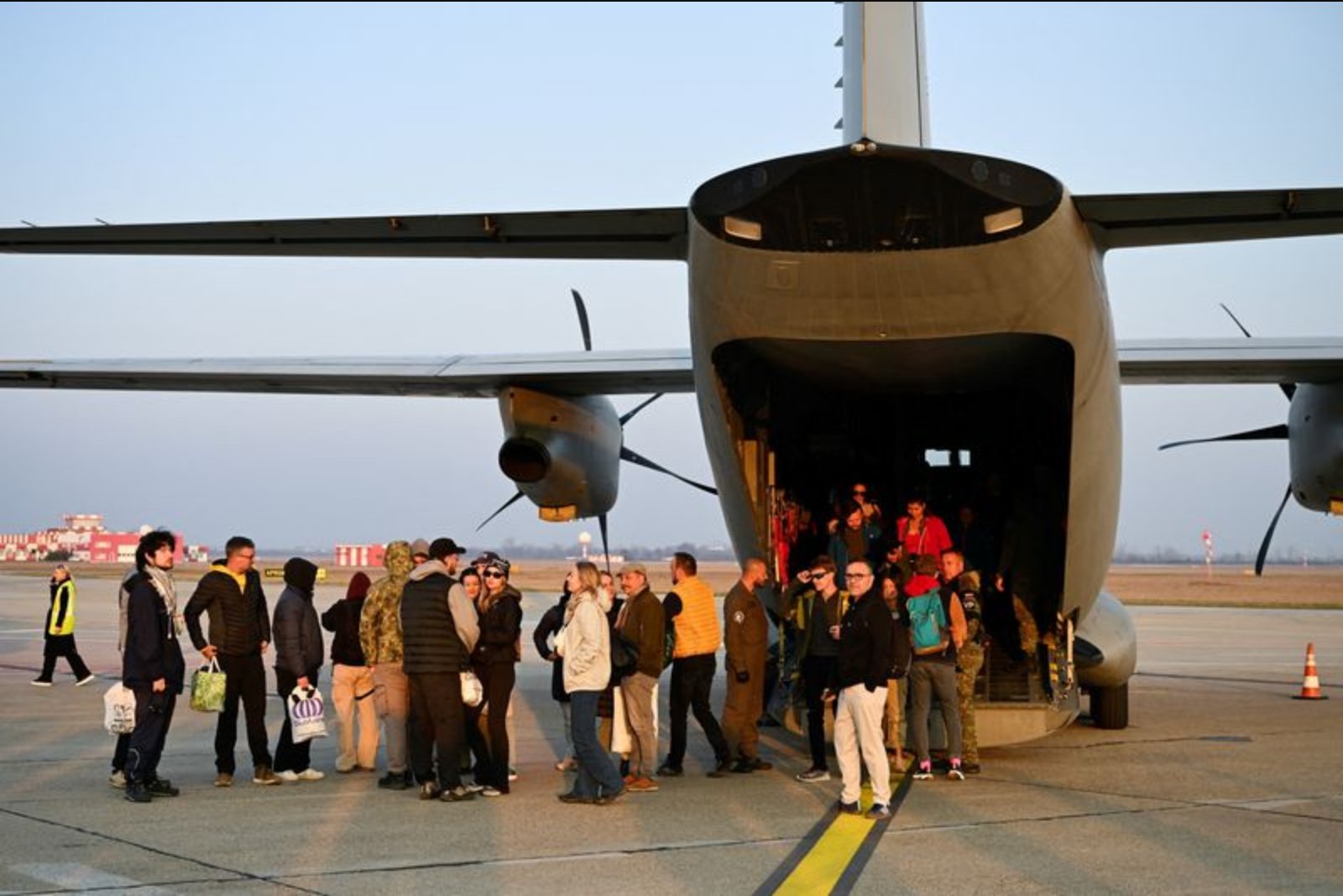
March 10 - The suspension of commercial flights in areas of the Middle East, triggered by an intensifying conflict after U.S. and Israeli strikes on Iran, has trapped many foreign nationals in the region. Governments across Europe and beyond have announced a variety of repatriation actions - from single charter flights to military airlifts and land evacuations - to extract citizens who are stranded abroad.
Overview
As scheduled airline services falter, states have been forced to deploy consular teams, lease or dispatch aircraft, arrange bus convoys and in some cases consider using military assets to bring people home. The measures vary by country but share the immediate objective of moving vulnerable citizens out of areas where regular air travel has been interrupted.
Country-by-country arrangements
- Austria - The foreign ministry said it had assisted 117 vulnerable citizens to depart the UAE and Israel through neighbouring states and had arranged a first charter flight from Muscat on March 4 for 170 people. The ministry warned that departures by land would be undertaken at travellers' own risk.
- Bulgaria - Three flights run by GullivAir, Bulgaria Air and the State Aviation Operator were planned to bring Bulgarian nationals back from Dubai, Abu Dhabi and Oman on March 4 and March 5. The scheduled rotations included a 326-seat GullivAir flight from Dubai, a Bulgaria Air Boeing 737 rotation via Oman, and a 90-seat government aircraft from Abu Dhabi.
- Czech Republic - By March 9 the Czech foreign ministry said it had organised 10 repatriation flights to return more than 1,500 stranded citizens.
- Estonia - On March 4 Estonia's foreign ministry said it had organised a 180-seat flight from Muscat for the following day, available to Estonian citizens in Oman and the United Arab Emirates.
- European Union - The European Commission is coordinating repatriation flights under the EU Civil Protection Mechanism as member states request assistance. The EU reported having supported more than 42 flights to date, bringing over 4,100 Europeans back to states including Belgium, Bulgaria, Czechia, Italy, Cyprus, Latvia, Lithuania, Luxembourg, the Netherlands, Austria, Portugal, Romania, Slovakia, and Sweden, according to a March 9 statement.
- Finland - Finland planned a single repatriation flight with roughly 160 seats on March 8 to assist the approximately 3,000 Finnish citizens it said were stranded in the United Arab Emirates. Finnair stated on March 6 that it was preparing to operate flights from Muscat, Oman to Helsinki for customers stranded in Dubai, with a first flight scheduled for March 10 and additional flights planned later in the week.
- France - The French foreign minister said multiple repatriation flights were planned from March 4 for French nationals, of whom around 400,000 are in the region. France has deployed consular teams at Israel's borders with Egypt and Jordan to facilitate land exits enabling onward air travel, and applied a similar mechanism in the UAE at borders with Oman and Saudi Arabia where airspace remained open.
- Germany - German Foreign Minister Johann Wadephul said two flights carrying about 250 people were scheduled for March 5 and March 6 from the Gulf, after an initial flight landed in Frankfurt on March 5.
- Greece - The Greek foreign ministry said it had repatriated hundreds of citizens from Abu Dhabi, Dubai, Jerusalem, Oman and the UAE during the prior week.
- Hungary - Hungary reported repatriating 87 people on March 4 from Amman, Jordan, with another flight carrying 88 people planned for March 5. A further flight was scheduled for March 6 from Sharm-el-Sheikh, Egypt. Hungary rented a Flydubai plane for March 5 and March 6 to evacuate Hungarians from Dubai and had two flights each on March 7 and March 8 departing from Riyadh, Saudi Arabia.
- Italy - Italy's foreign ministry said about 25,000 Italians had returned from the Middle East on commercial flights supported by the ministry. Rome has increased consular staffing in Oman and the UAE and is coordinating returns across multiple countries, with sizeable groups moving from the UAE and others travelling by land through Qatar, Kuwait, Bahrain and Saudi Arabia. The ministry said Italians in Oman, Israel, the Maldives and Thailand were also receiving consular assistance.
- Netherlands - The Dutch government said it was preparing to use military resources to repatriate citizens from countries they could not leave on their own, although it did not provide details on specific destinations or timing.
- Poland - The Operational Command of the Polish Armed Forces said the first group of Polish citizens evacuated by military airlift from the Middle East arrived in Poland on March 6.
- Portugal - A charter TAP flight carrying 139 Portuguese citizens and eight foreigners landed in Lisbon on March 6; Portugal's foreign ministry said further repatriations were being planned.
- Romania - Romania's foreign ministry said airline FlyDubai had scheduled two flights to Bucharest on March 4 and March 5. The ministry reported it had received more than 3,000 repatriation requests and had around 16,000 nationals registered in the region.
- Serbia - An Air Serbia flight from Sharm el-Sheikh landed in Belgrade early on March 4 carrying 67 passengers, all evacuated from Israel.
- Singapore - Singapore said it would deploy an air force A330 multi-role aircraft to assist the departure of Singaporeans from Riyadh on March 10, with a second flight from Saudi Arabia planned for March 12, the foreign affairs ministry said on Facebook.
- Slovakia - Slovakia's government reported having carried out 15 repatriation flights since evacuations began, transporting 641 people, most of whom were Slovak nationals, and said it was planning additional flights, according to its foreign ministry on March 9.
- Slovenia - On March 3 Slovenia organised four buses escorted by police to transfer Slovenian citizens and families with children from Dubai to Muscat airport in Oman. The first Slovenian flight took place on March 3, with two additional flights scheduled for March 4.
- Spain - Spain began evacuations on March 3. More than 175 Spaniards arrived on a flight from Abu Dhabi and further flights were expected from the UAE via Istanbul, according to Foreign Minister Jose Manuel Albares. Spain said it was reinforcing its embassies in the UAE, Saudi Arabia, Oman and Bahrain to assist with repatriation efforts.
- Sweden - Sweden chartered a plane to repatriate 180 stranded Swedes who had been identified as vulnerable.
- Thailand - Thailand planned to evacuate nationals from Iran by land to Turkey on March 7 and March 10, while citizens stranded in Iraq, Qatar, Bahrain, the UAE and Jordan were returning or would return once airspace reopened.
- United Arab Emirates - The UAE's civil aviation authority planned to begin operating "special flights" across the country's airports to assist some of the tens of thousands of passengers stranded in the region, state news agency WAM reported.
- United Kingdom - The British Foreign Office said chartered flights left Oman on March 5 after technical delays on March 4, prioritising vulnerable UK nationals seeking to leave the region. The office said around 130,000 British citizens had registered their presence in the region.
What governments have emphasized
Across the statements, officials stressed a focus on vulnerable travellers and coordination between consular teams, airlines and military assets where necessary. The EU has played a coordinating role by supporting flights under its Civil Protection Mechanism. Several countries have paired air moves with land routes and border assistance to maximize the number of people who can exit the region despite airspace restrictions.
Additional notes
The flow of repatriations includes a mix of state-organised charters, commercial rotations arranged by national carriers, military transport and ground transfers. Available seat counts cited by national authorities and airlines indicate some flights are limited in capacity, prompting prioritisation of vulnerable citizens where necessary.
Currency reference used in reporting: $1 = 0.8615 euros.
Financial ticker mentioned in related material: FIA1S.