
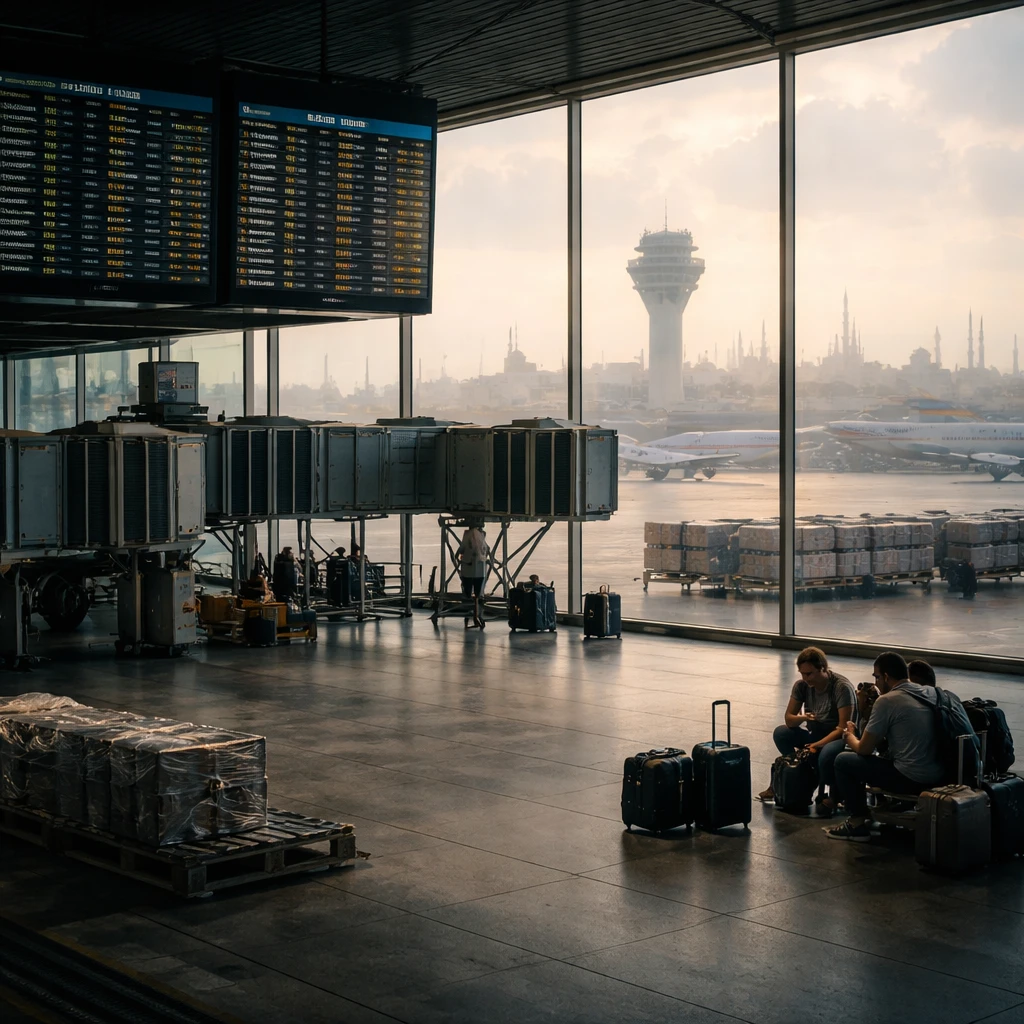
The ongoing U.S.-Israeli military campaign targeting Iran has produced a cascade of business disruptions around the world, affecting everything from passenger travel to the availability of raw materials used in manufacturing. Corporations and supply-chain managers are grappling with higher energy costs, constrained logistics, and the uncertainty of operating in a region where airspace and sea lanes have become contested.
Below is a sector-by-sector account of the main effects observed so far, drawn from reporting and company notices issued since the campaign began.
Travel chaos and air cargo bottlenecks
Tens of thousands of flights have been cancelled or rerouted and many airline schedules adjusted worldwide as much of the Middle East airspace, including that of Qatar, has been closed due to missile and drone threats. The restrictions and diversions have pushed global aviation into what industry participants describe as the most severe operational crisis since the pandemic-era disruptions.
Dubai International Airport (DXB), a central hub for international passengers, has been particularly hard hit. Disruptions at DXB have cascaded through global networks because many long-haul routes and connections rely on a small number of Middle Eastern transit points. With regional hubs operating under strain, passengers have sought alternatives including private jets, or long overland trips to airports in neighboring countries such as Riyadh in hopes of finding commercial departures there.
The conflict has also affected a strategic oil export corridor, which has driven up jet fuel prices and contributed to rising air fares on several international routes. These higher fuel costs and reduced flight options are compressing capacity for time-sensitive air cargo. Shipments that rely on rapid delivery - from fresh produce to urgent aircraft parts - are currently vulnerable as cargo capacity tightens and air freight rates climb.
Airlines facing elevated costs and operational strain
The sudden closure of Gulf airspace and the rerouting of long-haul flights have reverberated through airline networks and weighed on carrier share prices. Ticket prices for routes between Asia and Europe have risen sharply as airlines adopt longer trajectories to avoid restricted zones. Several carriers have announced route changes; examples cited include Wizz Air and Lufthansa. Low-cost carriers such as Ryanair have reported increases in short-haul demand.
Jet fuel, the carriers' second-largest expense after labour, has roughly doubled in price since the start of the conflict, creating immediate pressure on airline economics. Even carriers that maintain fuel hedges have begun to announce fare increases, fuel surcharges and capacity reductions to manage unexpectedly high refining margins. The operational environment has grown more hazardous for flight crews as drone incursions and missile threats increase the risk profile of some flight paths.
For Indian airlines, the restrictions represent a renewed challenge. The Middle East is a key corridor for flights to Europe and the United States, particularly since Pakistan banned Indian carriers from its airspace last year, which had already forced many Indian operators to rely more heavily on Middle Eastern transit routes.
Reputational and economic risks for Gulf tourism hubs
The conflict threatens the Middle East's positioning as a premium tourism destination, an image built up through extensive investment across cities from Abu Dhabi to Dubai. Tourism in the region is a multi-hundred billion dollar industry and depends heavily on perceived safety and smooth international connectivity. With major shopping districts and tourist destinations seeing reduced hours or temporary closures, the conflict has exposed how global travel and tourism are vulnerable to shocks concentrated in a few major hubs.
Defense spending and supply replenishment
U.S. forces have employed a mix of weaponry against Iranian targets, including Tomahawk cruise missiles, stealth aircraft and low-cost one-way attack drones modeled after Iranian designs. The Pentagon reported using artificial intelligence tools from Anthropic, including Claude, in the course of its operations. Separately, the U.S. Department of Defense designated the AI lab as a "supply-chain risk," restricting government contractors from using its technology in military work after a dispute over the company’s safeguards.
In response to munitions expended during operations, the U.S. administration convened senior executives from seven defence contractors to discuss efforts to replenish armaments and related systems. The meetings reflect the Pentagon's push to restore inventories drawn down by recent operations.
Critical metals and raw materials under strain
Industrial producers in the Gulf and beyond have been directly affected by the conflict. Qatalum, a Qatari aluminium smelter, began shutting down operations, and Aluminium Bahrain announced it had suspended shipments and declared force majeure because it was unable to move metal safely through the Strait of Hormuz. The Gulf region supplies roughly 8% of global aluminium, and the announcements were followed by a sharp uptick in aluminium prices on the London Metal Exchange, along with higher physical premiums in Europe and the United States.
Other industrial chains are exposed to regional shipping disruptions as well. Nickel producers in Indonesia that rely on the Gulf for as much as 75% of the sulphur used in processing may face production cuts if shipping remains constrained. The broader consequence is a potential squeeze on supply for materials used in a range of manufacturing processes.
Apparel, food and luxury segments feel the pinch
Some consignments of garments bound for global clothing retailers have become stranded at airports in Bangladesh and India as flight disruptions affected cargo flows. South Asia is a major producer for fast fashion brands worldwide, and interruptions to air transport jeopardize the steady cadence of new inventory arriving at retailers.
Luxury goods groups, already contending with sluggish demand in some markets, are seen as particularly exposed to distribution and travel disruptions. Names such as Richemont and Zegna were identified among firms likely to feel pressure from the current environment.
The restaurant and hotel sectors in India are reporting heightened operational risks, including potential shutdowns tied to constraints on the supply of cooking gas. Authorities are responding by establishing a panel to assess industry petitions and map out remedial measures. Producers of packaged water are experiencing higher input costs as the conflict affects the availability of plastic resins and other packaging components - rising oil prices have pushed up the cost of polymer feedstocks used to manufacture bottles, caps, labels and cartons.
Semiconductors, data centres and technology supply chains
Officials in South Korea have warned that an extended conflict could disrupt the supply of certain semiconductor manufacturing inputs that originate in or transit through the Middle East, including helium - a critical gas for chip fabrication that lacks a practical substitute. The potential for constrained helium flows underscores vulnerabilities in the chip supply chain.
Separately, drone strikes that caused damage to some Amazon data centres in the United Arab Emirates and Bahrain have prompted questions about the robustness of technology infrastructure and the pace at which large technology firms have expanded regional capacity. The incidents highlight risk considerations for data centre operators and cloud-service customers operating in or extending into areas with elevated security risks.
Banks and corporate responses to security threats
Major banks with regional operations have implemented contingency measures in response to threats against Gulf banking interests tied to the U.S. and Israel. Citigroup and Standard Chartered reportedly directed staff in Dubai to work from home. HSBC announced the temporary closure of all branches in Qatar, citing staff and customer safety concerns. These steps illustrate how financial institutions are adapting workplace practices and branch networks amid heightened security concerns.
What the current disruptions reveal
The operational shock from the U.S.-Israeli campaign on Iran has exposed how concentrated dependencies - a handful of air hubs, a limited set of raw-material supply routes and regional processing facilities - can transmit localized conflict into global economic pain. The scale and scope of the disruptions span aviation, metals, fashion, hospitality, technology infrastructure and banking, underscoring a broad set of market and operational risks that companies and policymakers must monitor closely.
At present, reporting indicates widespread impacts across industry sectors and trade flows, but the precise duration and long-term effects will depend on how the security situation evolves and how quickly logistics and supply chains can adapt to rerouting and constrained capacity.