
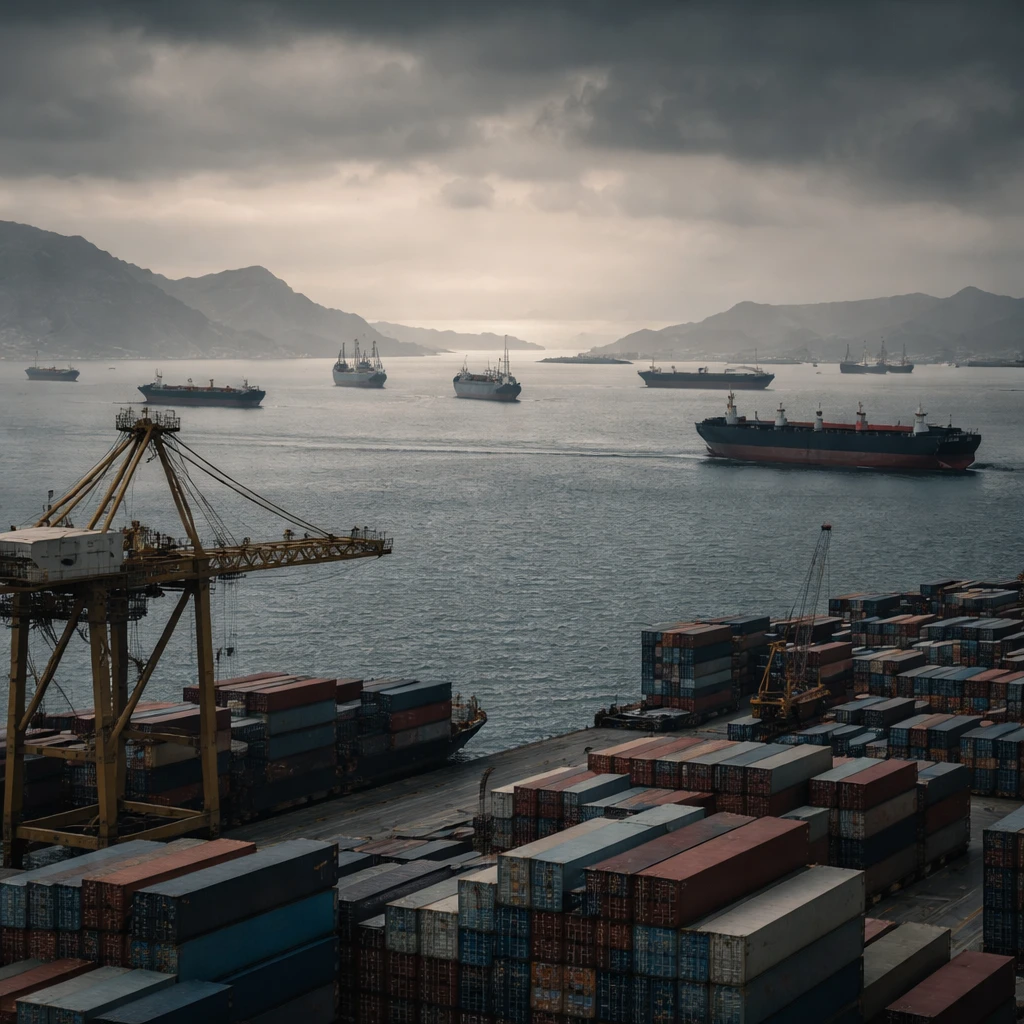
The widening military confrontation between the U.S. and Israel on one side and Iran on the other has sent immediate shockwaves through global business, interrupting key transport routes, lifting energy prices and tightening the availability of crucial raw materials.
Sea traffic through the Strait of Hormuz - a channel responsible for about one-fifth of global oil flows - slowed to a near halt after Iran launched drone strikes in response to U.S. and Israeli operations. At the same time, heavy air transit routes across the Gulf have become largely inactive. The result is a sharp disruption to the movement of goods ranging from foodstuffs to automotive parts and industrial inputs.
Executives are already reporting cost pressure. Young Liu, chairman of Foxconn - the world's largest electronics manufacturer and an important partner to Nvidia - warned that if the disruptions persist, the effects will be felt broadly across companies. "If these effects last longer, everyone will start to feel them," he said.
Energy markets reacted quickly. Brent crude futures have risen toward $90 per barrel, a level below the peaks seen in 2022 but still sufficient to push costs higher across industries. Retail motorists in the United States experienced an immediate impact at the pump: the nationwide average for a gallon of regular gasoline rose to $3.32 on Friday from $2.98 a week earlier.
Higher oil and gas prices are reverberating through corporate cost structures and stoking concerns among investors and policymakers about renewed inflationary pressure. "Any time you see an increase in oil price or gas price, it's got a knock-on effect further down on every company, on every industry," said Simon Hunt, CEO of Italian drinks maker Campari, after the firm's results.
For Europe - which is still recovering from the energy shock of 2022 - consequences are particularly acute in sectors that consume large amounts of energy, such as chemicals. Analysis cited by the IW German Economic Institute projects that sustained oil at $100 per barrel could subtract 0.3% from Germany's GDP this year and 0.6% next year, a combined hit to economic output on the order of roughly 40 billion euros over two years.
Some companies are using contractual protections to blunt exposure. Campari said it holds long-term contracts to mitigate the impact of big spikes in energy prices, while Reckitt Benckiser's chief financial officer Shannon Eisenhardt said the consumer goods firm has hedged about 55% of its oil and gas price exposure for 2026. But representative bodies for energy-intensive industries in France reported immediate damage: Uniden said the spot price of gas in Europe jumped about 80%, leading some firms to halt or slow production due to the uncertainty.
Airlines have been among the first sectors to feel the fallout. Wizz Air, which has hedges in place, said the conflict would reduce its net profit for fiscal year 2026 by around 50 million euros.
Shipping disruptions have also affected specialized industrial inputs. Sulphur movements have been interrupted, and several major aluminium producers invoked force majeure clauses after freight routes became impractical. Qatalum, a Qatari smelter, began shutting down operations this week, while Aluminium Bahrain (which later halted shipments) declared force majeure because it could not move metal via the Strait of Hormuz. Producers from the Gulf contribute about 8% of global aluminium supply. These developments sent aluminium prices on the London Metal Exchange sharply higher and lifted physical premiums in Europe and the United States to multi-year levels.
Beyond base metals, officials in South Korea warned that a prolonged confrontation could interrupt supplies of key semiconductor manufacturing materials from the Middle East - notably helium, which is essential for chip production and has no ready substitute.
Damage from drone strikes to some of Amazon's data centres in the United Arab Emirates and Bahrain has raised questions about technology supply chains and the pace at which major cloud and technology companies have been expanding infrastructure in the region.
Financial institutions and analysts are weighing how a sustained energy shock might affect global growth. Morgan Stanley suggested that the episode could bring the need to invoke the "recession playbook", while Goldman Sachs analysts estimated that a temporary rise in oil to $100 per barrel could slow global growth by about 0.4 percentage points.
Much depends on how long the conflict endures. Some market observers note that political considerations may reduce the appetite for a lengthy, costly war ahead of domestic election calendars, but the uncertainty remains central to near-term forecasts. "You don't really want this to last for too long," said Emmanuel Cau, Head of European Equity Strategy at Barclays. "If it is a few weeks or months, of course you're going to have earnings expectations starting to be cut."
Business lines that rely on steady sea freight are already reporting disruption. British auto distributor Inchcape warned that some shipments from Japan to Europe might be delayed by weeks, while market turmoil and travel disruption have prompted online travel agent Loveholidays to prepare to postpone its planned London IPO.
Energy executives have framed the episode as a reminder of persistent vulnerability. Markus Krebber, CEO of RWE, Germany's largest power producer, said that energy was once again dominating headlines worldwide. "Gas and oil prices are volatile, key shipping routes face geopolitical pressure, and policymakers are concerned about supply risks," Krebber said. He added that the renewed uncertainty highlights an uncomfortable reality: the next energy crisis is a matter of when, not if, and poses questions about preparedness.
At present, the chain of immediate effects is clear - interrupted transit corridors; higher fuel and commodity costs; production curtailments in energy-intensive industries; localized shutdowns at smelters; and mounting uncertainty in technology and logistics networks. How those pressures feed through to corporate margins and broader economic growth will hinge on the conflict's duration and whether supply and insurance markets can adapt quickly enough to stabilize trade flows.
Key points
- Disruption of Middle East sea and air routes has slowed oil shipments through the Strait of Hormuz and darkened busy Gulf air corridors, pushing up fuel prices and transport costs.
- Energy-intensive sectors such as chemicals, metals and manufacturing face immediate production and cost pressures; semiconductor production may be affected if supplies of helium and other inputs are interrupted.
- Airlines, shipping, metal producers and parts of the tech sector are reporting direct hits to operations and profits, and some firms are employing hedges and long-term contracts to manage exposure.
Risks and uncertainties
- Duration risk - the economic and corporate impact depends heavily on how long the conflict continues; a prolonged episode could force earnings revisions and slow growth.
- Supply-chain risk - closed or constrained shipping lanes and disrupted air routes could delay shipments of critical inputs and finished goods, hitting industries from autos to consumer goods.
- Energy-price risk - sustained higher oil and gas prices could translate into broader inflationary pressure and reduced margins for companies, particularly those in energy-intensive sectors.