
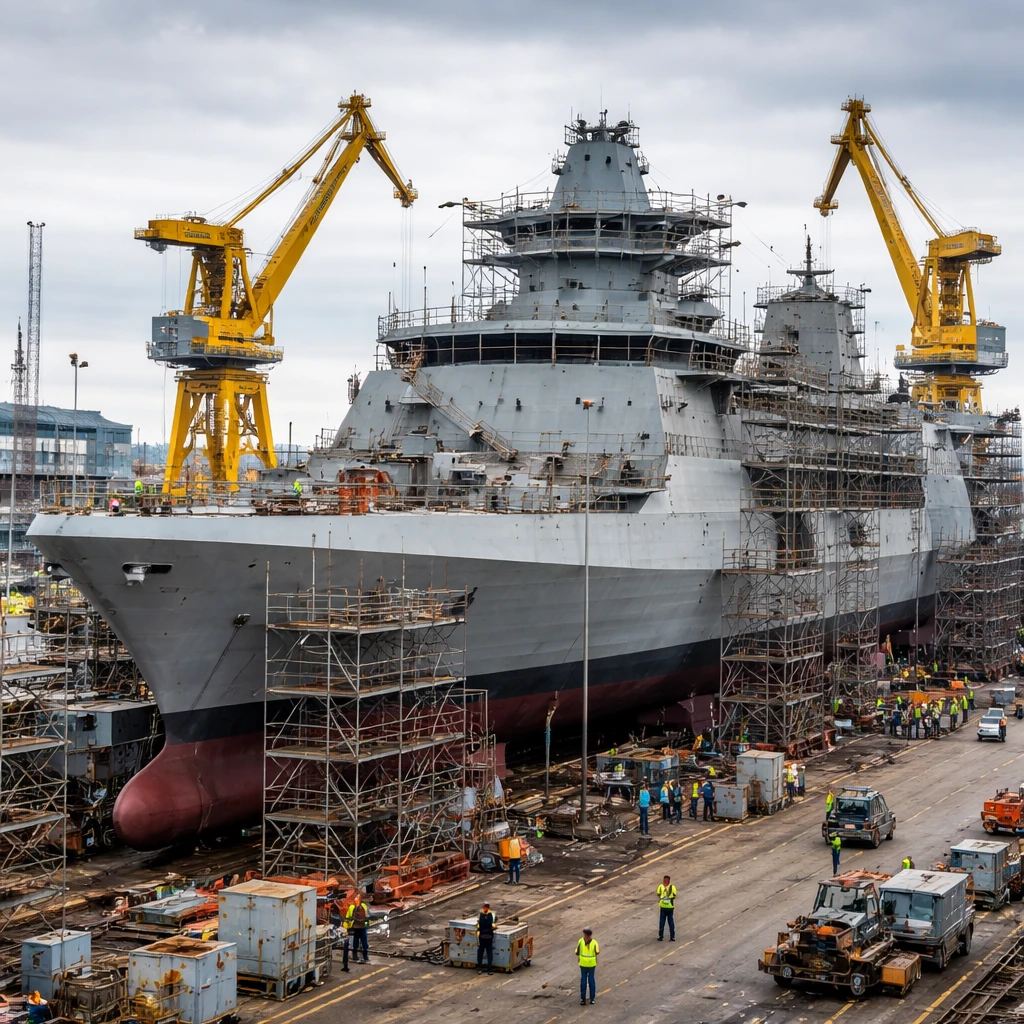
Germany has abandoned plans to construct six F126 frigates, officials told industry figures and lawmakers, choosing instead to acquire eight Meko A-200 frigates. The change in procurement strategy is expected to result in roughly €2 billion of write-offs tied to the F126 programme.
The announcement had an immediate market impact. Shares of Rheinmetall, the Düsseldorf-based defence group that had been positioned to assume lead-contractor status for the F126 in a €12.8 billion arrangement, fell more than 14% on the news. Earlier this year Rheinmetall completed the acquisition of shipbuilder Naval Yards Lürssen for €1.5 billion as part of a wider push into naval capabilities.
Conversely, TKMS, which already holds a contract to supply four Meko A-200 frigates at roughly €1 billion apiece, climbed by more than 10% by 08:02 GMT.
The F126 programme had repeatedly encountered problems during its development. Cost overruns and schedule delays linked to software issues were reported, and relations between Germany's procurement agency and Damen Naval - the Dutch shipbuilder that won the contract in 2020 - deteriorated. Those tensions had led to an agreement to transfer lead-contractor status to Rheinmetall prior to the decision to cancel the programme.
The F126 was designed as a multipurpose warship measuring 166 metres and displacing around 10,000 tonnes, with a pronounced focus on anti-submarine warfare. That capability had been given heightened priority following Russia's full-scale invasion of Ukraine in 2022 and amid stepped-up NATO deterrence efforts in adjacent waters.
Industry sources described uncertainty over the status of the first F126 hull, which had already begun taking shape at the Wolgast shipyard in northeastern Germany. "Will it now all be sent to scrap?" one person familiar with the project asked.
The cancellation occurs while Berlin progresses with a large-scale military overhaul budgeted at €780 billion through 2030, underscoring a period of significant procurement activity and shifting priorities within German defence planning.
Key points
- Germany will not proceed with construction of six F126 frigates and will purchase eight Meko A-200 vessels instead.
- Rheinmetall shares plunged more than 14% after it was poised to lead the F126 programme in a €12.8 billion deal; TKMS shares rose over 10% as it already holds a contract for four Meko A-200 frigates.
- Approximately €2 billion in costs associated with the F126 programme are expected to be written off.
Risks and uncertainties
- Cost and schedule risk: The F126 programme had experienced cost overruns and delays linked to software issues, representing continued execution risk for large naval platforms - impacting shipbuilders and defence contractors.
- Contract and procurement friction: Strained relations between the procurement agency and the original contractor contributed to changes in project leadership and ultimately to programme cancellation - a governance risk for defence procurement.
- Asset disposition uncertainty: The fate of the partially constructed first F126 hull at the Wolgast shipyard is unclear, creating short-term operational and capital recovery uncertainty for yard operators and suppliers.