
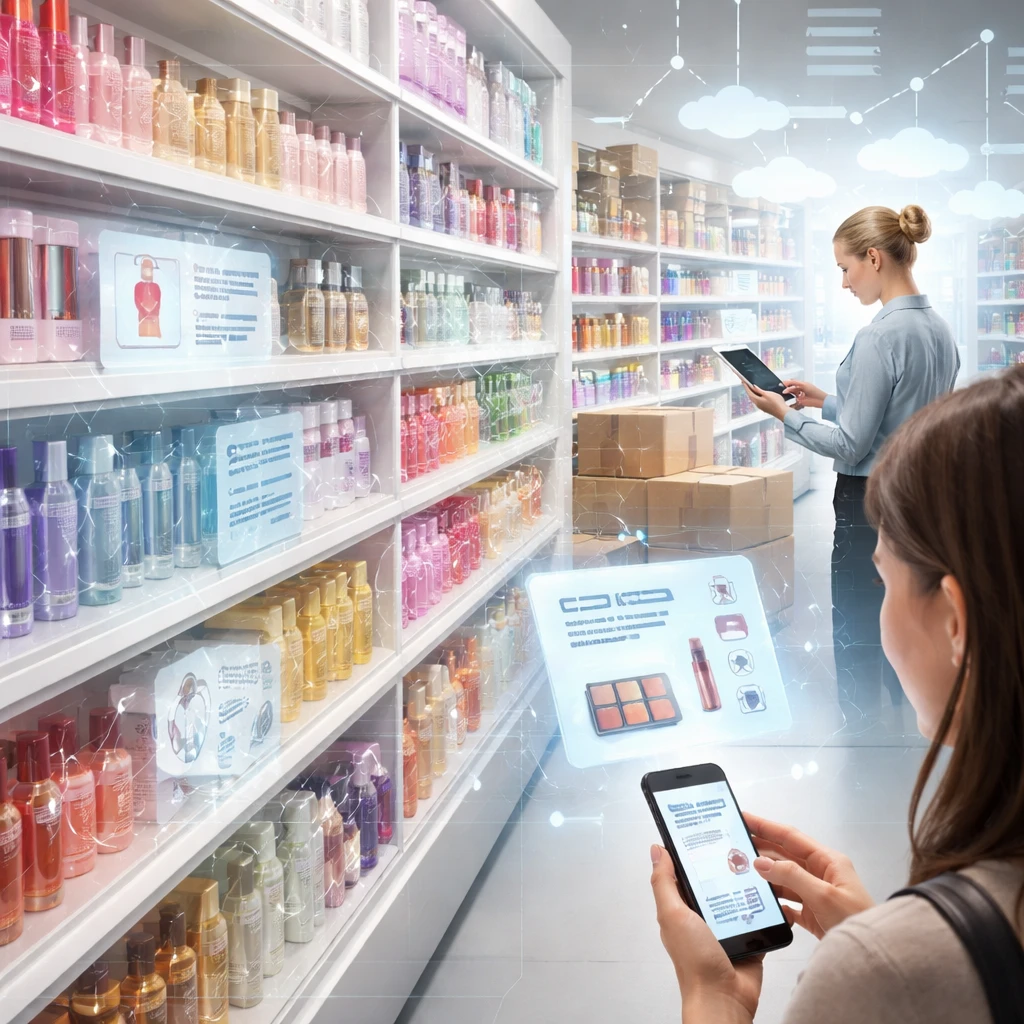
Artificial intelligence is increasingly central to how beauty products are found, tested, and merchandised, according to research from Jefferies. The firm highlights a shift in the discovery pathway driven by large language model search and a competitive advantage for companies that prepare product data for machine consumption - a process Jefferies calls Generative Engine Optimization, or GEO.
GEO is intended to make product information more accessible to AI agents so that brands surface more frequently in AI-generated answers and recommendation lists. Jefferies points to a noticeable difference in visibility for companies that have restructured their product metadata for machine readability. Within the analyst coverage, e.l.f. Beauty is reported to be furthest along, claiming a roughly 70% visibility lead compared with peers in LLM search results after adjusting its product data structure.
LLM-based search is gaining traction as a discovery channel. Jefferies references platform engagement numbers and survey signals indicating a material shift - ChatGPT is cited as having about 700 million weekly active users - and more than half of U.S. adults reportedly trust AI-driven brand recommendations at levels comparable to Google. As those agents draw on a mix of sources - trusted publishers, Reddit, YouTube, and retailer product pages - brands that appear on curated "best of" lists and that are supported by scientific or clinical citations obtain an advantage in how often they are recommended.
Retailers and brand owners are responding to compressed trend cycles. Jefferies notes that product virality often peaks within a few months and tends to fade by roughly six months, creating a premium on speed and decision accuracy. Companies that use AI to shorten development and merchandising lead times are thus better positioned to capture ephemeral demand spikes. Estée Lauder is highlighted for its AI-enabled Atelier in Paris, which the firm expects to drive a 30% to 50% reduction in development lead times over time. e.l.f. Beauty is expected to benefit materially from AI-supported trend identification because its baseline product lead times are already among the shortest in the industry - about nine weeks.
At the retail level, Jefferies argues that AI-enabled reductions in time-to-shelf and faster introduction of new products will increase category fragmentation. As retailers gain the ability to identify, test, and scale emerging brands with less capital and inventory risk, smaller and nascent brands can reach shelves and digital listings more quickly. Platforms such as TikTok Shop are explicitly named as places where nascent brands can gain early traction, which AI tools then detect and help scale into broader retail distribution.
Several retailers and beauty companies are specifically cited for their initiatives. Ulta Beauty has a partnership with Google to improve how its products are presented to AI agents, with a focus on positioning product listings and the manner in which information is delivered. Ulta has also invested in AI-driven data and cloud infrastructure, including proprietary personalization and analytics systems that inform faster merchandising choices and supply chain efficiencies. Jefferies notes that AI work at Ulta is being applied to fulfillment optimization with the potential to reduce out-of-stocks and markdown risk, and to payroll management.
Other companies are experimenting with personalization and development use cases. Bath & Body Works operates "Gingham Genius," an AI-enabled fragrance finder that uses large language models and customer data to produce personalized scent and gifting suggestions. Sally Beauty discussed rolling out AI-driven personalization across its apps to bolster digital sales, and Inter Parfums has indicated use of AI to speed new product development. Olaplex implemented an AI-supported demand-planning system, with early indicators showing improved forecasting accuracy.
Coty described GEO as an "increasingly critical gateway" for consumer discovery and is actively exploring the approach across brands. The company also highlights generative AI for digital asset creation, with reported reductions in post-production asset costs of 70% to 90% for selected brands, a benefit tied to lower marketing spending and increased content output.
Jefferies also details some early pilots and partnerships. Estée Lauder launched a six-month GEO pilot across three brands and intends to scale learnings across its portfolio. Ulta's work with Google focuses on optimizing product information for agent visibility. e.l.f.'s conversion and visibility gains are linked in part to its restructuring of product data to enhance machine readability.
Despite the advantages, companies will likely face near-term cost pressure. Higher spending on data architecture and systems to support AI tools can weigh on operating margins before efficiency gains materialize. Ulta explicitly noted that selling, general, and administrative expense growth will be affected by AI investments.
There are also reputational hazards tied to customer-facing AI. Jefferies cites caution from Sephora and Skinfix that inaccurate or biased AI outputs could harm brand perception if errors appear in consumer-facing tools. This risk profile underscores the sensitivity of beauty as an experiential category in which in-person testing, sampling, and human interaction remain important. Jefferies does not argue that AI replaces brick-and-mortar retail; rather, it sees AI shifting how discovery occurs while still acknowledging the continuing role of physical stores.
In short, Jefferies identifies a transition in which brands that combine fast development cycles, structured product data, and scale in digital infrastructure can leverage GEO and AI-driven personalization to accelerate discovery and conversion. The firm sees incumbents that adopt these capabilities early as advantaged, while fast-moving new entrants could scale more quickly and contribute to greater market fragmentation.
Key takeaways
- GEO - making product data machine-readable - is emerging as a key determinant of visibility in LLM-based search and AI recommendations.
- Companies with short product lead times and robust digital infrastructure, such as e.l.f. Beauty and Estée Lauder, are positioned to capture trend-driven demand more effectively.
- AI is accelerating time-to-shelf and personalization but is not viewed as a wholesale replacement for in-store experiences in the highly experiential beauty category.
Risks and uncertainties
- Higher near-term spending on data and systems could depress operating margins for retailers and brands until efficiency gains are realized - an issue directly noted by Ulta.
- Inaccurate or biased outputs from customer-facing AI tools could damage brand reputation, a concern expressed by Sephora and Skinfix.
- Faster product churn and increased newness led by AI-enabled merchandising could heighten share fragmentation, imposing strategic challenges for legacy brands.