
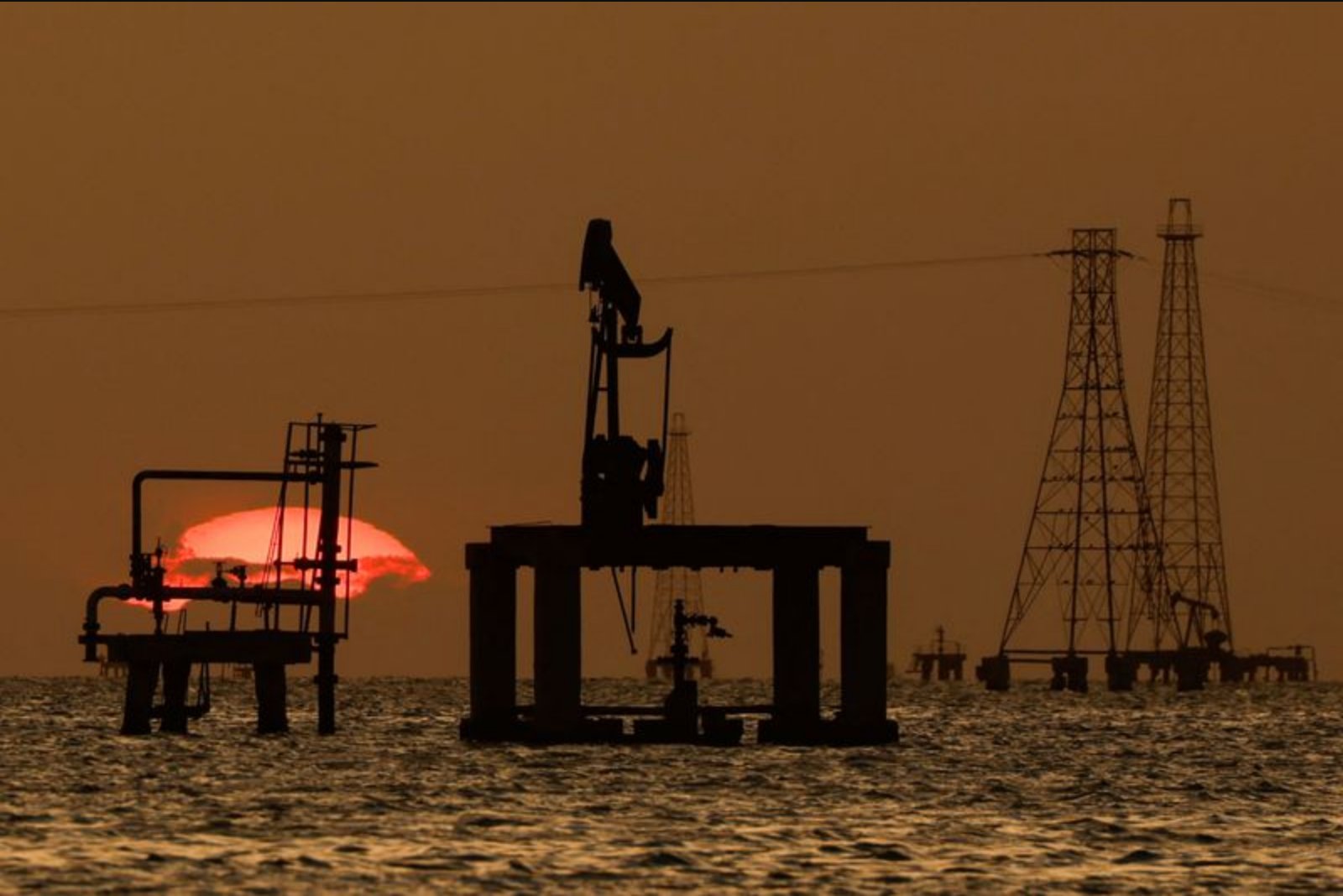
In recent months a large aging rig called Alula completed a voyage from China to Venezuela's Lake Maracaibo, stirring local interest because new drilling equipment had been absent from the region for years amid U.S. sanctions. The transit was not smooth - as the rig passed beneath the bridge linking Maracaibo city to the oilfields on the lake's eastern shore it struck an underwater pipeline amid a maze of roughly 20,000 kilometers of metallic pipe that lies beneath the lake. The strike caused a crude leak that took months to repair. After repairs were finished, the rig was finally installed in the polluted waters late last year, but the increase in production since that installation has been modest.
The Alula's bumpy arrival encapsulates the operational realities facing foreign energy companies that are positioning to expand quickly in Venezuela. Firms such as U.S. major Chevron, Spain's Repsol, Italy's ENI, France's Maurel&Prom and China National Petroleum Corp have varying degrees of engagement in the country. Washington has been loosening some restrictions this year, and U.S. President Donald Trump has publicly urged American firms to invest as much as $100 billion to rebuild an oil sector that has been undercut by two decades of neglect, mismanagement and underinvestment under the administrations of Hugo Chavez and Nicolas Maduro.
Recent easing from Washington has included a small number of general licenses allowing energy companies to export, import, invest and operate oil and gas projects inside the OPEC member. Officials and executives familiar with operations in Venezuela are projecting that modest, fast-moving interventions could yield an increase of up to 500,000 barrels per day from current output of around 1 million barrels per day within as little as six months, according to two executives with assets in the country. The U.S. Secretary of Energy, Chris Wright, speaking from Caracas this month, has said he expects a "dramatic increase" in Venezuelan production in coming months.
Across Venezuela's oil regions and in energy hubs such as Houston, companies and service providers are mobilizing for what many describe as an enormous repair and rehabilitation effort. Comparisons have been drawn to the scale of rebuilding required in Iraq after the second Gulf War or the efforts to restore Kuwaiti oilfields damaged by Saddam Hussein. Yet, sources interviewed by industry workers, executives and analysts emphasize that while the initial phase of work can be conceived as relatively straightforward, even those tasks are fraught with obstacles.
What the first phase looks like
In conversations with people who have direct experience in Venezuela, the near-term playbook centers on actions that use equipment already in the country and target infrastructure that needs relatively quick rehabilitation. That set of projects includes:
- Deploying rigs that are already on site to resume drilling or workovers;
- Refurbishing wells that have been neglected or are underperforming;
- Repairing crude upgraders that are running below capacity;
- Fixing ports, pipelines and terminals operated by state oil company PDVSA.
Despite appearing to be low-hanging fruit, these tasks are complicated by damaged or missing supporting systems and logistical bottlenecks. A reporter who toured Lake Maracaibo in early February recorded scenes of derelict oilfield equipment, storage tanks overflowing with crude, abandoned fields, shorelines stained black by pollution, and long lines of vehicles buying gasoline near PDVSA storage terminals and operating sites. Those on-the-ground observations underline the scale of cleanup and repair needed even to accomplish what might be considered the simplest interventions in a basin that holds some of Venezuela's oldest production facilities and its second-largest capacity.
Case study - China Concord and the Alula rig
One of the concrete projects that illustrates the practical challenges is the work carried out by China Concord Resources Corp, the company that brought the Alula rig to Venezuela. The firm designed a roughly $1 billion program aimed at expanding combined light and heavy oil output from two fields to about 60,000 barrels per day by the end of the year, up from about 16,000 barrels per day in December. The plan calls for refurbishing as many as 875 wells that have been inactive before new drilling can commence.
However, a source close to the project said China Concord is contending with a series of unplanned technical and logistical problems that have constrained its progress. Those include an inadequate supply of the gas needed to maintain reservoir pressure at wells, the loss of critical technical data, and the absence of reliable transport for workers. These barriers have prevented the company from meeting its output targets. Complicating the outlook further, it is unclear whether the project will continue to proceed as planned, after public statements from President Trump signaling that companies tied to global rivals such as China, Russia and Iran were not welcome in Venezuela. Under the previous sanctions regime, firms from those countries tended to be among the few willing to operate in Venezuela.
Chevron and the chase for light crude
Chevron, long a major foreign operator in Venezuela, is viewed by industry observers as being in a favorable position to realize early production gains. The U.S. company needs supplies of light crude - the type being produced in parts of Maracaibo by companies such as China Concord - to blend with heavier grades and to operate efficiently across Venezuelan assets. Light oil and diluents are particularly valuable because they enable movement and export of the country's vast extra heavy crude. Without access to either functioning upgraders or adequate diluents, Venezuela's extra heavy oil cannot be loaded onto tankers or shipped efficiently.
The availability of relatively easier-to-produce barrels in places like Lake Maracaibo and the Monagas North area is increasing interest among foreign firms in taking on work in heavily polluted or technically difficult basins that state company PDVSA has deprioritized while concentrating activity in the Orinoco Belt. One former employee with experience in Venezuela said producing oil around Maracaibo could be less costly than in other regions, particularly as it often does not require significant pre-export treatment, an advantage when oil prices are low.
Other near-term options being considered by operators include reopening wells that had been shut down due to a lack of specialized equipment or electricity, reconditioning wells that are underperforming, and drilling new wells. The same former employee suggested Chevron likely has an extensive list of potential new well locations it is reviewing. In public comments, Chevron said that it "has been a part of Venezuela's past and remains committed to working in partnership for its future," and that it welcomes recent U.S. licenses and legal reforms in Venezuela. PDVSA and the country's oil ministry did not answer requests for comment, and China Concord was not immediately reachable for comment.
Heavy crude and the Orinoco challenge
Beyond the comparatively easier gains in places like Maracaibo, the larger and more technically demanding challenge is restoring production across the Orinoco Belt, where Venezuela's extra heavy crude dominates the reserves picture. Companies with contractual stakes across the country are competing for access to specialized rigs and other equipment that remain physically in Venezuela. According to three sources with knowledge of the matter, there are as many as 14 drilling rigs that have been in storage in the country for years and are owned by SLB, the Houston-headquartered oil services company. SLB was a principal service provider to Chevron when the U.S. major began its most recent drilling program in Venezuela in 2024 under a prior broad U.S. license. Those rigs were originally deployed for PDVSA projects prior to the 2019 sanctions that prevented many U.S. firms and entities complying with U.S. sanctions from operating in Venezuela.
SLB told contacts that it continues to maintain operational facilities, equipment and personnel in Venezuela and that it is in "the early stages of collaboration" with customers on next steps. The company said it is confident that under appropriate conditions and with a safe environment, its activities could be ramped up rapidly.
At the Orinoco, drilling and workover rigs are critical because production is often managed through clusters of wells. Yet the more immediate constraint for units of extra heavy crude may be diluents and upgraders - equipment and blending capacity needed to turn thick, tar-like oil into grades that can be exported. Chevron and its PDVSA partners are prioritizing access to drilling rigs, refurbishments of upgraders and securing light oil or naphtha for blending. The U.S. company would also face the task of renovating PDVSA-owned infrastructure such as the Bajo Grande export terminal and of dredging the shipping channel in Lake Maracaibo - a channel that has not been properly maintained for years in part because sanctions made it difficult to hire dredging services.
To make a material impact at the Orinoco, Chevron would also need significant work on the Petropiar project's upgrader to restore it to full capacity. Sources within Chevron say that the Petropiar upgrader has not been fully repaired for years. Across Venezuela, only five projects out of more than 40 joint ventures between PDVSA and foreign and domestic partners currently have access to upgraders or blending stations that can process Orinoco extra heavy crude. The Orinoco region holds more than 80 percent of Venezuela's estimated 303 billion barrels of crude reserves, underscoring the strategic importance of restoring upgrading and blending capacity.
Firms lacking access to upgrader facilities would be forced to import costly diluents to make the extra heavy crude exportable, a solution that would reduce profit margins and introduce additional logistical complications given Venezuela's limited capacity to unload, transport and store such diluents.
Other repair projects and field potential
Some companies with regional ties are already working to bring idled equipment back into service. North American Blue Energy Partners, which has connections to U.S. asphalt magnate Harry Sargeant, has been repairing at least one rig owned by PDVSA for months for use at the Petrocedeño project in the Orinoco. Sources said that completing those repairs could return the equipment to service relatively quickly. The company did not immediately respond to requests for comment.
Independent strategists note that many fields previously written off as exhausted may still hold substantial production potential. Thomas O'Donnell, an energy strategist who consults independently, said that fields labeled as depleted often were simply neglected because PDVSA lacked the skilled personnel or equipment to maintain them. He observed that seismic and reservoir surveys in many mature fields were last carried out in the 1990s or early 2000s using older two-dimensional technology. By bringing such fields up to modern standards, O'Donnell suggested firms could attain sizable production increases - in some cases perhaps doubling current output in those fields.
Legal, security and policy risks
Even as operators and service companies map out projects that could yield rapid production gains, a set of legal and security risks loom. An oil services executive with Venezuela experience, speaking on condition of anonymity, said the country could potentially raise total production at existing fields to as much as 1.5 million barrels per day in under a year - but only if producers obtain the licenses required to operate. The same person warned that supply chain disruptions and acute security problems, particularly around Maracaibo, continue to pose serious hurdles.
Another material concern is legal uncertainty around contracts signed now and whether future governments would honor them. Venezuela's National Assembly in January approved a broad oil reform intended to give greater autonomy to foreign companies, but some of the new contract templates - which had been pushed previously by the Maduro administration with limited uptake - are still viewed by potential investors as risky. Executives have said additional regulatory clarity is necessary to govern those contracts. Observers also note constitutional questions about the long-term legitimacy of the reform passed by the legislature.
International political recognition remains unsettled as well. The United States, the European Union and other countries have not recognized the results of recent parliamentary and presidential elections in Venezuela, saying those ballots were rigged. That unresolved international stance feeds into investment uncertainty because foreign governments' policies can change. One important political risk for foreign investors is that future U.S. administrations may alter policy - including the pressure that prompted Caracas to negotiate sharing of control over oil exports and revenues with Washington - and that could affect the legal and commercial environment for companies operating in Venezuela.
Workers with long experience at terminals in the Maracaibo area also paint a stark picture about the scale of capital and effort required. One employee at PDVSA's La Salina terminal near Lake Maracaibo, with 22 years of experience in the area, said the necessary investment is enormous. "Many companies arriving have the means to fix this, but it is yet to be seen if they will be willing once they see this disaster," the worker said.
Near-term upside and long-term complexity
Industry sources canvassed for this analysis outline a two-tiered reality. On one hand, companies can capture relatively quick wins by focusing on projects that mobilize equipment already in-country, refurbish wells and repair logistic chokepoints. Those interventions could unlock hundreds of thousands of barrels per day in a compressed timeframe if licenses, labor and materials fall into place.
On the other hand, realizing the full potential of Venezuela's hydrocarbon base - particularly the heavy crude of the Orinoco - will require far more intensive capital, secure and reliable supplies of diluents or repaired upgraders, dredging and terminal rehabilitation and a secure, well-managed supply chain. The economics of these larger efforts are complex: imported diluents reduce margins, and costly refurbishments and upgrades require capital that only some partners may be willing to commit given legal and political uncertainty.
As U.S. and international firms weigh opportunities in Venezuela, the choice will often come down to balancing the potential for rapid early production gains against the operational, security and legal hurdles that could erode returns or stall projects. For some companies, the immediate opportunity will justify the risk; for others, the long list of uncertainties will remain a deterrent.
Bottom line
Recent arrivals of rigs and modest project starts have created momentum toward higher Venezuelan output in the near term, but the pathway to larger and sustained increases runs through complex technical work and a heavily constrained legal and logistical environment. Initial refurbishments and the use of existing equipment could deliver material gains quickly, yet the deeper task of restoring upgrader capacity, securing diluents, and repairing transportation and port infrastructure will demand far greater investment, coordination and regulatory clarity.
Industry participants and local workers alike emphasize that the country contains abundant reserves and that many fields are technically recoverable with the right resources. Nevertheless, the combination of physical damage, lost data, security concerns and legal ambiguity means that execution will be difficult, costly and uncertain.
Is CVX a bargain right now? The fastest way to find out is with our Fair Value calculator. We use a mix of 17 proven industry valuation models for maximum accuracy. Get the bottom line for CVX plus thousands of other stocks and find your next hidden gem with massive upside.