
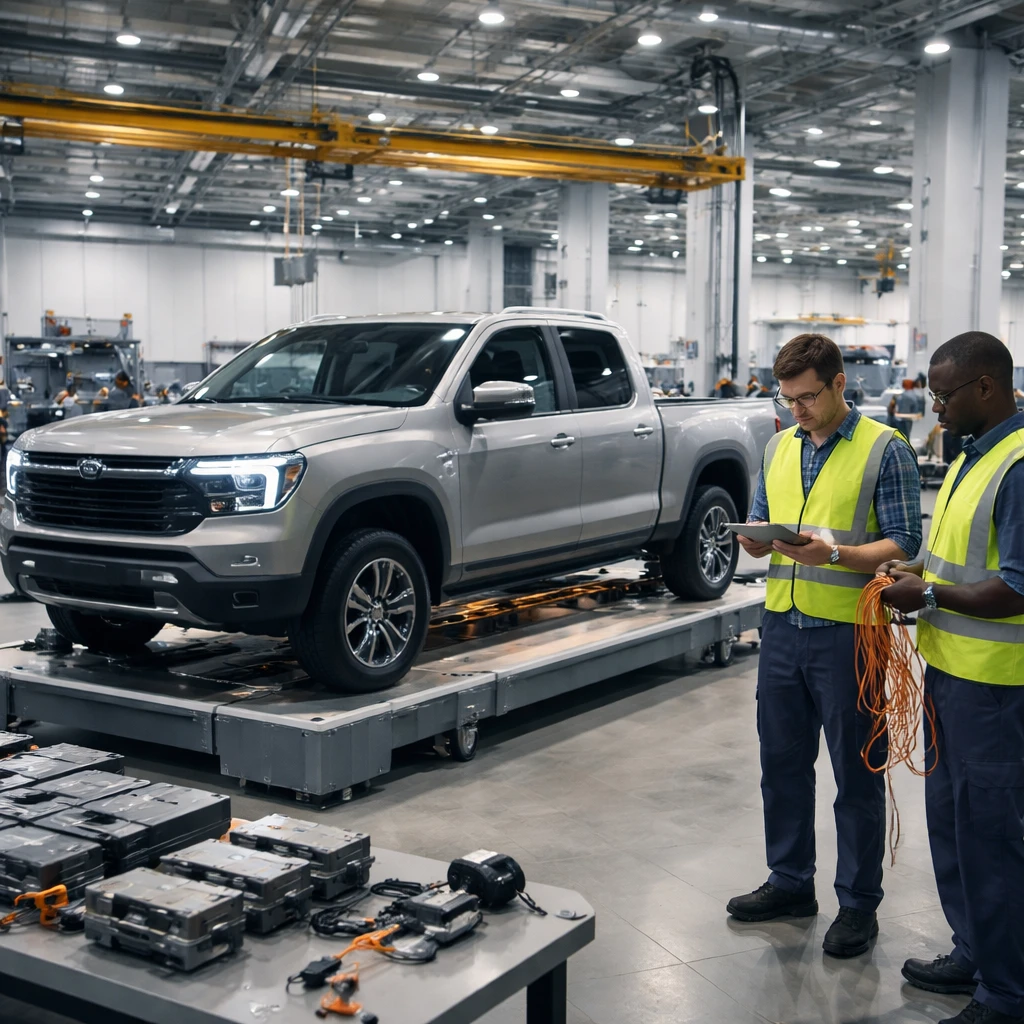
Ford Motor has completed development of a new electric vehicle architecture at its Long Beach, California facility that the company says will serve as the foundation for its next generation of battery-electric models. Known internally as the Universal Electric Vehicle, or UEV, the platform is positioned as a backbone for a series of future vehicles as Ford continues to press forward on electrification while many peers have slowed investments.
Company executives view the UEV as a financial lever for the Model e EV division, which has posted annual losses measured in the billions. Ford expects the platform to be a major contributor to moving the unit from those losses to breakeven by 2029. The automaker has also stated that cars and trucks developed on its future EV architecture will reach profitability within a year of their market launch.
The first production application of the UEV will be a midsize pickup truck aimed at the U.S. market, with a target retail price in the neighborhood of $30,000 and a planned introduction next year. Ford says additional models will follow on the same platform.
Alan Clarke, Ford's EV product leader, discussed the program during an interview at the Electric Vehicle Development Center in Long Beach and said the company sees the midsize pickup as uniquely positioned on price and product attributes. "The midsize pickup truck, there won't be anything that competes with it, either in price or product form, and so I think it sort of stands alone in that sense," Clarke said.
"Agility is key," Clarke added, describing the team's ability to adjust development priorities amid difficult industry conditions. "We've been able to pivot around all the different market conditions. The EV industry has had massive headwinds, and so we've had to adjust."
Clarke, who spent 12122
Recently promoted from senior director to vice president of Advanced Development Projects, Clarke also addressed how Ford expects to narrow the cost gap between electric and internal combustion vehicles. The automaker pointed to a smaller battery pack using new lithium iron phosphate cells produced in the United States, together with a 48-volt electrical architecture intended to improve efficiency and reduce weight.
On competition, Clarke said he is "pretty confident" the UEV can compete with Chinese-made vehicles, while noting the companies operate under different conditions. He referenced government support afforded to some Chinese manufacturers and lower labor costs there, saying, "We only win with speed, and we have to play by the rules here." Clarke emphasized the need to match price points that American consumers are willing to pay if Ford hopes to be successful.
The rollout strategy for the UEV is to start with the midsize pickup and then introduce further derivatives on the same architecture. Ford frames the platform as both a product and cost-efficiency play aimed at making EVs financially competitive and commercially viable within a tight timeframe, though the company also acknowledges the market has required adjustments to plans and pace.
As Ford moves toward production on the UEV-based truck and subsequent models, the vehicle costs, consumer pricing and the broader competitive environment remain focal points for assessing whether the platform will deliver the financial turnaround the company has outlined.