
Stock Markets February 23, 2026

FedEx Seeks Full Reimbursement for Emergency Tariffs Ruled Illegal by Supreme Court

Shipping giant files suit in Court of International Trade after high court said it has exclusive jurisdiction over tariff refunds

By Leila Farooq FDX
FedEx Seeks Full Reimbursement for Emergency Tariffs Ruled Illegal by Supreme Court
FDX

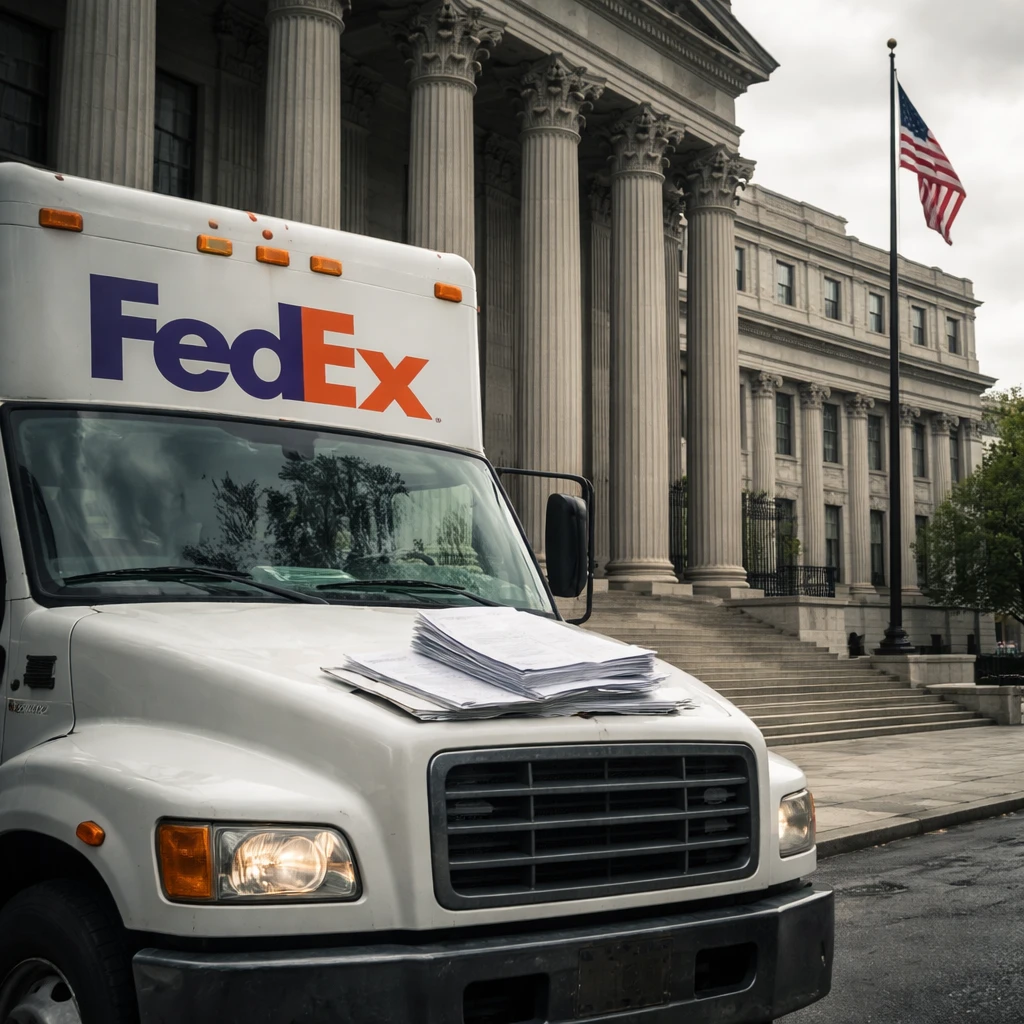
FedEx has sued the U.S. government in the Court of International Trade seeking a full refund of emergency tariff payments that the Supreme Court recently found unlawful. The lawsuit follows the high court's determination that former President Trump exceeded his authority in imposing the tariffs under the International Emergency Economic Powers Act, and comes amid unresolved questions about the disposition of over $160 billion in tariff revenue and a subsequent announcement of a new 15% universal tariff.

Key Points

  • FedEx has sued the federal government in the Court of International Trade seeking a full refund of emergency tariffs declared unlawful by the Supreme Court - this directly affects the shipping and logistics sector.
  • The Supreme Court ruled that the emergency tariffs exceeded presidential authority under the International Emergency Economic Powers Act and designated the Court of International Trade as having exclusive jurisdiction over related claims - a development with implications for trade policy and corporate legal strategies.
  • The ruling left unresolved what should be done with tariff revenues estimated to exceed $160 billion, while a newly announced 15% universal tariff would require Congressional approval to extend beyond 150 days - impacting broader trade and market policy dynamics.

FedEx Corporation filed a lawsuit on Monday in the Court of International Trade asking the U.S. government to return the money the company paid under emergency tariffs that the Supreme Court has since deemed illegal. The shipment carrier says it wants a "full refund" of the tariff charges it had remitted under the measures imposed by President Donald Trump.

The Court of International Trade was identified by the Supreme Court on Friday as having "exclusive jurisdiction" over legal claims tied to the disputed tariffs. FedEx's complaint is the first reported suit by a U.S. corporation seeking recovery following last week's Supreme Court decision, according to filings related to the case.

The Supreme Court concluded that the former president exceeded the authority granted by the International Emergency Economic Powers Act when he authorized the emergency tariffs. That ruling did not, however, resolve the question of what should happen to tariff proceeds already collected by the government - an amount estimated in the public record as exceeding $160 billion.

Several companies had previously brought legal challenges to the tariff program. The suits included filings from Costco, cosmetics company Revlon, and Japanese tyre maker Revlon. Those challenges were part of a broader wave of litigation that the Supreme Court's decision addresses in determining the proper legal venue and authority underpinning the tariffs.

In response to the Supreme Court ruling, former President Trump announced a 15% universal tariff under a different legal framework. That announcement also carried a procedural limit - any extension of the new tariff beyond 150 days would require approval from Congress.


Context and next steps

  • FedEx's filing asks the Court of International Trade to order repayment of tariffs paid under the emergency tariffs now held unlawful by the Supreme Court.
  • The Supreme Court's decision established the Court of International Trade's exclusive jurisdiction over disputes tied to the emergency tariffs but did not direct how collected revenues should be treated.
  • After the ruling, the former president announced a replacement 15% tariff that is subject to a 150-day limit unless Congress acts to extend it.

Risks

  • Uncertainty over the disposition of over $160 billion in revenue collected from the now-ruled-illegal tariffs - this affects federal receipts and companies that paid the levies.
  • Legal and jurisdictional questions remain in play even after the Supreme Court decision, as the Court of International Trade must adjudicate refund claims - legal outcomes may be protracted, affecting corporate balance sheets in the interim.
  • Policy uncertainty stemming from the announcement of a 15% universal tariff that is time-limited unless Congress approves an extension beyond 150 days - this creates short-term uncertainty for trade-exposed sectors and markets.

More from Stock Markets

DeepSeek Used Nvidia Blackwell Chips to Train New Model, Raising Export-Control Questions Feb 23, 2026 U.S. Futures Edge Up After Sharp Losses Driven by Tariff Uncertainty and AI Concerns Feb 23, 2026 Asian Stocks Falter as Wall Street Drop and Trade Uncertainty Weigh on Sentiment Feb 23, 2026 U.S. Officials Conducted January Rate Checks to Bolster Yen, Stood Ready to Intervene with Japan Feb 23, 2026 Woodside Rides Strong Production to 18-Month Share High While Keeping Dividend Intact Feb 23, 2026