
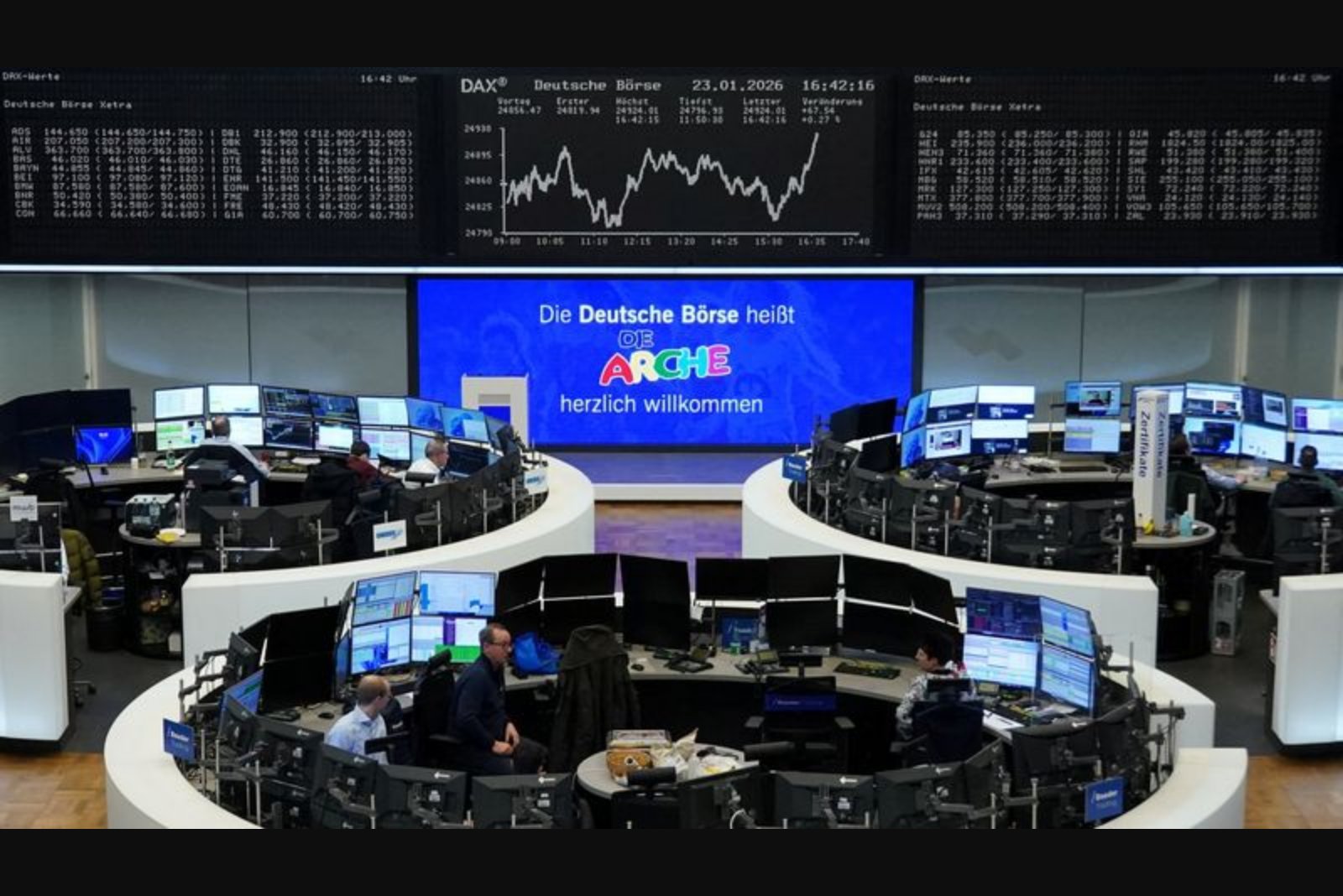
European equities fell on Monday amid a fresh bout of uncertainty over U.S. trade policy after a new U.S. tariff announcement. The pan-European STOXX index, which had closed last week at a record after a U.S. Supreme Court decision on prior tariffs, slipped amid concerns about the implications for international trade relationships.
By 0815 GMT the STOXX was down 0.3% at 628.62 points, with Germany's DAX registering the largest decline among major benchmarks, off 0.7%. Most sectors traded lower; technology names led the downturn with a 1.3% fall. Conversely, banks - generally perceived as more domestically oriented - were among the better performers.
The move followed a weekend announcement by the U.S. President introducing a new global tariff rate. The tariff was initially set at 10% and then raised to 15%, a change that generated ambiguity about the standing of existing trade arrangements, including those with the EU. The European Commission has said it will not alter current arrangements in response.
Corporate headlines produced notable single-stock moves. Italy's largest utility, Enel (MI:ENEI), rose 3.4% after the company said it planned to boost capital expenditure over the next three years with a renewed emphasis on renewable energy projects, principally in Europe and the United States. In contrast, Johnson Matthey (L:JMAT) tumbled 14% following an agreement to reduce the sale price of its catalyst technologies division to Honeywell (O:HON). The unit had underperformed in fiscal 2025 due to delayed projects and weaker profitability, prompting the price adjustment.
The broader market reaction reflected a mix of macro-driven caution and earnings or strategy-driven positioning: tariff uncertainty pressured internationally exposed sectors, while domestic-oriented industries showed relative resilience. Technology stocks, which often have more global revenue exposure, bore the brunt of the market decline on Monday.
Market takeaway
- Renewed U.S. tariff measures triggered risk aversion across European equity markets, trimming the STOXX and hitting the German DAX hardest.
- Technology sectors led losses, consistent with sensitivity to cross-border trade dynamics; banks outperformed among major sectors.
- Company-specific news drove significant stock moves: Enel advanced after a capex and renewables pivot, while Johnson Matthey fell sharply after agreeing to lower the sale price of a key business to Honeywell.
Context limitations
- Details on follow-on market reactions beyond the immediate session and longer-term policy impacts are not provided in the available information.
- The article reflects the data and corporate announcements cited for the trading session through 0815 GMT; subsequent developments are not covered here.