
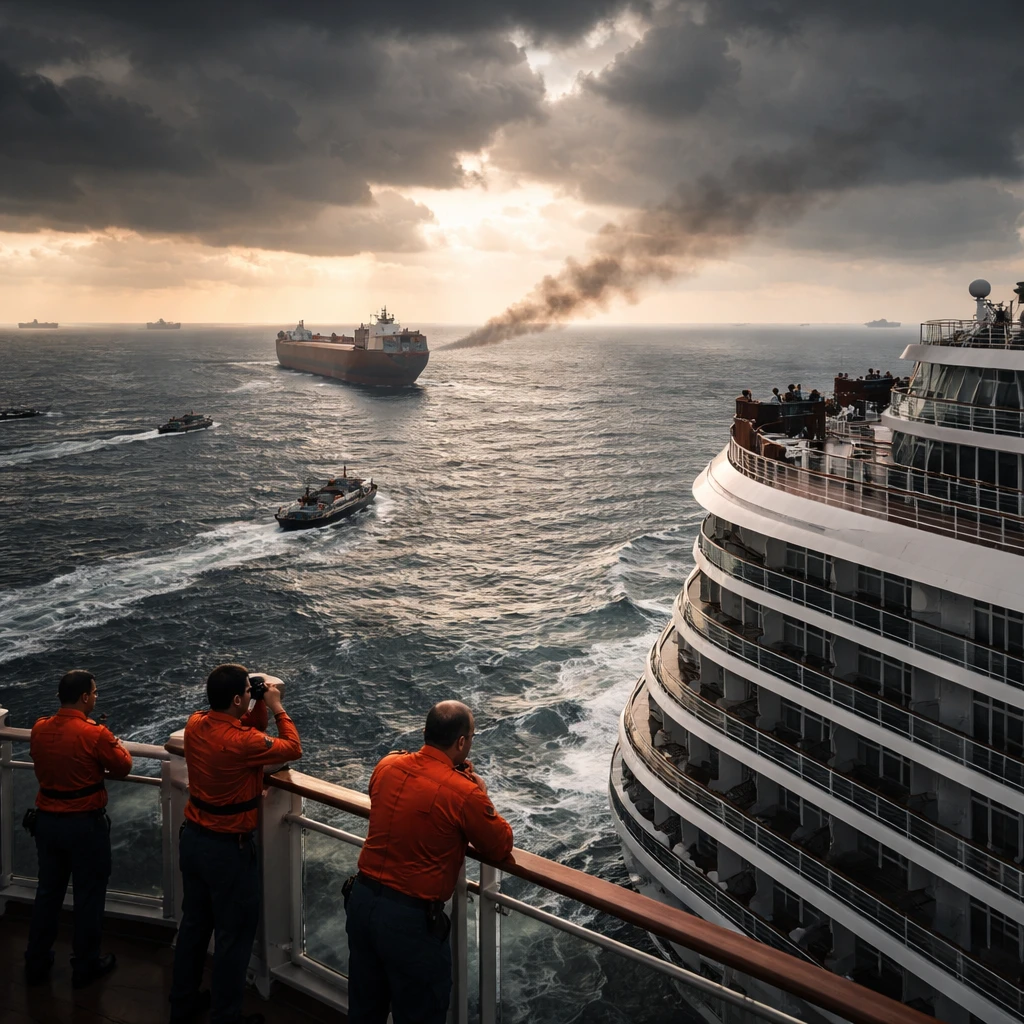
Cruise-sector equities opened lower Thursday after oil benchmarks climbed sharply amid renewed attacks on ships near the Strait of Hormuz. Carnival Corporation (NYSE:CCL), Royal Caribbean Cruises Ltd (F:RCL), Norwegian Cruise Line Holdings Ltd (NYSE:NCLH) and Viking Holdings Ltd (NYSE:VIK) all moved lower in pre-open trading as crude futures surged toward the $100-per-barrel level, raising immediate questions about fuel cost pressure in an industry where energy costs commonly account for roughly 10% to 15% of revenue.
Carnival led the losses among the large operators, slipping 3.2% to $25.15. Royal Caribbean and Norwegian each lost 2.6%, while Viking shares dropped 2.9%. The gap in share-price reactions reflects differences in fuel-risk management. According to TIKR analysis, Carnival does not hedge its fuel consumption, which means price spikes feed through directly to earnings with no hedging cushion. By comparison, Royal Caribbean and Norwegian maintain fuel hedging programs that typically cover some near-term needs and therefore blunt, though do not eliminate, short-term price shocks.
The commodity move was pronounced. Brent futures rose $7.31, or 8%, to $99.29 per barrel, and WTI climbed $6.80, or 8%, to $93.93 as of Thursday's close. The escalation followed Iranian attacks on two tankers in Iraqi waters overnight on March 11-12, increasing the tally of vessels struck in the area to at least 16 since the U.S.-Israeli military operation in Iran began on February 28.
Market participants and analysts noted an immediate impact across travel markets. The global travel sector weakened on Thursday as observers highlighted the potential for higher fuel bills, increased cancellations and the costs of rerouting ships and aircraft. Major Gulf transport hubs added to the strain; Dubai airport, which handles more than 1,000 flights daily and is the world's busiest international airport by that metric, remained closed for a third consecutive day as of Thursday, further clouding demand and routing for carriers and tour operators.
Strait of Hormuz risks and oil flows
Iran's Revolutionary Guards issued a warning that any vessel transiting the Strait of Hormuz could be targeted. The strait is a critical chokepoint that carries about a fifth of global oil supply - roughly 21 million barrels per day - and tanker traffic has already contracted sharply. Only five oil tankers passed through the strait on March 1, compared with roughly 60 tankers per day in recent periods, S&P Global data show.
"If the reduction in tanker traffic continues for a week or so it will be historic," said Jim Burkhard, S&P Global head of crude oil research.
Hardline rhetoric accompanied the military activity. "Get ready for oil to be $200 a barrel, because the oil price depends on regional security, which you have destabilized," said Ebrahim Zolfaqari, spokesperson for Iran's Khatam al-Anbiya military command headquarters. "We won't allow even one litre of oil to reach the U.S., Zionists (Israel) and their partners. Any vessel or tanker bound to them will be a legitimate target."
In response to the disruption, the International Energy Agency agreed to a record release of 400 million barrels from strategic stockpiles, with the United States contributing 172 million barrels from its Strategic Petroleum Reserve. Still, some market strategists cautioned that stockpile releases could be a temporary reliever. "The IEA's release of oil reserves may be only a temporary solution, as disruptions to oil shipments through the Strait of Hormuz and a major production halt in some Middle Eastern countries could cause a long-term supply crunch," said Tina Teng, market strategist at Moomoo ANZ.
On the forecasting front, Goldman Sachs raised its Q4 2026 Brent crude price outlook to $71 per barrel from $66, citing expectations of a longer disruption to flows through the Strait of Hormuz. Since the regional conflict began, Brent has climbed more than 36% and WTI about 39%, with both benchmarks briefly topping $119 on Monday March 9.
Margin exposure and company-level implications
The immediate financial implication for cruise operators centers on fuel cost exposure and the extent to which firms can hedge or pass through higher costs. For Carnival specifically, which the TIKR analysis characterizes as unhedged, a sustained $20 rise in crude prices could cut annual operating income by an estimated $400 million to $600 million, equivalent to about $0.30 to $0.45 per share. That estimate is based on fuel consumption representing roughly 10% to 15% of revenue and assumes no pricing pass-through to customers.
Using Carnival's approximate $20 billion in annual revenue as a reference point, the analysis implies fuel costs would increase by about $200 million to $300 million for every $10 sustained rise in crude prices, again absent offsetting price increases for consumers.
Royal Caribbean and Norwegian do maintain partial hedges, typically covering 30% to 50% of near-term fuel needs. Those programs will cushion some of the immediate impact but will not remove margin pressure if elevated prices persist. Viking's smaller, higher-end fleet profile may allow greater pricing flexibility to help absorb or pass through fuel surcharges, though that depends on demand elasticity and competitive dynamics.
What investors and managers will be watching next
- Carnival's Q4 2025 earnings: Results are expected around March 19, when management could offer updated guidance on fuel-cost impacts and discuss how the Middle East situation may influence the 2026 outlook.
- Crude price direction: Whether Brent maintains levels above $100 is a key variable; sustained prices at or above that threshold would markedly increase margin pressure across the cruise operators.
- Strait of Hormuz tanker flows: Tanker traffic through the strait is a primary gauge of how long supply disruption may last - S&P Global analysts warn that if the current five-tanker-per-day rate persists for another week it would be the largest sustained oil supply disruption in history.
- Booking and cancellations: Consumer behavior will matter - booking trends and cancellation rates will help determine how demand responds to higher travel costs, route disruptions and continued Gulf airport closures.
- Hedging disclosures: Updates from Royal Caribbean and Norwegian on hedging positions in upcoming earnings calls will clarify how much protection they retain for Q2 and Q3 2026.
- Competitive pricing: Whether cruise lines can impose fuel surcharges or increase fares without reducing load factors will affect each operator's ability to protect margins.
Summary
Renewed attacks on tankers near the Strait of Hormuz pushed Brent and WTI sharply higher, denting cruise-sector equities. Carnival, an unhedged fuel consumer, fell most, while Royal Caribbean, Norwegian and Viking also dropped amid concerns about higher operating costs. Key items to monitor include upcoming Carnival results, crude price persistence above $100, tanker traffic statistics through the strait, booking and cancellation trends, and hedging status updates from the hedged operators.
Key points
- Major cruise stocks declined in pre-market trading as Brent neared $100 per barrel, with Carnival down 3.2% to $25.15 and other operators off by around 2.6%-2.9%.
- Fuel typically represents about 10%-15% of revenue for cruise lines; unhedged exposure means price spikes hit earnings directly, while partial hedging programs provide limited short-term protection.
- Travel and energy markets are being affected simultaneously - immediate impacts include route disruptions, airport closures in the Gulf, and elevated risk to tanker flows through the Strait of Hormuz.
Risks and uncertainties
- Duration of tanker-traffic disruption - if the reduced flow through the Strait of Hormuz persists, the supply shock could be historic and sustain higher oil prices, increasing costs for transportation-dependent sectors including travel.
- Effectiveness and longevity of strategic stockpile releases - the IEA's record release of 400 million barrels, including 172 million from the U.S., may be a short-term measure that does not prevent longer-term supply constraints.
- Consumer demand response - higher fares or fuel surcharges and continued Gulf airport closures could lead to cancellations and softer booking trends, creating revenue pressure for cruise operators and adjacent travel sectors.