
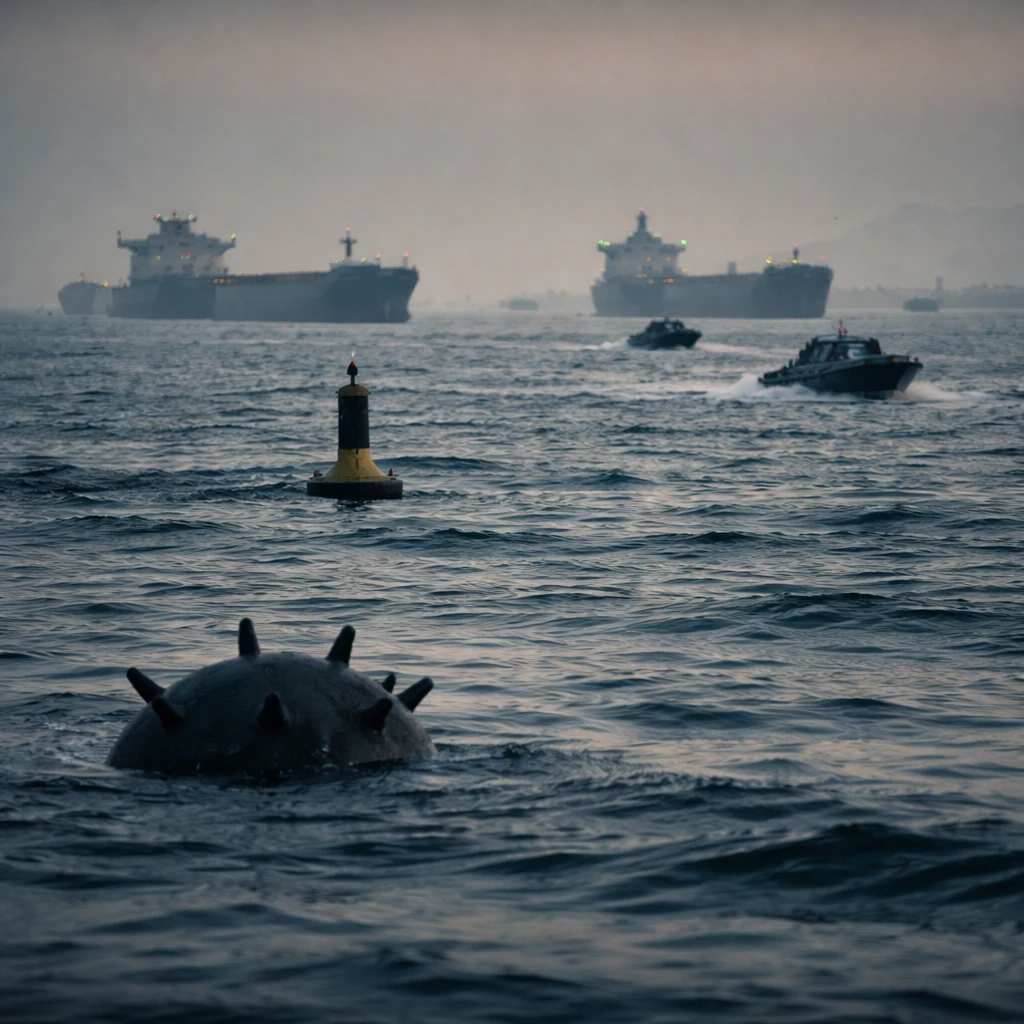
Crude oil prices reversed higher on Tuesday after media reports emerged that Iran has begun placing mines in the Strait of Hormuz, the strategic waterway that transports roughly one-fifth of global crude shipments. The initial market move pushed major stock averages lower during the session as investors reacted to the supply risk signaled by the reports.
Two people familiar with U.S. intelligence reporting told reporters that Iran has deployed a few dozen mines in the strait in recent days. Those sources also noted that Iran continues to retain around 80% to 90% of its small boats and mine layers, implying the capability to lay many more mines if it chose to do so. The reporting emphasized that the recent deployments were limited in number but left open the possibility of wider action because of Iran's remaining assets.
The Islamic Revolutionary Guard Corps, which is now reported to share control of the strait with Iran's conventional navy, is described as having a range of capabilities relevant to denying or disrupting maritime traffic. Those capabilities identified in the reporting include dispersed mine-laying craft, explosive-laden boats and shore-based missile batteries. The IRGC has previously issued warnings that any ship transiting the strait could be subject to attack.
According to the reporting, the navigational channel has been functionally closed since the start of the war, with the state of the strait characterized as extremely hazardous for vessels attempting to transit. U.S. officials on Tuesday said the U.S. Navy had not escorted any ships through the strait. President Donald Trump said on Monday that his administration was considering options to provide escorts.
In a post on his social media platform, President Trump wrote: "If Iran has put out any mines in the Hormuz Strait, and we have no reports of them doing so, we want them removed, IMMEDIATELY! If for any reason mines were placed, and they are not removed forthwith, the Military consequences to Iran will be at a level never seen before. If, on the other hand, they remove what may have been placed, it will be a giant step in the right direction!"
Market implications of the reports were evident in both oil and equities. Crude prices traded higher on the news of mine deployments and the potential for further maritime disruption, while broad market averages declined during the session as investors weighed the possible supply-side impact.
This account sticks to the details reported by intelligence sources and official statements: a limited number of mines reported deployed, a substantial remaining inventory of mine-laying boats, reported IRGC capabilities, the stated hazard to navigation in the strait, the absence of U.S. Navy escorts as of Tuesday, and the U.S. president's public warning.