
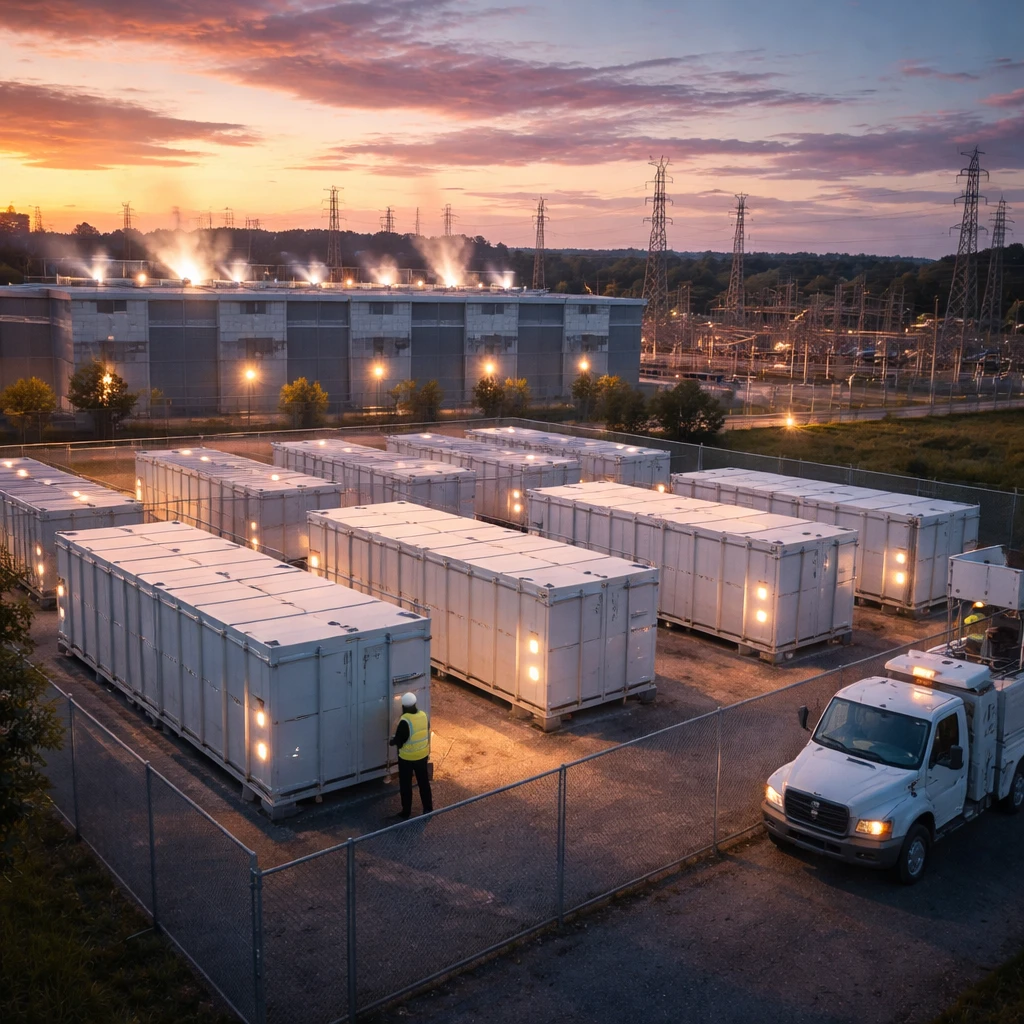
Barclays has mapped out leading names in the U.S. Battery Energy Storage Systems sector as part of a wider review of more than 400 firms in digital and power infrastructure that underpin growing AI hyperscaler capacity needs. The firms cited span generalist manufacturers, niche chemistry developers and software-centric energy management platforms that service utility, commercial and residential customers.
The companies noted by Barclays provide a mix of hardware, software and services across different storage technologies and duration profiles. Below is a company-by-company account of the key capabilities and the most recent corporate developments highlighted in the review.
Tesla
Tesla produces utility and commercial-scale energy storage systems marketed as Megapacks, in addition to residential Powerwall units. Tesla’s storage business has evolved into a material element of its overall portfolio. The company’s energy arm, Tesla Energy Ventures, has been authorized to supply electricity in Great Britain. Separately, Tesla received regulatory clearance to convert its investment in xAI into an equity stake in SpaceX. On the analyst front, GLJ Research reiterated a Sell rating on the company’s stock, citing safety concerns.
Canadian Solar
Canadian Solar offers end-to-end energy storage solutions that include proprietary power blocks, project development and long-term operations and maintenance services. Its approach is to support projects across the lifecycle. Canadian Solar’s subsidiary, Recurrent Energy, completed the sale of a 200 MWh Fort Duncan Battery Storage facility in Texas. The parent company also closed a $230 million convertible senior notes offering to raise capital.
Energy Vault
Energy Vault focuses on utility-scale solutions using gravity-based systems, green hydrogen and battery storage targeted at both short-duration and ultra-long-duration use cases. The company reported its first positive Adjusted EBITDA in the fourth quarter of 2025. Energy Vault also forged a strategic partnership with Peak Energy to develop energy storage solutions dedicated to AI infrastructure.
Eos Energy Enterprises
Eos manufactures zinc-based battery energy storage systems designed for utility-scale and industrial long-duration deployments, positioning its chemistry as an alternative to conventional lithium-ion. Eos reported a significant miss on both revenue and earnings per share forecasts for its fourth quarter of 2025. In response to the results, Guggenheim downgraded the company’s stock to Neutral from Buy.
ESS Tech
ESS Tech develops iron flow battery technology capable of delivering up to 12 hours of flexible energy capacity, aimed at applications that require extended discharge durations. In its fourth-quarter 2025 earnings, the company highlighted a substantial reduction in losses despite reporting a decline in revenue for the full year.
Fluence Energy
Fluence combines intelligent energy storage hardware with digital optimization software to serve grid applications globally, offering integrated solutions for utilities and commercial customers. The company reported a wider-than-expected loss for its first quarter, although revenue exceeded expectations. Following that report, Jefferies upgraded Fluence’s stock to Buy, while Mizuho lowered its price target.
GE Vernova
The General Electric spinoff supplies containerized battery energy storage solutions, including a RESTORE DC Block product designed for 2-8 hour utility-scale projects. GE Vernova completed a $2.6 billion senior notes offering to help finance its acquisition of the remaining stake in Prolec GE. The company also received an upgrade to Buy from Rothschild Redburn.
NextEra Energy
NextEra develops standalone battery storage projects as well as systems co-located with generation assets, with a focus on improving grid reliability and enabling load shifting. The company completed a $2 billion capital raise through an equity units offering and raised its quarterly dividend by 10%. NextEra also received a Buy rating upgrade from Erste Group and an increased price target from UBS.
Stem
Stem operates Athena, an AI-driven platform that monitors and optimizes utility-scale, commercial and industrial energy assets, emphasizing software-enabled energy management. Stem reported positive adjusted EBITDA for both its fourth quarter and full-year 2025. Separately, UBS lowered its price target on the company’s stock, citing a slower outlook for software sales.
Ads-Tec Energy
Ads-Tec Energy develops and manufactures scalable battery systems up to multi-megawatt capacity for decentralized energy management applications. The company secured new contracts for large-scale battery storage projects in Germany and Austria, including a 10 MW system for a public utility in Mühlacker.
Vertiv
Vertiv integrates battery energy storage systems into mission-critical infrastructure for data centers, focusing on reliability and continuous operation in support of compute and networking facilities.
Collectively, the companies span a range of technology choices - from lithium-ion and zinc-based chemistries to flow batteries, gravity systems and green hydrogen - and present varying commercial approaches: turnkey project development, equipment manufacturing, software-enabled optimization and project monetization through asset sales or capital markets activity. Barclays’ selection underscores how BESS providers are positioned to support expanding hyperscaler demand for resilient, flexible power solutions across durations and scales.