
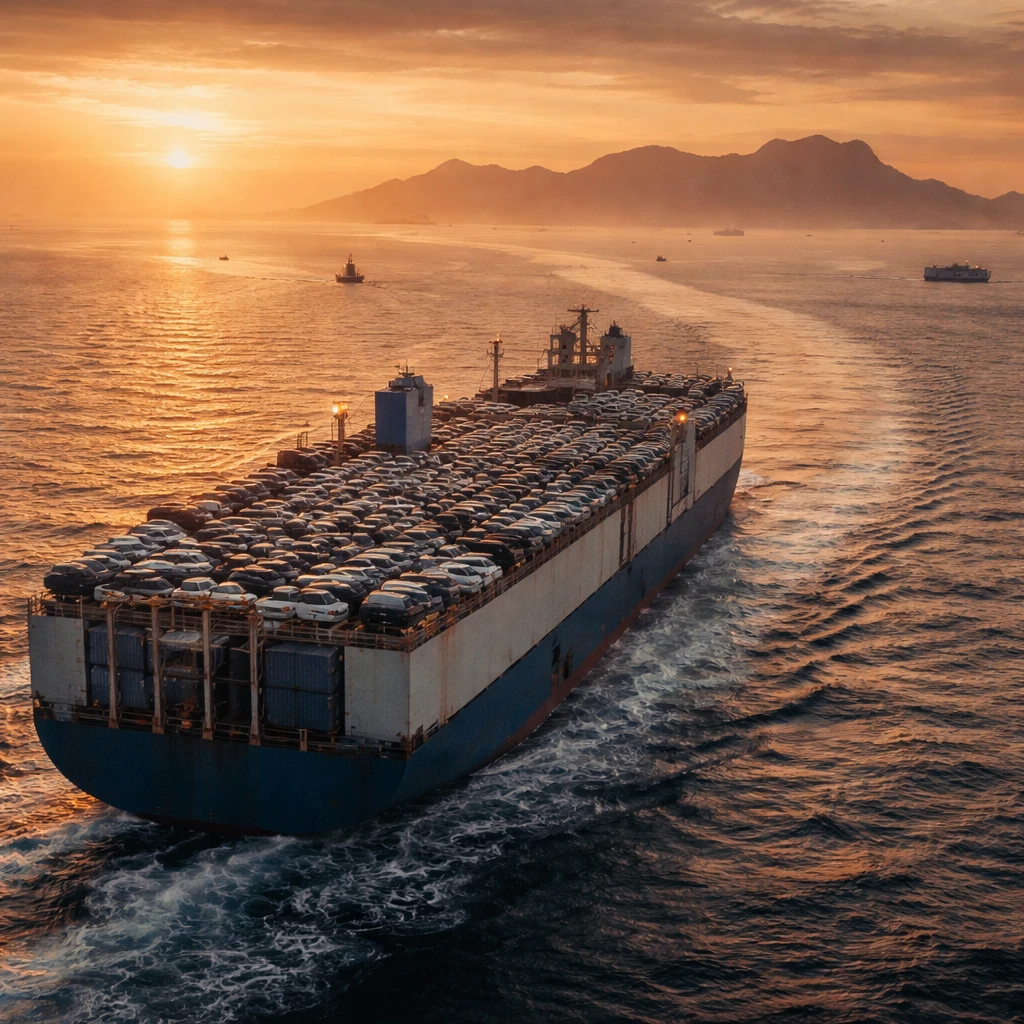
The fallout from U.S.-Israeli strikes that prompted Iran to close the Strait of Hormuz has exposed certain automakers to material near-term disruption, according to a Bernstein research note. With the Gulf shipping lane effectively shut, vessels have been forced to take a much longer course around Africa’s Cape of Good Hope, adding an estimated 10 to 14 days to transit times and creating immediate logistical and cost pressures.
Bernstein flagged Chinese producers and Stellantis as the companies with the largest direct exposure to a Middle East market that recorded roughly 3 million new car sales in 2025. Iran alone accounted for 38% of regional sales last year, lifting the stakes for manufacturers that depend on Persian Gulf demand and transit routes.
Chinese exporters carry the heaviest direct burden. Bernstein, citing China Customs data, notes that the Middle East absorbed 17% of China’s total passenger vehicle exports in 2025, a share that grew at a 59% five-year compound annual growth rate. At the company level, Bernstein identifies Jianghuai as the most exposed, with 9% of its total volumes tied to the region; SAIC follows at 7%, Chery at 6%, and both Changan and Great Wall at 3% each.
Chery merits special mention inside Iran, where it holds a 6% market share and ranks as the largest Chinese exporter to the broader Middle East by volume. Those positions leave the company and other high-exposure exporters vulnerable to both direct demand shocks in Iran and to shipping delays that complicate distribution across the region.
Among European producers, Stellantis stood out in 2025 for its relatively strong performance in the Middle East and Africa. The group generated €9.71 billion in revenue from the region, reporting adjusted operating income of €1.36 billion and an adjusted operating margin of 14% - one of the firm’s few profitable regional markets. That regional strength contrasted with Stellantis’ overall results, which showed an adjusted operating loss of €911 million for the year. Stellantis shares have already fallen 11% since Friday’s close, and Bernstein noted the company’s recent strategic emphasis on gas-powered HEMI V8 engines looks poorly timed as fuel prices climb.
Luxury and mainstream brands posted differing exposures. Ferrari shipped 626 cars to the Middle East in 2025, representing 4.6% of its global shipments and a 31% increase from 479 units the prior year. At scale, Toyota led all international automakers in the region with a 17% market share, followed by Hyundai at 10%.
Bernstein observed that Japanese manufacturers face limited immediate impact from the Iran situation because longstanding sanctions had already excluded them from the Iranian market; instead, Saudi Arabia accounts for the bulk of their regional sales. That distinction reduces their direct vulnerability to disruptions centered on Iran, at least for now.
The note highlights supply-chain and cost-channel knock-on effects beyond vehicle unit sales. European truck orders, which had been robust in recent months, could slow if diesel prices rise - fuel accounts for 20% to 30% of total truck ownership costs, and higher diesel costs would dampen operator economics. Tyre makers such as Michelin and Bridgestone, which had previously guided for raw material tailwinds in early 2026, face the risk that those benefits reverse should oil prices remain elevated. Bernstein emphasizes a three to six month lag between crude prices and tyre makers’ cost base, meaning current crude strength could weigh on margins further down the line.
Bernstein’s broader warning is that a protracted conflict could lift oil prices and sap global consumer confidence, exerting downward pressure on auto demand well beyond the Gulf. The research note frames the risk as one that starts with immediate shipping disruptions and extends to manufacturing margins, dealer inventories, and consumer purchasing power across multiple regions.
Market implications
The near-term consequences are centered on logistics and fuel-related costs, but the pathways to wider market stress are clear in Bernstein’s analysis: interrupted shipping schedules and higher oil prices translate into higher distribution costs, more constrained supply timing for vehicles and parts, and compressed margins for suppliers with commodity-linked inputs. If the conflict persists, those effects could feed into weaker vehicle demand and slower commercial-vehicle investment.
Given the concentration of Chinese exports to the Middle East and Stellantis’ earnings reliance on the region, investors and industry participants will be watching shipping patterns, oil-price trajectories, and regional demand indicators closely in the coming weeks.