
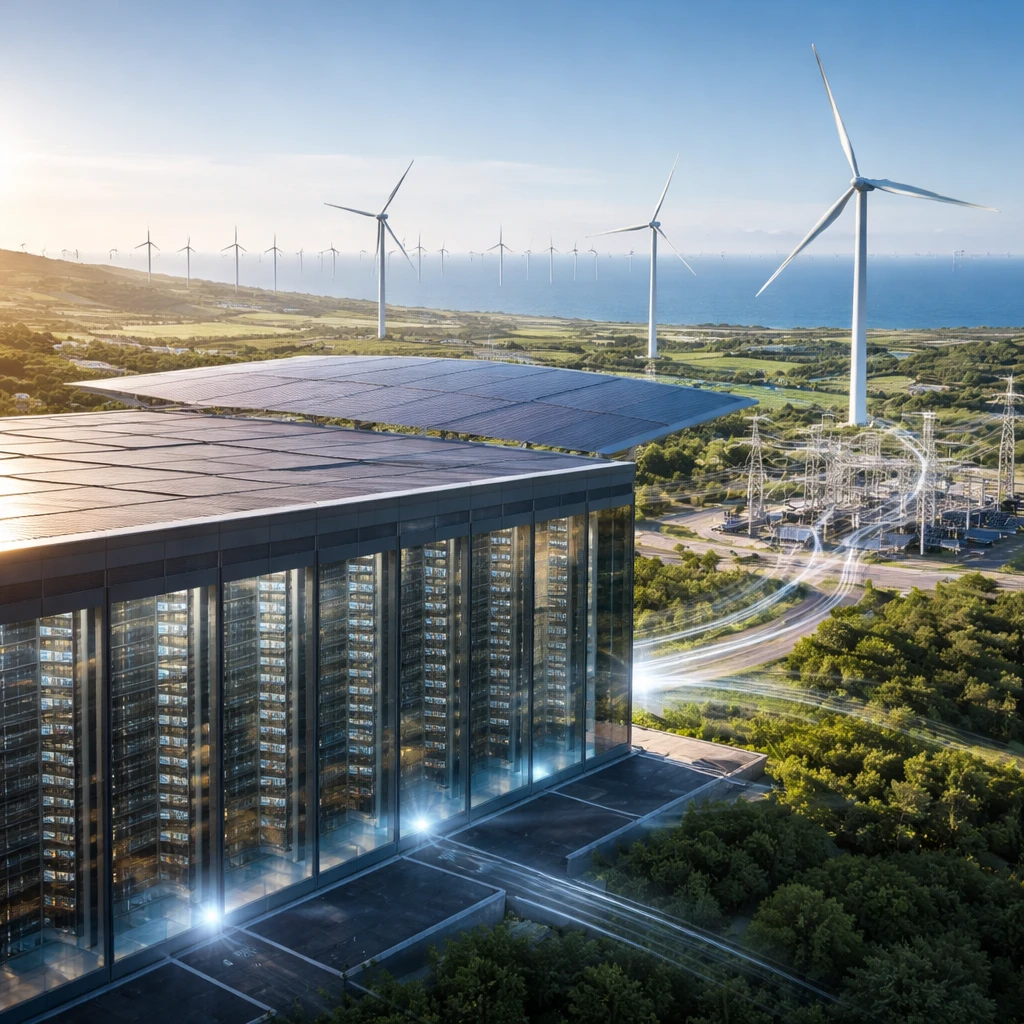
A senior director at a research institute affiliated with China’s National Development and Reform Commission (NDRC) outlined forecasts showing a dramatic rise in electricity consumption from data centers over the remainder of this decade. The expert estimated that current data center power use of around 300 billion kilowatt-hours would expand to roughly 1 trillion kilowatt-hours by 2030, representing about 7% of the country’s total power consumption.
The same expert highlighted a significant cost advantage for domestic AI computing, estimating costs in China at below $3 per million tokens compared with about $15 per million tokens abroad. Those lower operating costs are presented alongside expectations for the power system to adapt, with more than 80% of incremental electricity demand between 2026 and 2030 expected to be supplied by newly built renewable resources.
Capacity additions are forecast to be substantial. Annual wind and solar installations are projected to top 250 gigawatts during 2026-2030, while 2026 alone is expected to see roughly 120 gigawatts of wind and between 180 and 220 gigawatts of solar. Offshore wind, after a period of slowdown, is projected to recover to over 10 gigawatts per year, a rebound the expert attributed to improved project readiness and clearer policy implementation.
Offshore development is also expected to shift geographically and technically. The expert anticipates a gradual move toward deeper-sea projects, with deep-sea installations accounting for roughly 50% of new offshore wind capacity by 2030.
Market signals for green electricity are strengthening. The green certificate market is expanding, with average transaction prices in the second half of 2025 rising by about 90% compared with the first half of 2025. Over the longer term, green certificate prices are projected to increase to between 1 and 2 Chinese yuan cents per kilowatt-hour by 2030.
Cost metrics for newly built utility-scale projects in 2025 were cited as follows: solar levelized cost of energy (LCOE) in the range of 0.136 to 0.242 yuan per kilowatt-hour and wind in the range of 0.12 to 0.25 yuan per kilowatt-hour. After accounting for transmission fees and government funds, the expert estimated that the all-in power cost for data centers in northern China would be roughly 0.30 to 0.35 yuan per kilowatt-hour.
The expert expects solar-plus-storage to become the dominant generation model, with system-level cost parity anticipated by 2030. The ratio of renewable generation paired with storage is forecast to rise from below 10% at present to over 20% by 2030. Independent energy storage is singled out as a major growth area; the capacity target of 180 gigawatts by 2027 is judged likely to be achieved as early as this year.
On system operation, renewables are expected to play a larger role in meeting peak demand. By 2030, renewable energy is projected to support about 20% of peak load, up from roughly 10% today, driven by improvements in forecasting, coordination and intelligent dispatch.
The expert also called for a shift away from uniform nationwide curtailment limits toward region-specific guidance. In eastern China, curtailment below 5% is considered reasonable, whereas the previously strict 5-10% caps in western and Three North regions could be relaxed to around 15% to better reflect local conditions.
Finally, the expert identified an industry inflection point around 2027, when annual installations are expected to stabilize at more sustainable levels - in excess of 200 gigawatts of solar and 120 gigawatts of wind per year.