
Registration records and interviews with several people engaged in the trade indicate that tens of thousands of foreign-brand cars are being exported from China to Russia through informal channels that often sidestep government sanctions and automakers' own restrictions on Russian sales. The sanctions and corporate exit pledges date to responses after Russia's 2022 invasion of Ukraine. Despite those measures, a steady flow of vehicles - spanning Japanese, Korean and European brands - continues to reach the Russian market largely via intermediaries based in China.
Those involved in the trade and statistical data from Russian research firm Autostat show most of the cars are either manufactured in China, where many global brands produce models with local partners, or are shipped through China after being built elsewhere. An expanding subset of these imports are labeled as zero-mileage "used" vehicles - cars sold in China as new and then reclassified and exported as used. That practice allows dealers and traders to avoid seeking automaker approval for shipments destined for Russia.
One former exporter at a Sichuan-based car trading company, Zhang Ai Jun, described the mechanics: reclassifying new cars as used makes exports easier. "This way is to export more easily," she said. Those zero-mileage cars are typically offered at deep discounts in China, but in Russia they command prices close to those of never-registered new cars, according to a Russian dealer and shipping documents reviewed for this report.
Scale and composition
Autostat's registration figures reveal the scale of the trade and how China has grown into a primary conduit for foreign-brand cars entering Russia. The data show imports from China constitute a growing share of Western and Japanese brand vehicles registered in Russia, and that South Korean-branded cars are also moving in sustained volumes through similar channels. The number of vehicles made in China that are registered in Russia has more than doubled since 2023, according to the dataset.
Autostat reports that these China-made foreign-brand cars now account for nearly half of the almost 130,000 vehicles sold in Russia in 2025 that were manufactured by automakers from countries imposing sanctions. Since the onset of the invasion in early 2022, more than 700,000 vehicles from those foreign brands have been sold in Russia, the data show.
Toyota emerges as a leading foreign seller by registration figures. Nearly 30,000 Toyotas were purchased in Russia in the most recent year captured by Autostat, and almost 24,000 of those were listed as made in China. Mazda also registered significant sales, with nearly 7,000 units sold over the same period, nearly all of which were recorded as China-made. Hybrids, including some from Toyota, rank among the most popular Japanese models in Russia, according to sources in China auto retail.
German luxury brands and high-end demand
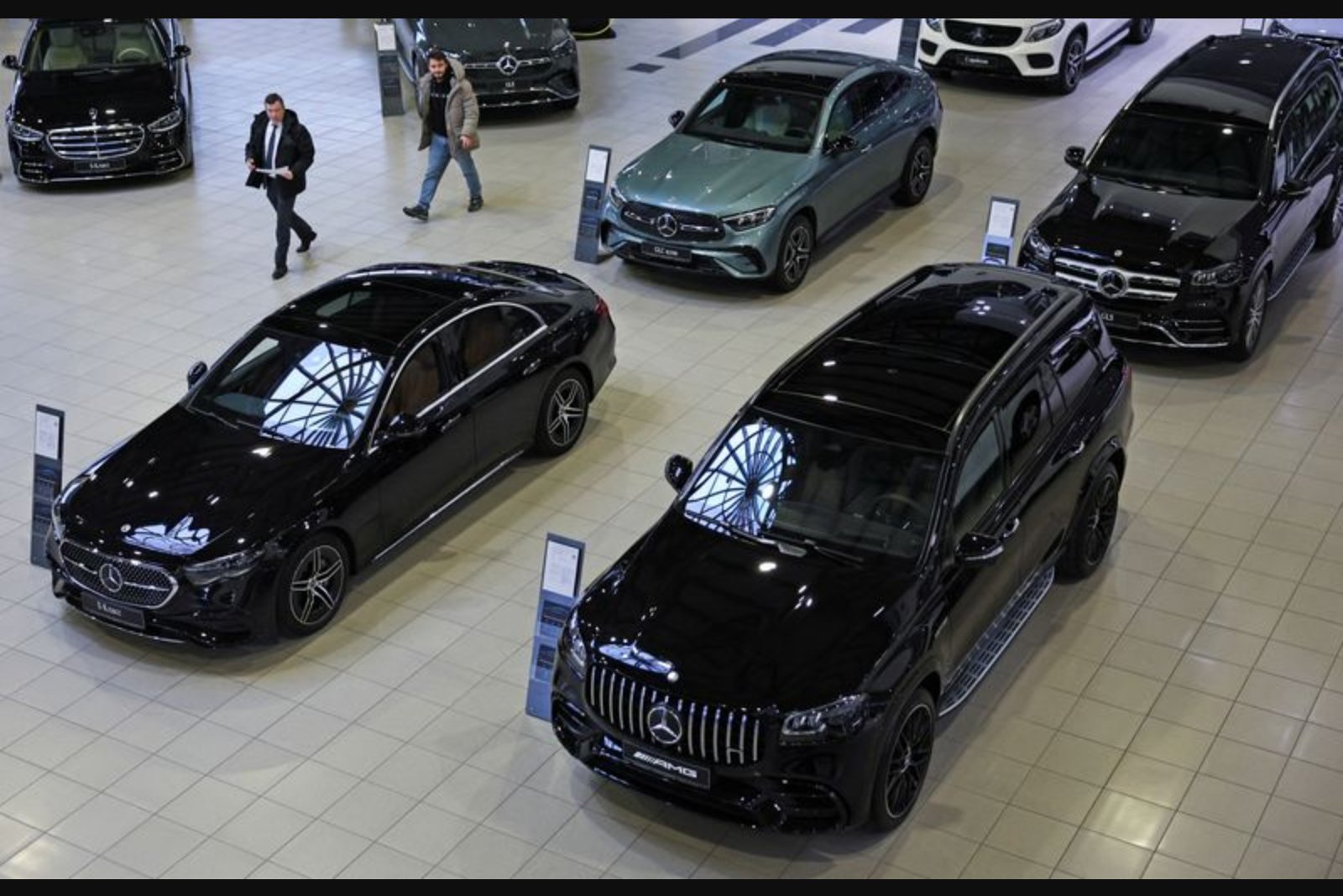
German marques remain coveted by many Russian buyers. Autostat data show almost 47,000 registrations last year for new vehicles from BMW, Mercedes and the Volkswagen Group, including Audi, Porsche and Skoda. More than 20,000 of those were manufactured in China. The remainder were built in Europe but industry analysts and importers say many of those cars likely passed through China en route to Russia.
Luxury SUVs, in particular, appear to find routes through the gray market. Dozens of shipping documents examined for this report show German luxury SUVs being shipped to Russia from China, including models like the Mercedes GLC 300 and the BMW X1 xDrive25i. One high-end model singled out for its popularity among wealthy buyers is the Mercedes G-class, a vehicle that can sell for about 120,000 euros, or about $142,700, and is produced only in Austria.
"Given the trade between Russia and China - which has grown significantly in recent years in terms of cars - it is obvious to conclude that many of those cars imported into China from Germany end up in Russia," said Felipe Munoz, an industry analyst who runs the Car Industry Analysis platform.
How dealers and traders operate
Dealers and importers at the Russian end describe networks of middlemen linking Chinese traders to local dealerships. One sales director at a Moscow dealership, Dmitry Zazulin, said that many customers insist on vehicles from Western brands such as Mercedes, but the dealership can obtain those models only through parallel channels. He also said his dealership does not import zero-mileage used vehicles.
"There are lots of middlemen: This one knows that one; that one knows another, and that one can reach the dealer," said a Vladivostok dealer identified only by his first name, Vladimir, who said his outlet does not keep restricted foreign cars in stock but buys them case by case from Chinese traders to meet customer orders.
Traders transporting European, Japanese and South Korean brand cars from China to Russia often classify new cars as used to avoid requiring automaker approval for Russia-bound sales, the former Sichuan-based exporter said. The Chinese car market's heavy subsidies and intense competition can leave automakers and dealers seeking to move surplus vehicles, and labeling them as used is one method that has emerged to facilitate export.
Automakers' positions and enforcement challenges
Automakers from regions imposing sanctions have publicly stated they prohibit sales of their vehicles into Russia and say they work to prevent unauthorized exports. They cited the difficulty of investigating potential breaches, noting such probes are "time-consuming and complex" and often require assistance from third parties, according to a statement attributed to one German luxury automaker.
BMW said it has instructed its China retail operation to "strictly oppose any potential vehicle exports to Russia," adding that when cars do end up in Russia as gray-market imports, "this happens outside our sphere of influence - and also expressly against our will." Toyota also asserted it stopped sending cars to Russia in 2022 and stated, "Toyota does not export new vehicles to Russia," without addressing the registration figures recorded in Autostat. Mazda issued a similar stance, saying that any new Mazdas sold in Russia "have been resold through third parties that are outside of Mazda's control."
Government responses and enforcement efforts
Authorities in sanctioning countries have said they monitor and investigate possible violations of export controls and sanctions. One European economy ministry noted customs agencies undertake regular probes and coordinate with counterparts across the European Union. Japan's trade ministry said automakers, exporters and dealers are bound by its sanction rules and warned domestic businesses that knowingly exporting cars to third countries for resale to Russia could violate sanctions. South Korea's trade ministry said it has been working to prevent circumvention of export controls and has been cracking down on indirect exports of used cars to Russia.
China's commerce ministry and Russia's industry and trade ministry did not respond to requests for comment for this report. Both countries have publicly said they oppose unilateral sanctions and consider them illegal.
Market-level impacts
Sanctions and automaker commitments have significantly reduced sales of foreign-brand vehicles in Russia from the pre-invasion peak. Autostat's figures indicate that sales of vehicles from regions that later imposed sanctions fell from more than one million in 2021 to roughly one-eighth of that level in the years after the invasion. Despite that sharp contraction, registrations of China-made foreign-brand cars are rising and increasingly represent a significant portion of foreign-brand sales recorded in Russia.
Some research firms that rely on industry sales numbers rather than registration records report no official new-car sales for several German brands in Russia for the current year. Autostat's approach, which is based on new-car registrations in Russia, captures zero-mileage imports because, under Russian registration rules, imported vehicles with zero mileage may be considered new even when they were previously sold in China.
Evidence from shipping and registration documents
Shipping documents reviewed for this report show multiple examples of vehicles that were exported to Russia from China, including luxury SUVs. Importers and analysts note that vehicles built in Europe frequently travel to China and then onward to Russia. The Autostat numbers further suggest that the bulk of the Toyotas registered in Russia last year were made in China, and that most Mazdas sold were China-made as well.
Practical limits to enforcement
Sanctions experts stress there are numerous ways restricted products can still find their way into targeted markets, even when companies and regulators seek to block such flows. One sanctions specialist, Sebastiaan Bennink, said restricted goods still often trickle into the sanctioned market despite best efforts. "There are so many ways to skirt sanctions it is almost impossible to prevent certain cars from ending up in Russia," he said.
While the Autostat statistics identify China as the main pathway for many of these cars, the full set of routes by which vehicles reach Russia cannot be definitively determined from the available registration and shipping data alone.
Investor-facing content
The article included a screening-style mention of an investment tool evaluating a particular ticker. ProPicks AI evaluates VOWG alongside thousands of other companies every month using more than 100 financial metrics and generates ideas based on fundamentals, momentum and valuation. The promotional note stated the AI has highlighted notable past winners and can identify whether VOWG is currently featured in any of its strategies or if there are other opportunities in the same space.
Conclusion
Registration files and interviews with participants in the market show that a significant and growing number of foreign-brand vehicles are finding their way into Russia via China, frequently classified as zero-mileage used cars to ease export and registration processes. Automakers and sanctioning authorities say they prohibit such exports and are attempting to detect and prevent infractions, but they acknowledge the practical challenges of tracing and enforcing restrictions. The data point to an evolving gray market that continues to sustain demand among Russian buyers for foreign-branded vehicles despite formal restrictions on their sale.