
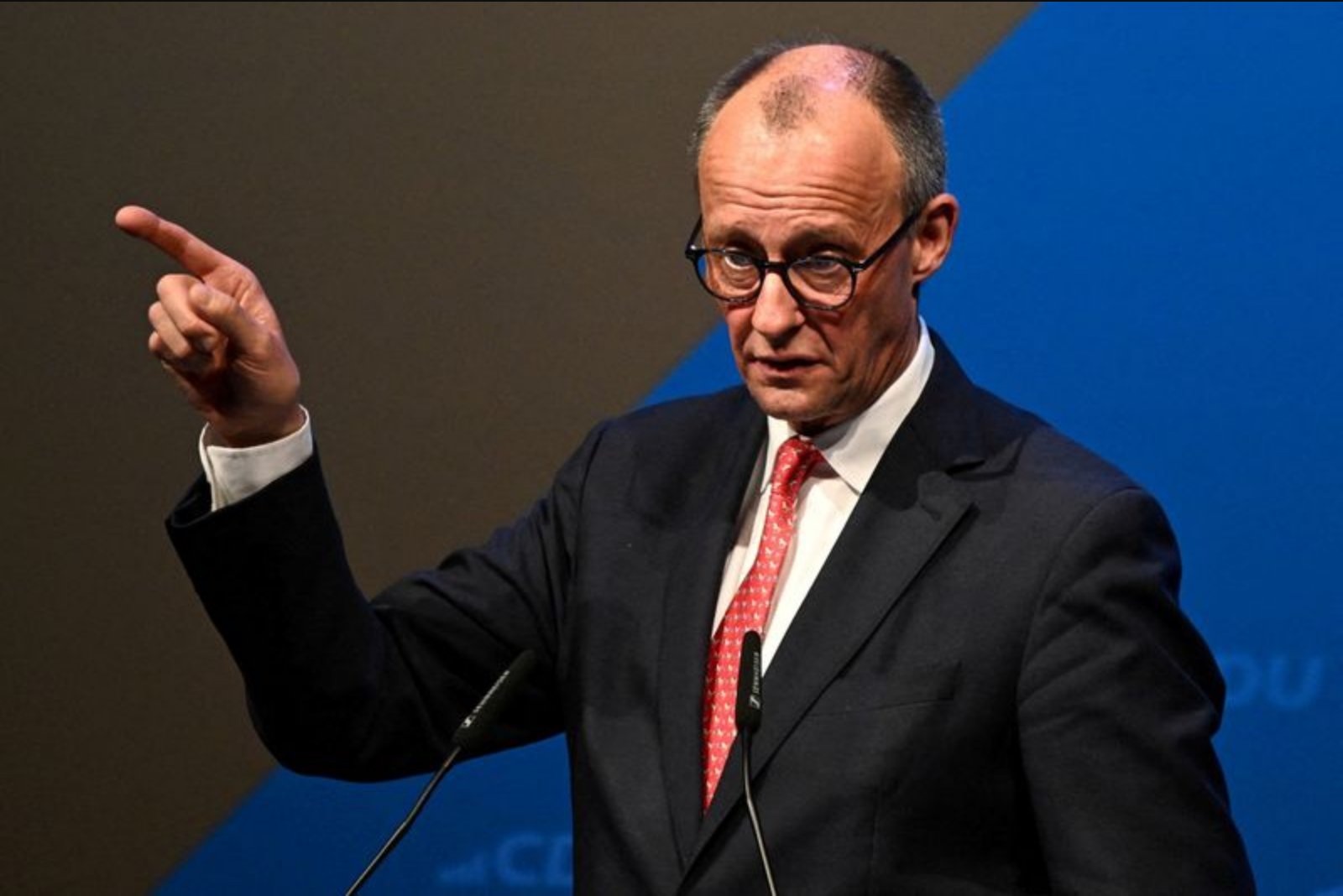
German Chancellor Friedrich Merz this week travels to China in a bid to reset a critical economic relationship that has been strained by shifting trade flows, intensifying competition and geopolitical tensions. The visit marks Merz's first to China since becoming chancellor and he will be accompanied by senior executives from some of Germany's largest automakers, including the heads of Volkswagen, BMW and Mercedes-Benz.
The trip begins on Wednesday and will be followed by a trip to Washington next week. During the China stop, Merz is scheduled to meet President Xi Jinping and Premier Li Qiang and is expected to sign several economic agreements. His itinerary also includes visits to a Mercedes-Benz electric vehicle assembly plant and a Siemens Energy facility, signaling the focus on securing industrial and technology-related commitments.
German manufacturers and exporters have been deeply integrated into China’s economy for decades, and China remained Germany's largest trading partner last year. However, the structure of that relationship has shifted markedly over the past five years. Chinese exporters have moved from being recipients of German industrial inputs to formidable competitors in many sectors. German officials attribute part of that shift to what they view as an undervalued Chinese currency, which has helped Chinese firms expand exports and erode longstanding German trade surpluses.
The result has been a pronounced swing in bilateral trade balances. By 2025, Germany recorded an almost 90 billion euro trade deficit with China. Mikko Huotari, executive director of the Merics think tank in Berlin, described the imbalance as having "reached alarming proportions," and said that the economic and business outlook for many German firms operating in China has deteriorated.
German industry has been hit by a combination of factors. Companies face vigorous competition from China’s rapidly growing electric vehicle sector, which has intensified pricing and market-share pressures across segments. At the same time, U.S. tariffs have imposed additional costs on European firms, with those measures adding billions of euros to their expense burdens.
These commercial strains are occurring against a broader geopolitical backdrop. Chancellor Merz has warned that Europe is confronting a new era of great power rivalry in which advanced technology, raw materials and manufacturing supply chains can be used as instruments of state power. That warning frames the urgency behind his outreach to Beijing as well as the subsequent visit to Washington.
China has moved to position itself as a dependable global partner amid geopolitical uncertainty sparked by shifting U.S. policies. Its large consumer market and the technical capabilities of many Chinese manufacturers make it an indispensable location for Western firms. Yet the environment for foreign companies in China has become more challenging, prompting appeals from German industry groups.
Germany's main industry association has formally urged the chancellor to take up concerns including excess production capacity in some sectors, distortionary competition practices and export controls on strategic commodities. Those export controls have real consequences: China, which accounts for more than 90% of the world's processed rare earths and rare earth magnets, tightened export rules last year, a move that produced immediate repercussions among Western manufacturers.
At the same time, Chinese producers have increasingly closed off or displaced foreign competitors within the domestic market. "We see pricing pressure, we see new competitors and entrants in nearly every segment, and thus, heavy shifts in what used to be the structure of the market," said Oliver Thoene, Mercedes-Benz's head of China operations, reflecting the competitive pressures facing established global players.
European policymakers have responded with protective measures of their own. The European Union has raised tariffs on Chinese-made electric vehicles entering Europe and is tightening safeguards for local steel producers by lowering import quotas and increasing tariffs following sustained industry lobbying against Asian rivals. These moves form part of a broader attempt to shield European manufacturers from what officials describe as underpriced imports.
Against this complex mix of commercial competition, trade policy shifts and geopolitical rivalry, Chancellor Merz's delegation-level visit to China aims to secure tangible economic outcomes while addressing concerns raised by German industry. The trip's sequence - China followed by Washington - underscores the dual challenge facing German policymakers in balancing economic engagement with strategic caution in a rapidly changing global environment.
Summary
Chancellor Friedrich Merz leads a high-level delegation to China in his first visit as chancellor to sign economic agreements and inspect industrial sites, while German firms face growing competition from Chinese electric vehicle makers and rising costs from U.S. tariffs. Germany's trade relationship with China has shifted dramatically, producing an almost 90 billion euro deficit in 2025 and prompting calls from industry for government action on issues such as overcapacity and export controls.
Key points
- Merz travels to China with senior business leaders, meets Xi Jinping and Li Qiang, and is expected to sign economic pacts; visit includes stops at a Mercedes-Benz EV plant and a Siemens Energy site.
- Trade dynamics have shifted: Germany ran an almost 90 billion euro trade deficit with China in 2025 as Chinese exporters closed the surplus gap.
- Sectors most affected include automotive manufacturing, energy equipment and companies dependent on processed rare earths and magnets.
Risks and uncertainties
- Competitive risk - German and other Western manufacturers face intense pricing and market-share pressure from Chinese electric vehicle makers, impacting automotive sector revenues and margins.
- Supply risk - Export controls on strategic materials, including processed rare earths and magnets where China supplies over 90% of global processed output, create vulnerabilities for manufacturers across technology and industrial sectors.
- Policy risk - Trade defensive measures such as higher tariffs and reduced import quotas by the EU introduce uncertainty for exporters and could prompt further trade frictions affecting steel and automotive markets.
Note: Currency conversion used in reporting showed $1 = 0.8488 euros.