
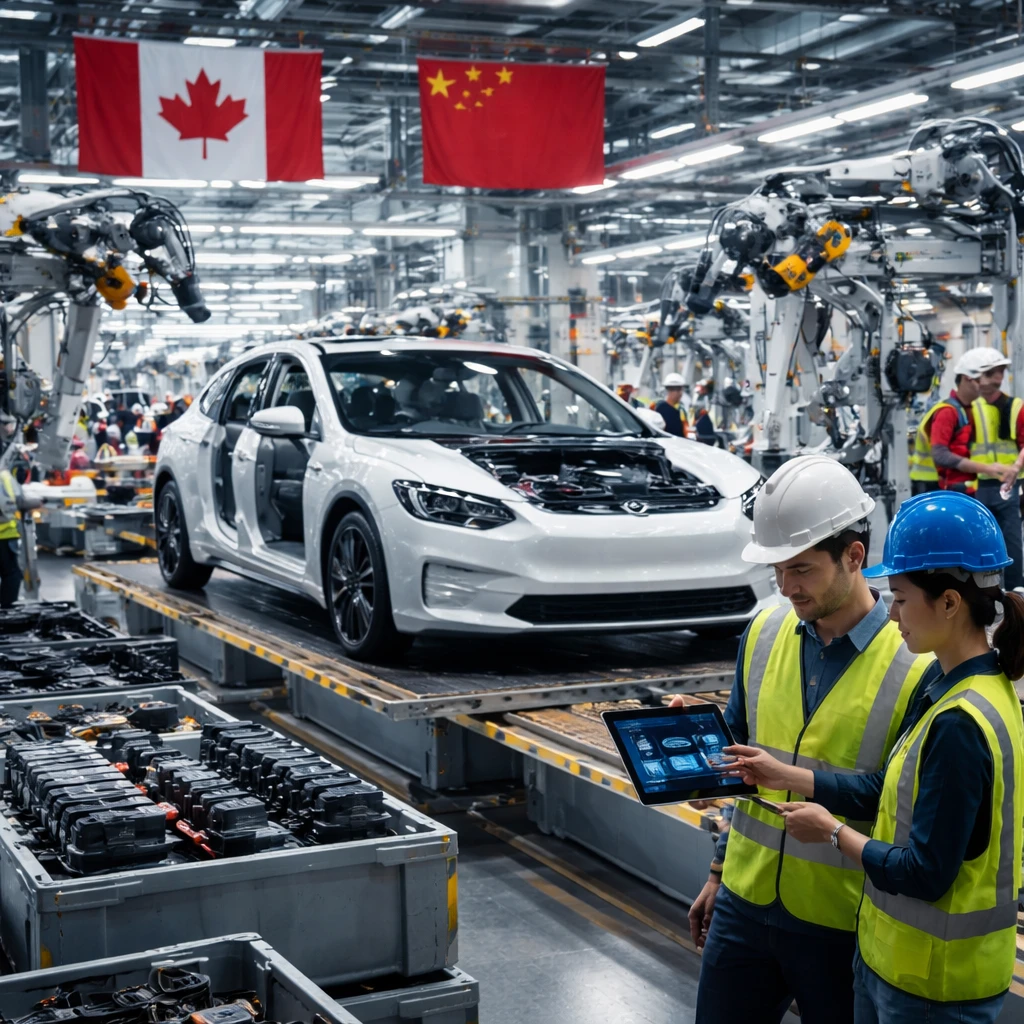
Canada is actively pursuing the establishment of a Chinese-Canadian electric vehicle assembly operation on Canadian soil that would build vehicles for export, Industry Minister Mélanie Joly said on Friday.
Joly outlined a model in which major Canadian auto parts suppliers that already operate in China - including Magna International Inc., Linamar Corp. and Martinrea International Inc. - would join with Chinese EV manufacturers in a joint-venture assembly plant in Canada. "We believe that these great Canadian champions can partner with Chinese EV companies to make a Canadian-Chinese car to export it around the world," she said.
The proposed approach represents a change in tone from earlier government criticisms of China for allegedly subsidizing its manufacturers and raising security questions about Chinese vehicle technology. Joly emphasized that Ottawa is looking for practical ways to manage those concerns, saying: "We can find a way to have software in the car that will address the security concerns."
Beyond software, Joly said Canada would work to ensure that labor standards meet Canadian expectations and that local supply chains are developed as part of any collaboration. She said there are "active conversations" underway about how Canadian firms could complement Chinese automotive investments, and she specifically cited discussions involving Ottawa-based software developer QNX, which is owned by BlackBerry Ltd.
During a recent trip to China, Joly met with representatives of BYD Co. Ltd., the world's largest electric vehicle producer, and Chery Automobile Co., she said.
Addressing cost considerations, Joly acknowledged that Canadian labour tends to be more expensive than in China but argued a jointly developed vehicle could still be competitive internationally. She pointed to Honda Motor Co.'s manufacture of the Civic in Ontario as an example of producing an affordable vehicle in Canada despite higher labour costs.
Joly framed the initiative as fitting within a broader trade relationship. She noted the project aligns with Prime Minister Mark Carney's trade agreement with Chinese President Xi Jinping. As part of recent adjustments in trade policy, China began removing duties on Canadian agricultural products in January, and Canada exempted up to 49,000 Chinese-built electric vehicles annually from a 100% tariff imposed in 2024.
Canada is also courting auto investment from other countries, with particular emphasis on South Korea. Governments recently signed a non-binding agreement intended to advance Korean automotive presence in Canada, with a focus on attracting manufacturers such as Hyundai Motor Co. and Kia Corp., which sell heavily in Canada but currently manufacture elsewhere.
Joly pointed to regional market strength as part of the pitch. "Quebec is the biggest Kia market in the world. So we're having conversations. Our goal is to create jobs and attract investment in the auto sector," she said.
Context and next steps
According to the minister's comments, Ottawa is engaged in exploratory talks with multiple industry participants - from parts suppliers to software developers and foreign automakers - to assess how a Canadian-based assembly operation with Chinese partners could be structured. The government is signalling it will seek technical fixes for software-related security issues and insist on domestic labour and supply chain standards as conditions for collaboration.