
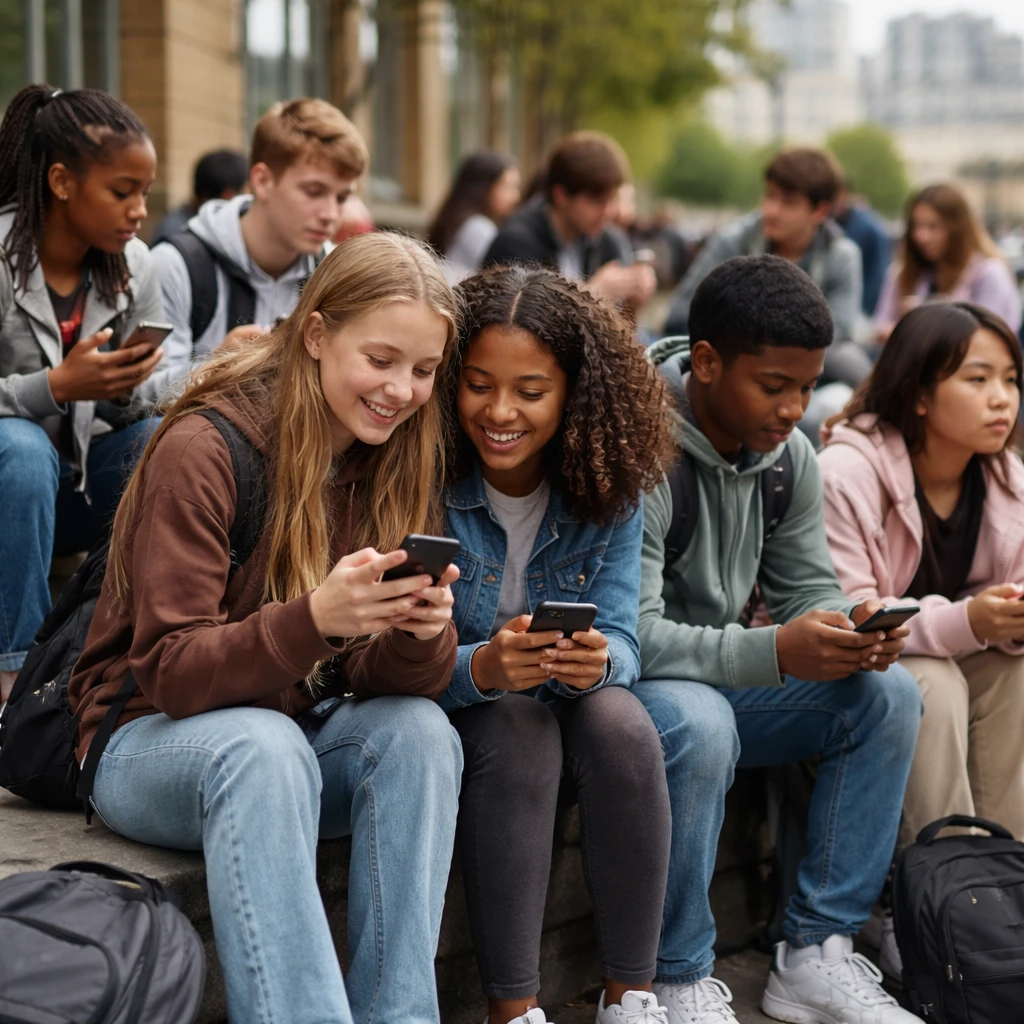
LONDON, March 16 - British teenagers interviewed at a south London school expressed a conflicted view of social media: they depend on platforms such as Snapchat, Instagram and TikTok to socialise, make connections and explore the world, yet many also said the same apps can leave them unhappy, exhausted or exposed to harmful material.
Those young people acknowledged that social media companies profit from time spent on their apps and that the platforms can be deliberately designed to keep users scrolling. At the same time, most of the pupils said they did not think it should be the government’s role to ban access outright.
Britain is among a number of countries reviewing ways to limit children’s access to social media amid growing concern about harms to young people. Officials have said the country could follow Australia by imposing a ban for under-16s, and the government has asked "everyone with a view" to contribute to a public consultation that closes in May.
Voices from the classroom
Teenagers aged 16 to 18 at the south London school described how the platforms fit into everyday life. For some, social media provides vital connections with friends and family, as well as a space to develop confidence and identity; for others, it is mainly a way to fill spare time.
"During the summer, I’d spend around eight hours a day on just TikTok," said Awand Khdir, 17, adding that usage has since fallen to "three or four hours" a day but that remains "still not good." He described the platform as offering little else to do beyond scrolling.
Sumiksha Senthuran, 16, said "mindlessly scrolling" could act as a contrast to the stress of revising for exams. Elizabeth Alayande, 17, said social media could help people build confidence and identity: "You can express yourself by posting videos or just relating with other people... and I don’t think it’s the biggest waste of time if you spread it out evenly with other priorities," she said.
Yet pupils also reported exposure to distressing content and online abuse. "Sometimes it’s quite negative because all you see is bad stuff… it’s quite tiring," said Teyanna Charley, 17. Vish Ragutharan, 16, who runs a blog about film, noted that posts can attract both negative and positive responses, calling negative replies a "real disadvantage." Joelle Azebaze Ayangma, 18, said content linked to body image was a problem: "When you see other girls on TikTok, you kind of want to look like them. And that’s really crushing people’s self-esteem."
Platforms' safety features and teenagers' ability to evade them
TikTok, Instagram and Snapchat highlighted the safety, privacy and security tools they offer for teenage users. Snapchat said it has age-specific protections for 13 to 17-year-olds, including making accounts private by default and blocking access to public profiles for younger teens. Instagram pointed to a sensitive content control setting for Teen Accounts and supervision tools for parents and guardians. A TikTok spokesperson noted that teen accounts automatically set a screen time limit of 60 minutes and prompt users to stop using the app after 10 p.m.; the company also said it age-restricts content that may be unsuitable for teens.
Despite those measures, the pupils Reuters spoke to said they were often able to work around controls. Some said that even with limits in place, the design of algorithm-driven feeds encourages prolonged use and that troubling material can still surface.
Policy debate and expert perspectives
While many parents and some politicians support a ban for younger teenagers, a number of psychologists and researchers who have advised lawmakers on children’s internet safety said there is no clear evidence a ban would be effective. Research Professor Amy Orben from the University of Cambridge emphasised that the impact of social media is not uniform: some teenagers face significant risks, while others gain valuable connection and support from the same platforms. "The online world, like the offline world, is very complex and its impacts will be very dynamic," she said.
Three experts who have provided advice to lawmakers told the government there was no clear proof that bans reduce harm. Industry data cited by those experts showed that one-fifth of Australian teenagers under 16 were still using social media two months after Australia’s ban, raising questions about how effective platforms’ age-gating methods are.
Professor Julia Davidson, an expert in child online safety at the University of East London, warned that for children over 13 it may already be too late. She pointed to a 2022 finding by British regulator Ofcom that six in ten children aged eight to 12 had social media profiles, despite many services requiring users to be at least 13. "How are we going to enforce a ban with 14 and 15-year-olds who have grown up with it and built extensive networks?" she asked.
Professor Sonia Livingstone, who leads the Digital Futures for Children centre at the London School of Economics, cautioned policymakers against choosing a blunt solution. She said a ban risks being "a very blunt hammer to crack a nut" and argued that requirements for "safety by design" would better balance protecting children without eliminating their access to the digital world.
Livingstone suggested a more targeted regulatory approach, urging officials to press social media companies to take responsibility for how their platforms steer young users. "Why don’t we say: Snapchat is the one where the randomers can get in touch with you. Instagram is the one where you can see the self-harm content. And TikTok is the one that wants you on so long that you can never get to sleep or do your homework," she said, urging a "divide and conquer" strategy aimed at platform-specific risks.
Enforcement challenges and unintended consequences
Students expressed doubts about the practicality of enforcing a ban. Leah Osando, 17, warned that bans would be difficult to police. "Even if children get banned... they’ll go onto the dark web or use a VPN," she said. Dua Arshia, 16, argued that restrictions could push young people toward platforms "where there’s more dangerous things." Ali Raza, 16, said he relies on apps to communicate with family abroad, underscoring that for some users the platforms serve essential functions.
Experts emphasised that the fundamental commercial incentives of the platforms should not be overlooked. "These are commercial platforms," Orben said. "They are designed to harness attention, and ... young people are increasingly saying that they struggle to get off." The concern is that algorithm-driven feeds can become addictive and in some cases direct children towards content that promotes self-harm or eating disorders.
Additional note on investor tools
Is META a bargain right now? One way to examine that question is through valuation tools that combine multiple industry models. Some services offer a "Fair Value" calculator that aggregates a mix of 17 valuation models to estimate upside potential for companies including META, and to identify stocks that may be undervalued. Such tools are separate from the policy debate over access and safety for young users.
Conclusion
As Britain weighs the possibility of tighter limits on children’s use of social media, teenagers, researchers and safety experts present a complex picture. Young people describe benefits tied to social connection and identity formation, yet also report real harms from disturbing content and hostile interactions. Experts advising lawmakers largely caution that outright bans appear to offer no clear solution and that regulatory pressure to design safer platforms may be a more effective path. The government consultation open until May will gather views on how to balance protection with young people’s digital lives.